

Standard Chartered's Bill Winters on Africa's Untapped Banking Potential
Bill Winters has positioned Standard Chartered as one of the few global institutions willing to deploy serious capital across African markets at a time when most Western banks are retreating, betting that the continent's rapidly urbanising population and vast infrastructure deficit represent a generational opportunity for patient lenders. His strategy hinges on the conviction that Africa's banking sector, where more than half the adult population remains unbanked, is not a frontier risk to be managed but the last great growth market in global finance.…

The Banker Who Sees What Others Overlook
When Bill Winters took the helm of Standard Chartered in 2015, he inherited an institution with deep roots in some of the world's most dynamic — and most challenging — markets. A veteran of JPMorgan, where he co-led the investment bank and built a reputation as one of Wall Street's sharpest minds, Winters could have steered Standard Chartered toward safer, more conventional shores. He didn't. He doubled down on the bank's historic commitment to Africa, Asia, and the Middle East — a decision that has increasingly come to define both his tenure and the bank's strategic identity. While many global lenders have retreated from frontier markets, Winters has moved in the opposite direction, arguing that Africa's banking opportunity is not a question of if, but when.
A Career Built on Calculated Conviction
Bill Winters' path to Standard Chartered was anything but linear. Born in the United States, he spent over two decades at JPMorgan Chase, rising through the ranks to become co-CEO of the investment bank. His departure from JPMorgan in 2009 was widely covered, and in the years that followed, he served on the UK's Independent Commission on Banking, helping to shape post-crisis regulatory frameworks. That dual experience — straddling both the commercial imperatives of banking and the architecture of financial regulation — gave Winters an unusually rounded perspective on what responsible growth looks like in emerging markets.
When Standard Chartered's board selected him as chief executive, the bank was under pressure. Profits had fallen sharply. Regulatory issues had mounted. Questions swirled about the institution's strategic direction. Winters moved swiftly, restructuring operations, tightening risk management, and exiting underperforming businesses. But he did not abandon the markets that made Standard Chartered distinctive. Africa remained central to the bank's vision — not as a legacy obligation, but as a deliberate strategic choice. That is a significant distinction.
Africa: The Opportunity Most Banks Walk Past
The numbers surrounding Africa's financial inclusion gap are staggering and well documented. The continent is home to a young, rapidly urbanizing population, with hundreds of millions of people still outside the formal banking system. The African Development Bank and the World Bank have repeatedly highlighted the enormous financing gap across infrastructure, trade, and small-to-medium enterprise lending. Yet many international banks have scaled back their African operations in recent years, citing regulatory complexity, currency volatility, and compliance costs.
Winters has taken a fundamentally different view. In public remarks and interviews, he has consistently argued that Africa's demographic trajectory and economic potential make it one of the most compelling long-term opportunities in global banking. Standard Chartered operates across a significant number of African markets — Kenya, Nigeria, Ghana, Uganda, and Tanzania among them. The bank's presence spans corporate and institutional banking, trade finance, and wealth management, areas where international expertise and local knowledge intersect.
Under Winters, Standard Chartered has put particular emphasis on trade finance. Africa's intra-continental trade has historically been underdeveloped relative to other regions, and the African Continental Free Trade Area (AfCFTA) agreement — one of the largest free trade areas in the world by number of participating countries — has created new momentum. Few outside the region have noticed just how much that agreement could reshape capital flows. Winters has spoken publicly about the bank's ambition to facilitate greater trade flows across the continent, positioning Standard Chartered as a bridge between African economies and global capital markets.
Digital Banking and Financial Inclusion
One of the more forward-looking aspects of Winters' Africa strategy has been the embrace of digital banking. Africa already proved its capacity for technological leapfrogging — mobile money platforms like M-Pesa transformed financial services across East Africa long before many Western markets adopted similar tools. Standard Chartered has invested in digital platforms and partnerships aimed at expanding access to banking services, particularly in markets where physical branch infrastructure remains limited.
Winters recognized early that traditional brick-and-mortar expansion is neither sufficient nor always practical in many African markets. Instead, the bank has pursued digital-first approaches to reach new customer segments, including small businesses and individual consumers who may be engaging with formal financial institutions for the first time. This strategy aligns with a broader industry shift, but Standard Chartered's commitment to executing it across multiple African jurisdictions simultaneously reflects genuine institutional ambition — not just a slide in a strategy deck.
Sustainability and Long-Term Capital Flows
Beyond commercial banking, Winters has increasingly positioned Standard Chartered as a participant in the sustainability agenda across its African markets. The bank has made public commitments around sustainable finance and has engaged with multilateral institutions and development finance organizations to channel capital toward renewable energy, infrastructure, and climate resilience projects on the continent. Africa's vulnerability to climate change — and its simultaneous need for massive infrastructure investment — creates a complex but significant opportunity for banks willing to structure and deploy capital at scale.
Winters has been vocal about the need for international financial institutions to play a constructive role in Africa's energy transition, acknowledging that the continent's development needs require a nuanced approach that balances emissions reduction with economic growth and energy access. That position has sometimes placed him in the center of broader debates about the responsibilities of global banks. He doesn't seem to mind. It reflects a pragmatic understanding of the continent's realities, not boardroom idealism.
A Leadership Model for Emerging Market Banking
What sets Bill Winters apart from many of his peers in global banking is his willingness to stay committed to markets that others have deemed too difficult. Running a bank with Standard Chartered's geographic footprint requires a tolerance for complexity that few chief executives possess or want. Currency devaluations, political transitions, regulatory shifts, macroeconomic volatility — these are features, not exceptions, of operating across Africa. Winters has managed these realities while simultaneously pushing the bank toward growth and modernization.
His tenure offers a compelling case study in what it means to lead a truly international bank with conviction rather than convenience. Africa's untapped banking potential is not a new observation. Economists, multilateral institutions, and development experts have made the argument for decades. What remains rare is a leader at the top of a major global bank who is willing to allocate capital, talent, and strategic attention to turning that potential into reality. In Winters, Standard Chartered found exactly that kind of leader — and Africa's banking sector is better positioned because of it.
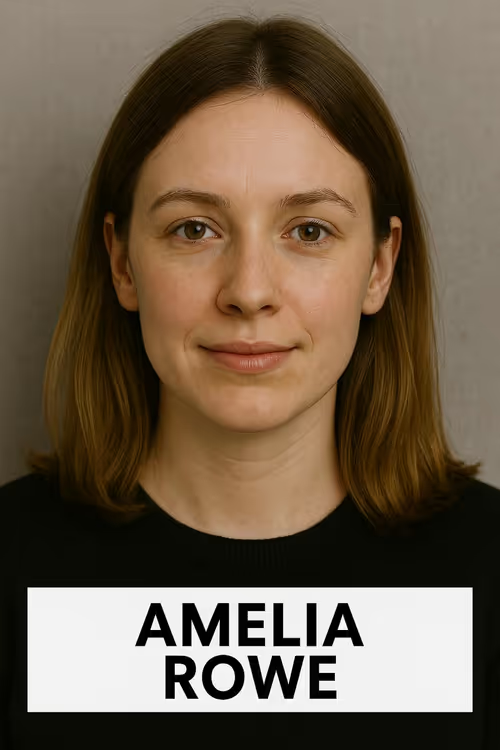
Amelia Rowe is a senior journalist at The Platinum Capital, covering banking and financial services.
Written by
Amelia Rowe
Senior correspondent · Banking & Economy
Amelia spent eight years inside a sovereign wealth fund before deciding she'd rather write about institutional money than allocate it. She covers central banking, insurance, and the macro decisions that quietly choose which markets get the next decade. Sharp on monetary policy; impatient with anyone who confuses noise with signal. Based in London. Reach out at amelia.rowe@theplatinumcapital.com.