

Tabby's Hosam Arab on How Buy-Now-Pay-Later Is Reshaping Gulf Retail
Under Hosam Arab's leadership, Tabby has emerged as the Gulf's dominant buy-now-pay-later platform, fundamentally altering consumer spending patterns across Saudi Arabia and the UAE by embedding frictionless credit at the point of sale. The company's rapid ascent reflects a broader structural shift in Gulf retail, where a young, digitally native population is abandoning traditional credit cards in favour of instalment-based finance that aligns more closely with both modern consumption habits and Islamic lending sensibilities.…

The Merchant Who Became the Mission
Hosam Arab does not fit the mould of a typical fintech founder. Before he became the chief executive of Tabby, the Gulf's most prominent buy-now-pay-later platform, Arab had already built and sold one of the Arab world's most notable e-commerce ventures. As co-founder and CEO of Namshi, the online fashion retailer that was acquired by Emaar Malls, he developed an instinct for what Gulf consumers actually want — not what Silicon Valley assumes they want. That distinction, colleagues and investors say, is what makes Tabby different from the dozens of BNPL operators that have launched and fizzled across emerging markets in recent years.
From E-Commerce Operator to Credit Architect
Arab's trajectory from Namshi to Tabby was not a leap so much as a logical extension. At Namshi, he spent years watching consumer behaviour at the checkout page — the hesitations, the cart abandonments, the friction between desire and affordability. When he founded Tabby in 2019, the thesis was deceptively simple: Gulf consumers, particularly younger ones, wanted flexible payment options that aligned with Islamic finance principles and did not penalise them with compounding interest. The product Tabby launched — allowing shoppers to split purchases into four interest-free instalments — was familiar in form to global models like Klarna and Afterpay, but its execution was tailored with precision to the regulatory, cultural, and commercial realities of Saudi Arabia and the United Arab Emirates.
What set Arab apart from competitors entering the same space was his merchant-side credibility. He had been a retailer himself. He understood the economics of customer acquisition and the value of higher average order values. Tabby was designed not merely as a consumer lending product but as a merchant growth tool, and that framing helped the company secure partnerships with a broad roster of regional and international brands operating in the Gulf.
Building at the Speed of Riyadh
Tabby's ascent has been closely intertwined with the broader economic transformation underway in Saudi Arabia. As the Kingdom has pushed to diversify its economy, modernise its retail infrastructure, and bring millions of young Saudis into a digitally connected consumer class, companies like Tabby have found themselves riding a structural tailwind. Arab has been deliberate about positioning the company at the centre of this shift. Tabby secured a licence from the Saudi Central Bank (SAMA) and has invested heavily in regulatory compliance — a choice that separated it from lighter-touch competitors who struggled to gain institutional trust.
The company's fundraising record tells its own story. Tabby has raised substantial venture capital across multiple rounds, attracting backing from prominent names including Sequoia Capital India (now Peak XV Partners), STV, Mubadala Investment Company, and PayPal Ventures, among others. In 2023, the company achieved unicorn status, becoming one of the most highly valued fintech companies in the Middle East. That was not merely a financial marker. It signalled that Gulf-born fintech companies could compete for global institutional capital on their own terms. That is a significant shift.
Rethinking Credit for a Region That Distrusts It
One of Arab's more underappreciated contributions has been cultural rather than technical. Few outside the region have noticed. In a part of the world where personal debt carries significant social stigma and where Islamic finance principles discourage interest-bearing lending, Tabby's interest-free model resonated with consumers in a way that traditional credit cards often did not. Arab has spoken publicly about the importance of responsible lending, and the company's model — which does not charge consumers interest or late fees that compound — has been central to its brand positioning.
None of this means the BNPL model escapes scrutiny. Globally, regulators have raised questions about whether split-payment services encourage overspending, and the Gulf is no exception. Arab has engaged with these concerns directly, advocating for clear regulatory frameworks and positioning Tabby as a proponent of consumer protection rather than an adversary of oversight. The company's willingness to operate within — and sometimes ahead of — regulatory expectations has earned it a degree of institutional goodwill that purely growth-focused competitors have found harder to secure.
The Operator's Temperament
Those who have worked with Arab describe a leader who is more operator than evangelist. He is not given to the breathless futurism that characterises much of the global fintech conversation. His public remarks tend to be measured, focused on unit economics, merchant value, and consumer trust rather than on disruption narratives. In interviews, he has consistently emphasised that Tabby's success depends on disciplined underwriting and sustainable growth, not on subsidising transactions to inflate volume — a lesson, perhaps, absorbed from watching the wreckage of overextended startups in other markets.
This temperament has shaped Tabby's culture and strategy. The company has expanded its product offering beyond simple instalments to include a broader suite of financial services, including a Tabby Card and cashback features, signalling ambitions that extend well beyond the original BNPL proposition. Arab appears to be building toward a more comprehensive consumer finance platform, though he has been careful not to overextend before the unit economics of each product are proven. Discipline first, ambition second.
A Gulf Story With Global Implications
Hosam Arab's journey from e-commerce entrepreneur to fintech chief executive is, in many ways, a story about the maturation of the Gulf's technology ecosystem. A decade ago, the idea that a Riyadh- and Dubai-based startup could attract top-tier Silicon Valley venture capital, achieve a billion-dollar valuation, and reshape how tens of thousands of merchants interact with millions of consumers would have seemed improbable. Today, it is simply what Tabby does.
The broader significance of Arab's work lies in what it demonstrates about the Gulf as a proving ground for financial innovation. High smartphone penetration, a young and digitally fluent population, substantial consumer spending power, and governments actively encouraging fintech development — few other markets can replicate that combination. Arab recognised these conditions early and built a company engineered to thrive within them. Whether Tabby ultimately pursues a public listing — a possibility that has been widely discussed in regional financial circles — or continues to expand its private-market position, its founder has already reshaped expectations about what Gulf-born fintech companies can achieve.
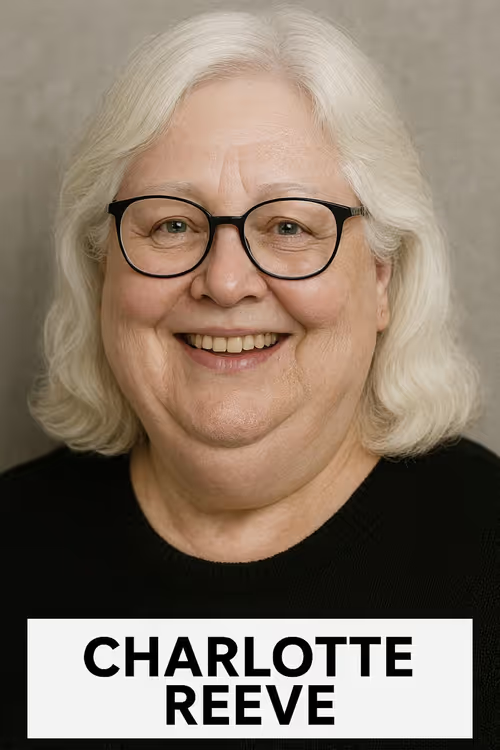
Charlotte Reeve is a senior journalist at The Platinum Capital covering fintech and digital finance across the Middle East and emerging markets.
Written by
Charlotte Reeve
Senior correspondent · Capital Markets & Fintech
Charlotte cut her teeth on an equities desk before moving to the other side of the notebook. She covers capital markets, stock exchanges, and the fintech operators trying to disintermediate the banks that trained her. Sharpest on market microstructure and payments infrastructure; still reads a prospectus for fun. Based in Singapore. Reach out at charlotte.reeve@theplatinumcapital.com.