
Khaldoon Al Mubarak: How Mubadala Is Quietly Reshaping Global Capital
Under Khaldoon Al Mubarak's stewardship, Mubadala Investment Company has evolved from a regional development vehicle into one of the most strategically consequential sovereign wealth funds on the planet, deploying capital across semiconductors, life sciences and energy transition with a discipline that has earned it a seat at tables once reserved for Wall Street's oldest names. His approach — patient, diversified and deliberately understated — represents a new archetype of state capitalism, one that is quietly redrawing the map of global financial influence from Abu Dhabi outward.…

The Architect of Abu Dhabi's Global Ambitions
In the rarified world of sovereign wealth, where trillions of dollars move with deliberate patience and strategic intent, few figures command as much quiet authority as Khaldoon Khalifa Al Mubarak. As Managing Director and Group Chief Executive Officer of Mubadala Investment Company, he oversees one of the world's most influential sovereign wealth funds — a vehicle that has become synonymous with Abu Dhabi's long-term economic vision. But Al Mubarak's influence stretches well beyond asset management. He serves as Chairman of the Executive Affairs Authority of Abu Dhabi and Chairman of Manchester City Football Club, roles that together reveal a man operating at the intersection of statecraft, global finance, and commercial enterprise with a rare combination of discretion and decisiveness.
From Strategic Counsel to Sovereign Capital
Al Mubarak's rise has been closely tied to Abu Dhabi's modernization agenda under Sheikh Mohamed bin Zayed Al Nahyan, President of the UAE. A Tufts University graduate with a degree in economics, he returned to the Emirates and rapidly assumed positions of influence within the emirate's governing apparatus. His appointment to lead what was then the Mubadala Development Company came at a moment when Abu Dhabi was signaling its intent to diversify away from hydrocarbon dependency — not merely as an aspiration, but as an operational imperative.
Under his stewardship, Mubadala merged with the International Petroleum Investment Company (IPIC) in 2017, a consolidation that created one of the largest sovereign wealth funds on the planet, with assets that have since grown substantially. The merger was widely regarded as a masterstroke of institutional rationalization. It eliminated redundancies and concentrated Abu Dhabi's investment firepower under a single, more agile entity. Al Mubarak managed this integration without the public friction that so often accompanies consolidations of this scale — a reflection of both his management style and his political capital.
A Portfolio That Defies Easy Categorization
What sets Mubadala apart under Al Mubarak is not simply its size but its philosophical orientation. Unlike some sovereign wealth funds that operate primarily as passive allocators, Mubadala has positioned itself as an active, strategic investor with deep sectoral expertise. Its portfolio spans technology, aerospace, semiconductors, healthcare, energy transition, and financial services — each vertical chosen not by opportunism but by a thesis about where long-term value creation will concentrate.
The fund's technology investments have drawn particular attention. Mubadala has been a significant investor in leading global technology firms and venture capital ecosystems, including a well-documented relationship with SoftBank's Vision Fund. Its bets in the semiconductor space stand out. The fund's stake in GlobalFoundries — one of the world's major chip manufacturers — shows a willingness to engage with capital-intensive, strategically vital industries that many institutional investors avoid. When GlobalFoundries went public on the Nasdaq in 2021, it marked one of the most notable listings tied to a sovereign wealth fund in recent memory. That is a significant shift.
In energy, Mubadala has pursued a dual strategy that reflects the complexity of Abu Dhabi's own position: continuing to extract value from hydrocarbons through entities like CEPSA, while simultaneously deploying capital into renewable energy and sustainability through Masdar, which operates under the broader Mubadala umbrella. This is not cognitive dissonance. It is the pragmatic balancing act that defines the energy transition for producing nations — and Al Mubarak has managed it with notable composure.
The Geopolitics of Capital Deployment
Al Mubarak operates in full awareness that sovereign wealth is never merely financial — it is inherently geopolitical. Mubadala's investment map reads as a strategic document as much as a portfolio report. Significant commitments in the United States, Europe, and Asia reflect Abu Dhabi's broader foreign policy orientation: building durable economic relationships that reinforce diplomatic ties and ensure the emirate remains relevant in a multipolar world.
His role as Chairman of the Executive Affairs Authority places him at the center of Abu Dhabi's policy coordination, giving him a vantage point that most fund managers could never access. This dual positioning — as both investor and policy architect — allows Mubadala to move with a coherence that purely financial institutions struggle to replicate. When Mubadala enters a market or a sector, it arrives not just with capital but with the implicit backing of a sovereign strategy. Few outside the region have noticed how unusual that combination really is.
This has made Al Mubarak a sought-after interlocutor for heads of state, global CEOs, and institutional investors alike. He is a regular presence at the World Economic Forum in Davos and other high-level convenings, where he is regarded as one of the most thoughtful voices on the future of sovereign capital and its role in shaping global economic architecture.
Manchester City and the Business of Soft Power
No profile of Al Mubarak would be complete without addressing his chairmanship of Manchester City Football Club, a role he has held since the Abu Dhabi United Group's acquisition of the club in 2008. Under his oversight, City has been transformed from a middling English football club into one of the most dominant sporting franchises in the world, culminating in the club's historic treble in the 2022-2023 season — winning the Premier League, FA Cup, and UEFA Champions League in a single campaign.
But the Manchester City project has always been about more than trophies. The development of the Etihad Campus, the expansion of the City Football Group into a multi-club ownership model spanning multiple continents, and the professionalization of the club's commercial operations all reflect the same long-term, infrastructure-heavy investment philosophy that characterizes Mubadala. Al Mubarak has spoken publicly about the club as a source of personal passion, but it also functions as a powerful instrument of soft power for Abu Dhabi — one that reaches billions of football fans worldwide in ways that no diplomatic communiqué ever could.
Quiet Power in a Loud World
In an era when many leaders of major capital pools cultivate public personas and court media attention, Al Mubarak remains notably restrained. He gives few interviews. He does not maintain a prominent social media presence. His public remarks tend to be measured, substantive, and stripped of the grandiosity that plagues so much contemporary corporate communication. That restraint is itself a kind of statement — a signal that the work speaks louder than the individual.
What Al Mubarak has built at Mubadala is not simply a large fund with a diversified portfolio. It is an institution that functions as the economic engine of Abu Dhabi's post-oil ambitions, a bridge between Gulf capital and global markets, and a model for how sovereign wealth can be deployed with both strategic discipline and commercial rigor. He has helped redefine what it means for a sovereign fund to be an active participant in the global economy — not merely a source of liquidity, but a shaper of industries and a builder of enduring value.
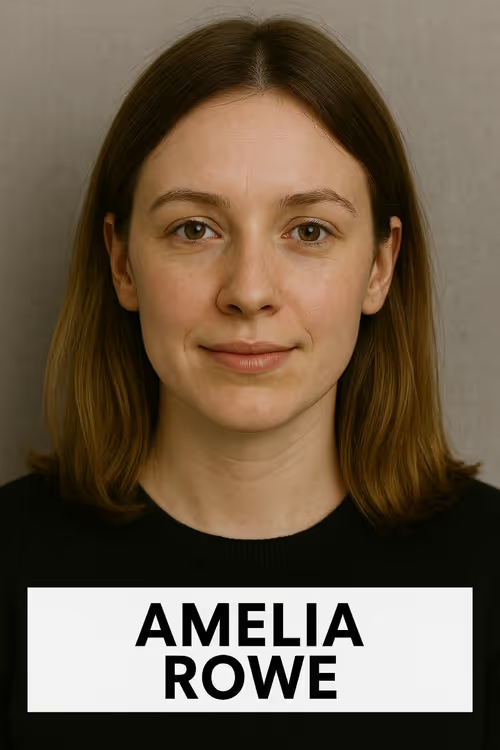
Amelia Rowe is a senior journalist at The Platinum Capital, covering finance, sovereign wealth, and global capital markets.
Written by
Amelia Rowe
Senior correspondent · Banking & Economy
Amelia spent eight years inside a sovereign wealth fund before deciding she'd rather write about institutional money than allocate it. She covers central banking, insurance, and the macro decisions that quietly choose which markets get the next decade. Sharp on monetary policy; impatient with anyone who confuses noise with signal. Based in London. Reach out at amelia.rowe@theplatinumcapital.com.


