

NEOM's Nadhmi Al-Nasr on Building a City From Scratch in the Saudi Desert
Few executives in the world carry a mandate as audacious as transforming 26,500 square kilometres of barren desert into a trillion-dollar urban ecosystem, yet Al-Nasr has staked his reputation on delivering precisely that under the unblinking gaze of Saudi Arabia's sovereign wealth fund. Whether NEOM ultimately reshapes the global playbook for city-building or becomes a cautionary tale of overreach, its chief executive remains the singular figure who must reconcile the kingdom's boundless ambition with the unforgiving physics of steel, concrete, and cash flow.…
The Man Tasked With Making the Impossible Possible
When Nadhmi Al-Nasr was appointed chief executive officer of NEOM in 2018, he inherited what may be the most ambitious urban development project in modern history — a $500 billion megacity rising from the barren sands of northwestern Saudi Arabia. A veteran of Saudi Aramco with decades of experience in complex engineering and project management, Al-Nasr was handed the job of transforming Crown Prince Mohammed bin Salman's sweeping vision into concrete, glass, and functional reality. His mandate was not simply to build a city but to construct a civilization-scale proof of concept for the future of human habitation, energy, and commerce. Few executives in the world carry a brief of comparable scale or scrutiny.
From Aramco to the Edge of the Red Sea
Al-Nasr's career before NEOM was shaped by his long tenure at Saudi Aramco, the world's most valuable energy company, where he held senior operational and leadership roles over more than three decades. Aramco is an organization renowned for managing enormous capital expenditure programs with military-grade precision — and that gave him a foundation uniquely suited to the demands of NEOM. Delivering complex infrastructure at scale, coordinating vast supply chains, managing stakeholder expectations across government and private sector boundaries: these were skills honed over years at the oil giant. His appointment signaled that the Saudi leadership wanted someone who understood how to translate grand ambitions into executable project plans, and who could do so within the demanding frameworks of the Kingdom's institutional culture.
The transition from fossil fuel operations to building a city premised on renewable energy and post-carbon living may seem paradoxical. Al-Nasr has framed it as a natural evolution. In numerous public appearances, he has positioned NEOM as an extension of Saudi Arabia's economic diversification strategy under Vision 2030 — the Kingdom's national blueprint for reducing its dependence on oil revenues. Under his leadership, NEOM has been presented not as a rejection of the hydrocarbon economy but as a declaration that Saudi Arabia intends to lead in what comes next.
Defining the Scope of NEOM
The sheer scale of NEOM defies easy comparison. Planned to cover approximately 26,500 square kilometers along the Red Sea coast — roughly the size of Belgium — the project encompasses several distinct sub-developments, each staggering in its own right. THE LINE, perhaps the most widely discussed component, envisions a linear city stretching 170 kilometers through the desert, designed to house millions of residents in a car-free, zero-emissions urban environment enclosed within mirrored facades. Then there's Trojena, a mountain tourism destination set to host the 2029 Asian Winter Games, and Oxagon, envisioned as a floating industrial complex and port city. Under Al-Nasr's stewardship, these projects have moved from conceptual renderings to active construction sites, with satellite imagery and media reports confirming large-scale earthworks and structural progress at multiple locations. That is a significant shift.
Al-Nasr has been candid about the enormity of the challenge. In interviews, he has described the work as requiring the simultaneous invention of new construction methodologies, regulatory frameworks, and technological systems. NEOM is not building on existing urban infrastructure. It is creating everything from utilities to governance structures from a blank canvas. That candor, combined with his visible presence at international investment forums and industry conferences, has helped maintain a degree of credibility around the project even as skeptics question its feasibility and timeline.
Managing Skepticism and Global Attention
No project of NEOM's ambition exists without controversy, and Al-Nasr has operated under intense international scrutiny throughout his tenure. Questions about the project's timeline, cost overruns, labor conditions, and displacement of local communities have been raised by journalists, human rights organizations, and industry analysts. Reports have surfaced suggesting that certain elements of the original vision — including THE LINE's projected population and completion dates — have been scaled back or adjusted. Al-Nasr and NEOM's communications team have addressed some of these concerns publicly, characterizing adjustments as standard practice for any project of this magnitude and emphasizing that the core vision remains intact.
What's hard to dispute is the project's capacity to attract global attention and talent. NEOM has recruited architects, engineers, urban planners, and executives from leading firms around the world. International consulting and construction companies have secured contracts across the project's various phases. The organization has also established partnerships with technology firms and academic institutions, positioning itself as an incubator for innovation in areas such as autonomous mobility, green hydrogen production, and digital infrastructure. Al-Nasr has been central to this recruitment and partnership effort, serving as NEOM's most prominent ambassador on the global stage. Few outside the region have fully grasped just how large that recruitment machine has become.
Leadership Under Extraordinary Pressure
Running NEOM demands a form of leadership that blends corporate discipline with the diplomatic instincts of a head of state. Al-Nasr reports effectively to the highest levels of the Saudi government, with Crown Prince Mohammed bin Salman serving as chairman of the NEOM board. The expectations are explicit and personal. Every milestone — or missed deadline — carries political weight beyond what a typical CEO faces. Al-Nasr has managed this dynamic by maintaining a public posture of unwavering confidence in the project while quietly overseeing the practical recalibrations that any undertaking of this complexity requires.
His leadership style, as observed through public forums and interviews, leans toward the methodical rather than the charismatic. He speaks in the language of project delivery — milestones, procurement cycles, systems integration — rather than soaring rhetoric. There's a strategic logic to that: in a project where the vision itself already strains credulity for many observers, an operational CEO who speaks in the vocabulary of execution provides a necessary counterweight to the dreamlike quality of NEOM's marketing materials.
A Legacy Still Being Written
It remains far too early to render a definitive judgment on Nadhmi Al-Nasr's tenure at NEOM. The project's full realization, if it occurs as envisioned, will unfold over decades. But here's what can be said with confidence: Al-Nasr has taken what began as a royal pronouncement and given it organizational form, physical momentum, and a degree of operational seriousness. He assembled one of the largest project-delivery teams ever constructed for a single development and kept the enterprise moving despite headwinds that would stall lesser efforts. Whether NEOM ultimately fulfills its extraordinary promise or becomes a cautionary tale about the limits of ambition, Al-Nasr's role in the story is already substantial. He is the man who broke ground — literally and figuratively — on what Saudi Arabia hopes will be the defining urban project of the twenty-first century.
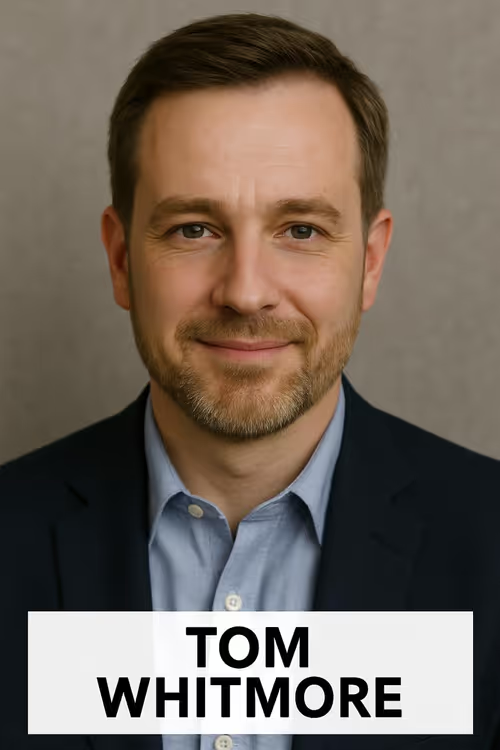
Written by
Tom Whitmore
Senior correspondent · Real Estate & Private Companies
Tom has interviewed most of the operators reshaping the Gulf skyline — and a few of the ones who tried and didn't. His beat is real estate, commodities, manufacturing, and the founder-led private companies that never bother to list. He knows which buildings and balance sheets survive a downturn before the spreadsheet does. Based in Dubai. Reach out at tom.whitmore@theplatinumcapital.com.