Chrystia Freeland and the G7's New Economic Security Framework
Canada's Chrystia Freeland has emerged as a central architect of the G7's evolving approach to economic security, marshalling allied consensus around a framework that seeks to de-risk critical supply chains and constrain adversarial capital flows without dismantling the liberal trading order wholesale. It is a delicate balancing act that demands both diplomatic tenacity and economic pragmatism, and its success or failure will likely define the West's capacity to project cohesion in an era of deepening geopolitical fracture.…
The Journalist Who Became a Geopolitical Architect
Chrystia Freeland has lived several professional lives, each one seemingly preparation for the next. A former Reuters bureau chief in Moscow, a celebrated author on the rise of global plutocracy, and eventually Canada's Deputy Prime Minister and Minister of Finance — Freeland brought to the world of economic statecraft something rare: a deep intellectual framework forged not in think tanks or treasury departments, but in the field, watching the post-Soviet oligarchic order take shape in real time. Her role in shaping the G7's approach to economic security represents one of the most consequential contributions by a Western policymaker in recent years. And its full significance is still unfolding.
From Moscow Correspondent to Economic Strategist
Freeland's influence on international economic policy starts with her journalism. As a young reporter in Moscow during the 1990s, she covered the chaotic privatisation of Russian state assets and the emergence of the oligarch class — experiences she later distilled into her 2000 book, Sale of the Century: Russia's Wild Ride from Communism to Capitalism. That work demonstrated an unusual ability to see economic policy not as a set of technical levers but as an expression of political power, national identity, and strategic ambition.
Her second major book, Plutocrats: The Rise of the New Global Super-Rich and the Fall of Everyone Else, published in 2012, examined the widening chasm between a globalised elite and the broader populations whose economic prospects were stagnating. Both works anticipated themes — the weaponisation of capital, the fragility of liberal economic norms, the political consequences of inequality — that would come to dominate policy debates a decade later. When Freeland entered Canadian politics in 2013, winning a seat in the House of Commons as a Liberal member of Parliament, she carried with her an analytical lens that few of her peers in government could match.
Sanctions Architecture and the Response to Russia's Invasion of Ukraine
Freeland's most visible contribution to economic security came in the wake of Russia's full-scale invasion of Ukraine in February 2022. As Canada's Finance Minister and Deputy Prime Minister under Justin Trudeau, she was among the most vocal and aggressive Western leaders pushing for severe financial sanctions against Russia, including the unprecedented step of freezing the reserves of the Russian central bank and restricting major Russian financial institutions from the SWIFT payments system.
Her personal history lent her an authority on the Russia file that was difficult to dismiss. Freeland, who is of Ukrainian descent on her mother's side and speaks both Ukrainian and Russian, had been banned from entering Russia since 2014 — a distinction she wore as a marker of credibility. Within the G7, she became one of the leading advocates for treating economic tools not as a supplement to traditional diplomacy but as a primary instrument of collective security. That is a significant shift. Canada, under her stewardship, moved quickly to implement asset-freezing measures and to coordinate with allies on energy sanctions, export controls, and the broader financial isolation of Moscow.
Redefining the G7's Economic Mandate
The broader significance of Freeland's work lies in how it helped drag the G7's institutional centre of gravity into new territory. For much of the post-Cold War period, the G7 functioned primarily as a forum for macroeconomic coordination and development finance. A talking shop with good catering. Under pressure from the events of 2022 and after, and with figures like Freeland pushing the conversation, the group began to articulate a more explicit economic security framework — one that acknowledged the strategic dimension of trade, investment, supply chains, and financial infrastructure.
This shift showed up in successive G7 communiqués, which increasingly referenced "economic coercion," "de-risking" of critical supply chains, and the need to safeguard economic sovereignty against authoritarian leverage. Many actors across multiple governments drove this evolution, but Freeland's intellectual contributions and her willingness to frame the debate in stark moral and strategic terms gave the conversation an urgency it might otherwise have lacked. She consistently argued that the rules-based international economic order was not self-sustaining — and that democracies needed to accept short-term economic costs to preserve long-term strategic integrity.
Domestic Pressures and Political Realities
Freeland's tenure as Finance Minister was not without friction. Managing Canada's fiscal position during and after the COVID-19 pandemic required difficult trade-offs, and she faced criticism from various quarters over the scale of government spending, inflationary pressures, and the federal deficit. Then came the dramatic exit. Her resignation from cabinet in December 2024, following a public disagreement with Prime Minister Trudeau over fiscal policy and economic direction, laid bare the tensions inherent in balancing domestic economic management with an ambitious international agenda.
In her resignation letter, Freeland warned against what she described as costly political manoeuvres at a time when Canada needed to maintain fiscal discipline to meet the challenges posed by an incoming U.S. administration under President-elect Donald Trump and growing global instability. The episode revealed both her willingness to take principled stands and the limits of what any single minister can achieve within the constraints of coalition politics and shifting political fortunes. It also, paradoxically, enhanced her reputation among many international observers as someone willing to sacrifice political position for policy conviction.
A Legacy Still Being Written
Chrystia Freeland's impact on the G7's economic security framework extends beyond any single policy decision or sanctions package. What she helped articulate — and what the Western alliance is still working to operationalise — is a fundamental rethinking of the relationship between economic openness and national security. The idea that trade and financial integration can be weaponised, and that democracies must therefore build resilience into their economic architectures, is now close to orthodoxy in Western capitals. Freeland did not originate every element of this thinking, but she was among its most effective champions at a moment when theory urgently needed to become practice.
Whether she returns to frontline politics, moves to an international institutional role, or re-enters public intellectual life, her record suggests a figure whose influence will outlast her formal time in office. In an era when the boundaries between economics and geopolitics have effectively dissolved, few Western leaders have been as well-equipped — by experience, intellect, and conviction — to address the resulting challenges. The framework she helped build will be tested repeatedly in the years ahead. Its durability will say a great deal about what she actually accomplished.
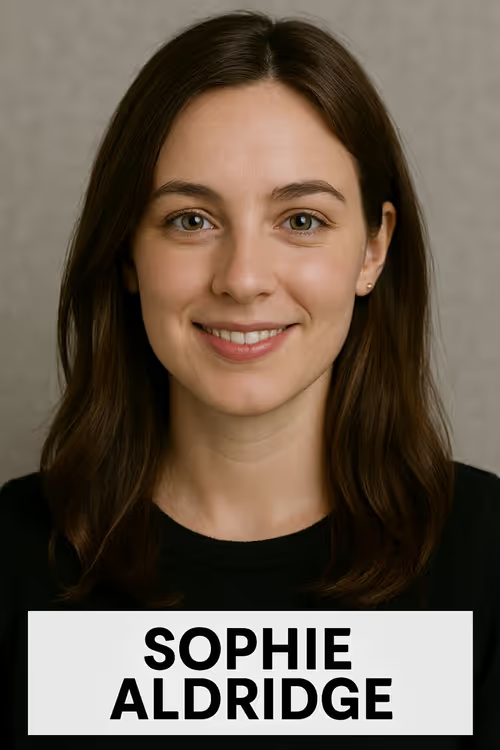
Written by
Sophie Aldridge
Global Economics Editor · Geopolitics
Sophie spent a decade advising governments on trade policy before deciding the story was more interesting than the memo. She covers global economics, geopolitics, and the power transitions reshaping emerging markets. Sharpest on sanctions, supply chains, and the politics behind the price of everything. Based in Washington, D.C. Reach out at sophie.aldridge@theplatinumcapital.com.