

Abu Dhabi Real Estate: The Quiet Giant Awakens
Abu Dhabi's real estate market has long operated in the shadow of its more flamboyant neighbour, yet beneath that studied restraint lies a capital methodically assembling the regulatory frameworks, infrastructure, and institutional-grade assets that serious long-term capital demands. What is unfolding now is not a speculative surge but a structural repricing of one of the world's most underleveraged sovereign real estate markets, and the window for early positioning is closing faster than most family offices have acknowledged.…

For years, Abu Dhabi sat politely in the background while Dubai commanded the global headlines, the Instagram feeds, and the lion's share of international capital. That dynamic is shifting — and for those with the resources to read the signals early, the window remains open. Not for much longer.
A Market That No Longer Needs to Announce Itself
Abu Dhabi's residential and commercial real estate markets recorded combined transaction volumes exceeding AED 100 billion in 2025. A decade ago, that figure would have seemed ambitious as a five-year target. In Q1 2026, momentum has not slowed. Aldar Properties — the emirate's dominant developer and increasingly a regional force — posted land and unit sales that outpaced its own internal projections, driven in part by sustained demand from Egyptian, Kazakhstani, and Southeast Asian investors who have quietly been rotating capital out of more volatile jurisdictions into UAE-denominated hard assets.
The reasons are not complicated. Abu Dhabi offers what Dubai sometimes cannot: lower entry price points per square foot in comparable-quality developments, a more measured release of inventory, and a sovereign wealth backdrop — anchored by ADIA and Mubadala — that provides institutional confidence no marketing brochure can replicate. That combination is proving persuasive to exactly the kind of capital that moves carefully and moves once.
The Dubai Signal and What It Means for Abu Dhabi
To understand Abu Dhabi's current moment, look at what is happening forty minutes up the highway. Dubai's residential market recorded AED 139.1 billion in sales during Q1 2026 alone — 44,200 transactions completed between January and March, up 4.6% year-on-year, with the luxury segment surging more than 25% against the same period in 2025. The numbers tell a complicated story, but the headline is simple: Dubai's prime corridors are becoming structurally constrained.
The deals confirm it. In June, AHS Properties acquired the Shangri-La Hotel on Sheikh Zayed Road from Abu Dhabi-based Mismak, a unit of First Abu Dhabi Bank, for AED 1.1 billion. Abbas Sajwani, founder and CEO of AHS Properties, was direct about his reasoning: "We did not buy a hotel. We bought a position in a corridor where supply is structurally constrained and demand is globally diversified." AHS has since announced a USD 6.8 billion mixed-use development on the Dubai Water Canal, slated for Q3 2026, as part of a year-end pipeline that now stands at AED 50 billion. Separately, Arabian Acres structured a landmark AED 400 million Jumeirah beachfront land deal in March 2026 — more than 113,000 square feet with 160 metres of private coastline, projected to generate a gross development value exceeding AED 1 billion.
When Dubai's best addresses run out of room, capital looks laterally. Abu Dhabi is not a consolation prize. It is the logical next chapter.
Saadiyat, Yas, and the Infrastructure of Aspiration
Abu Dhabi has spent the better part of fifteen years building the cultural and lifestyle infrastructure that luxury real estate requires as its foundation. That investment is now paying out.
Saadiyat Island — home to the Louvre Abu Dhabi, the under-construction Guggenheim Abu Dhabi, and the Natural History Museum Abu Dhabi — has transformed from a masterplan into a lived address. Aldar's Saadiyat Grove and adjacent projects have attracted buyers from Morocco, Nigeria, Indonesia, and the Gulf's own inter-emirate relocators, many of them family office principals or second-generation wealth holders seeking both a primary residence and a defensible store of value. These are not speculative buyers. They are people who intend to stay.
Yas Island tells a different but equally instructive story. It has evolved well beyond its entertainment identity to include high-specification residential communities appealing to a distinct and equally affluent cohort: operators, regional executives, and GCC nationals seeking lifestyle-integrated living within proximity to Abu Dhabi's expanding financial district. Price appreciation across both islands averaged 18 to 22% for villa product in 2025, according to internal Aldar data and independent broker assessments. That reflects genuine demand compression. Not speculative froth.
Sovereign Confidence and the Institutional Halo
Few markets globally can claim what Abu Dhabi offers: near-perfect alignment between sovereign institutional ambition and private development activity. ADNOC's ongoing expansion, the Abu Dhabi Global Market's emergence as a genuine competitor to DIFC for regional financial services, and Abu Dhabi's tourism receipts — which exceeded USD 5 billion in 2025 — together create a self-reinforcing demand ecosystem that most real estate markets can only approximate.
Family offices based in Riyadh, Doha, and increasingly Nairobi and Lagos have taken note. Several African family principals interviewed by TPC in 2025 cited Abu Dhabi's combination of political stability, Sharia-compliant financing options, freehold zones, and direct flight connectivity as primary drivers in their allocation decisions. For investors from Central Asia — particularly Kazakhstan and Uzbekistan, where the UHNW segment has grown substantially on the back of commodities and logistics wealth — Abu Dhabi's regulatory maturity and the UAE's golden visa framework have reduced friction to near zero.
Capital that once defaulted to London or Geneva is being redirected. Abu Dhabi is capturing a meaningful share. Few outside the region have noticed. They should.
What Sophisticated Investors Are Watching in the Second Half of 2026
The remainder of 2026 presents specific opportunities for serious capital allocators — and a narrowing timeline to act on them. Aldar's pipeline includes several master-planned communities where early-stage pricing still reflects developer incentive structures rather than secondary market premiums. That window historically closes within twelve to eighteen months of project announcement.
The Abu Dhabi government's continued investment in the Zayed City corridor — positioned as a future administrative and commercial spine — is already attracting institutional land buyers ahead of any retail market awareness. That is a significant shift. The smart money is not waiting for the announcement.
For family offices managing liquidity events or inter-generational transfers, the underlying economics hold up under scrutiny. Rental yields on premium Abu Dhabi product currently average between 5.5% and 7.2% net depending on asset class — surpassing comparable product in London, Singapore, or Paris on yield terms, while offering meaningful capital appreciation potential across a three-to-seven-year horizon. The emirate is also advancing its long-term commitment to double the non-oil GDP contribution from real estate and related sectors, a target backed by infrastructure spend that private capital can leverage rather than lead.
Those who watched Dubai's transformation from a regional curiosity into a global capital magnet will recognise the pattern. Abu Dhabi is not replicating that story. It is writing a quieter, more considered version of its own — and for investors who prefer substance over spectacle, that distinction is precisely the point.
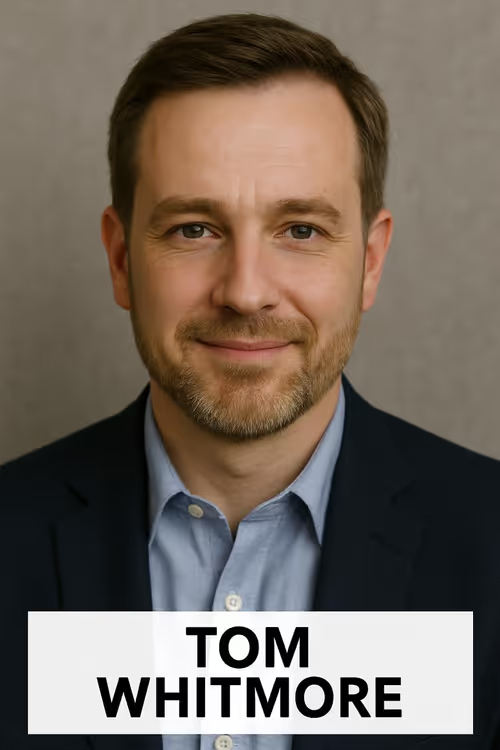
Written by
Tom Whitmore
Senior correspondent · Real Estate & Private Companies
Tom has interviewed most of the operators reshaping the Gulf skyline — and a few of the ones who tried and didn't. His beat is real estate, commodities, manufacturing, and the founder-led private companies that never bother to list. He knows which buildings and balance sheets survive a downturn before the spreadsheet does. Based in Dubai. Reach out at tom.whitmore@theplatinumcapital.com.