

Corporate Debt Refinancing: The Wall Coming Due
As trillions of dollars in corporate debt approach maturity over the next three years, boardrooms and sovereign wealth managers alike are confronting a refinancing landscape shaped by structurally higher interest rates, tightening credit conditions, and lenders unwilling to extend the forbearance that defined the post-pandemic era. For family offices and institutional allocators seeking to preserve and grow generational wealth, understanding which sectors face existential rollover risk — and which present asymmetric opportunity — is no longer a matter of strategic advantage, but of fiduciary necessity.…

A reckoning is coming for global credit markets, and for the family offices, sovereign-linked funds, and private investors who have quietly accumulated corporate debt exposure over the past decade, timing will be everything. Between 2025 and 2028, an estimated USD 11 trillion in corporate debt globally is scheduled to mature or require refinancing — a figure that dwarfs prior credit cycles and arrives precisely as interest rates remain stubbornly elevated across the United States, Europe, and key emerging markets. This is not a theoretical stress test. It is an active repricing event, and the most sophisticated capital in the Gulf, Central Asia, and Southeast Asia is already moving around it.
The Scale of the Problem — and the Opportunity Within It
The so-called "maturity wall" is exactly what it sounds like: a concentrated cluster of corporate bonds and leveraged loans, issued during the ultra-low-rate era of 2020 to 2022, now coming due in a radically different rate environment. In the United States alone, over USD 1.8 trillion in leveraged loans and high-yield bonds will mature before the end of 2027. Europe faces a parallel wave, with investment-grade and sub-investment-grade issuers alike confronting refinancing costs running 200 to 400 basis points above their original terms. The arithmetic is brutal. Companies that issued at sub-3% rates and must now roll over at 6% to 8% will see margins compress, covenant headroom shrink, and the menu of options narrow fast — asset sales, distressed capital raises, or worse.
For patient, well-capitalised private investors, that pain translates directly into opportunity. The question is not whether deals will emerge. They will. The question is how to access them selectively, structure appropriately, and avoid the situations where the underlying business simply cannot survive at any price.
Gulf Private Credit Moves First — GPG and the NinjaTrader Signal
The Gulf's emergence as a meaningful originator of private credit — not merely a passive allocator writing cheques to Western fund managers — ranks among the defining capital market shifts of this cycle. The clearest recent illustration came in mid-2026, when Gulf Partners Group (GPG), the Bahrain-anchored private markets firm launched in January 2026, closed a USD 100 million senior secured private credit facility for NinjaTrader Group, the leading retail futures trading platform in the United States. The deal was structured alongside Payward, the parent company of digital asset exchange Kraken, and marks GPG's first major deployment since launch.
GPG is anchored by Arzan Financial Group (AFG), a Kuwait-listed asset manager running over USD 5 billion in assets under management and USD 1 billion in proprietary assets. The firm is targeting up to USD 2.5 billion in deployment across the region over five years. The numbers tell a complicated story. It is not merely the size of the NinjaTrader deal that matters — it is the architecture. A Gulf-headquartered firm originating a senior secured credit facility for a Chicago-based fintech, structured alongside a crypto-adjacent co-investor, is precisely the kind of cross-border, asset-backed transaction the maturity wall will multiply in volume. As traditional bank lenders pull back from complex or mid-market situations, non-bank private creditors with regional mandates and global reach are stepping in — and setting their own terms.
Why Senior Secured Structures Are Dominating Family Office Dealflow
Across the GCC, Central Asia, and North Africa, the most active family offices and private wealth platforms are converging on one structure: senior secured private credit with short-to-medium duration. The logic is not complicated. In a world where refinancing risk runs high and equity valuations remain uncertain, first-lien exposure to hard assets — receivables, inventory, IP-backed cash flows, real estate — provides a margin of safety that unsecured or subordinated positions simply cannot match. Yields in this part of the capital structure are currently running between 9% and 13% in USD-denominated deals, depending on sector and jurisdiction. Against public market alternatives, the risk-adjusted case is difficult to argue with.
Family offices in the UAE and Saudi Arabia that built equity-heavy portfolios through the 2021 boom are now actively rebalancing. That is a significant shift. Several Riyadh-based principals have indicated privately that credit allocations within their alternatives books have doubled since 2023. The PwC Middle East TransAct report released in February 2026 recorded a 33% surge in Middle East M&A activity in 2025, with a meaningful share driven by debt-for-equity exchanges and recapitalisations — precisely the deal types a maturity wall generates at scale.
Technology, AI, and the Debt Structures Funding the Next Cycle
Not all refinancing stress is equal. Companies most likely to access capital on reasonable terms are those with demonstrable revenue growth, strong unit economics, or strategic positioning in sectors where sovereign and institutional conviction runs deep. Artificial intelligence infrastructure is the clearest example right now. KBW Ventures, the investment vehicle of Prince Khaled bin Alwaleed bin Talal Al Saud, made a strategic investment in Umanitek in February 2026 — an AI safety company founded in Zug, Switzerland, building systems to detect and neutralise digital harm at scale. Prince Khaled joined Umanitek's Advisory Board. This is an engaged, active position, not a passive allocation.
KBW Ventures, which holds stakes in companies including Turing, HerculesAI, Trifacta, and Signifyd, has consistently targeted B2B SaaS, fintech, and AI — sectors where recurring revenue models and high gross margins keep debt service ratios manageable even in a high-rate environment. For family offices considering private credit exposure, AI-adjacent companies with proven enterprise contracts represent a category where senior debt can be structured with genuine protection. The convergence of strategic Gulf capital and deep-technology companies is not coincidental. It reflects a calculated view that the next credit cycle will be shaped as much by data infrastructure as by physical assets. Few outside the region have fully absorbed that. They should.
What Sophisticated Investors Should Be Watching Now
The maturity wall will not resolve uniformly. Some companies refinance smoothly. Some restructure. A meaningful number will require emergency equity injections or forced asset sales — and that window opens hard between 2026 and 2027. For family offices and private investors across the GCC, Southeast Asia, and Africa, three priorities stand out right now: audit existing portfolio exposure to refinancing risk inside private equity and credit holdings; identify deal-by-deal opportunities in senior secured structures where Gulf-based originators like GPG are setting terms rather than co-investing passively; and hold enough liquidity to act when distressed situations surface.
The capital that moves early — with discipline and structural clarity — will define returns for the better part of a decade. The maturity wall is not a crisis for those positioned correctly. It is the most significant private credit vintage in years. And the Gulf is no longer watching from the sidelines.
Written by
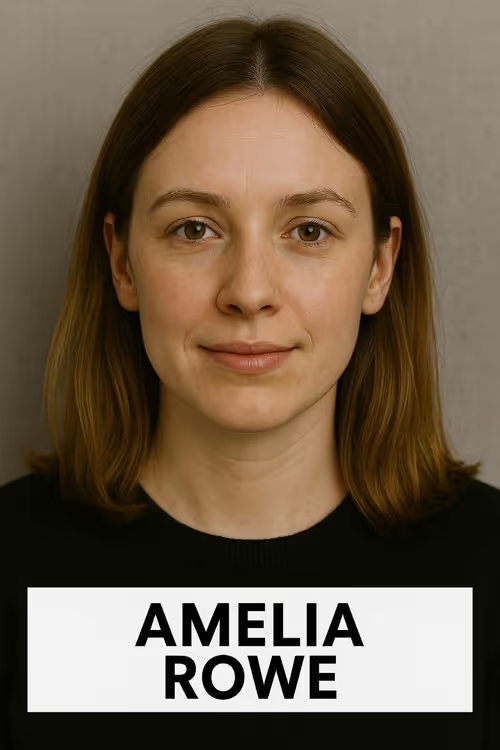
Amelia Rowe
Senior correspondent · Banking & Economy
Amelia spent eight years inside a sovereign wealth fund before deciding she'd rather write about institutional money than allocate it. She covers central banking, insurance, and the macro decisions that quietly choose which markets get the next decade. Sharp on monetary policy; impatient with anyone who confuses noise with signal. Based in London. Reach out at amelia.rowe@theplatinumcapital.com.