

African Private Equity: Where the Smart Money Is Deploying
As global capital markets grapple with compressed yields and geopolitical uncertainty, a discerning tier of institutional investors and family offices is quietly repositioning toward sub-Saharan Africa and North African growth corridors, where demographic tailwinds, urbanization, and an expanding middle class are producing risk-adjusted returns that developed markets simply cannot replicate. The convergence of maturing regulatory frameworks, currency hedging sophistication, and a new generation of battle-tested African fund managers has transformed what was once considered frontier speculation into a credible, high-conviction asset class commanding serious allocation from the world's most sophisticated pools of capital.…

The signal is unmistakable. As Abu Dhabi's MGX closes a record $49 billion AI fund and the family office of UAE President Sheikh Mohamed bin Zayed Al Nahyan quietly backs everything from European secondaries to Uzbek sovereign listings, the region's most sophisticated capital allocators are scanning every viable asset class with fresh urgency. Increasingly, their gaze is settling on Africa — not as a development bet, but as a returns story.
The Rerating of African Private Equity
For much of the past decade, African private equity carried a perception premium that kept institutional allocators at a distance. Currency volatility, regulatory opacity, shallow exit markets — the objections were real, and Gulf and Asian capital largely stayed away. That calculus is changing. According to the African Private Equity and Venture Capital Association, the continent attracted approximately $4.4 billion in PE fundraising in 2024, with deal volumes holding firm despite global headwinds that compressed activity across Europe and North America. But the headline figure only tells part of the story. Where the money is moving — and who is moving it — tells the rest.
The vintage cohort of funds that deployed between 2015 and 2019 is now returning capital. Several have done so at net IRRs comfortably in the mid-to-high teens, outperforming comparable emerging market funds in Southeast Asia and Eastern Europe. For family office principals managing between $50 million and $500 million, this is no longer a footnote. It is a reallocation conversation.
Nigeria, Egypt, and Kenya: Where Conviction Capital Is Flowing
Three markets are drawing the most serious institutional attention: Nigeria, Egypt, and Kenya. Each for distinct structural reasons. Nigeria's consumer economy — anchored by a population approaching 230 million and a fintech sector that has produced globally competitive companies — continues to attract growth equity capital despite naira volatility. The devaluation cycle that bruised earlier vintages has, paradoxically, created entry points that experienced managers are treating as generational. Lagos-based and pan-African funds are selectively deploying into healthcare logistics, agri-processing, and B2B software — sectors with dollar-linked revenue streams that naturally hedge currency exposure.
Egypt presents a different thesis entirely. The IMF's extended programme, now exceeding $8 billion in total support, has stabilised the macroeconomic framework sufficiently for private equity firms to underwrite exits with genuine confidence. Several regional GPs are building positions in Egyptian manufacturing and pharmaceuticals, capitalising on the country's role as a nearshoring destination for European supply chains. That is a significant shift for a market that spent years on the margins of serious PE activity. Kenya, meanwhile, remains the preferred gateway for East African exposure — its financial services sector, mobile infrastructure density, and relative regulatory maturity draw consistent interest from both pan-African and global managers.
Gulf Capital and the Africa Pivot
The most consequential development for African PE is not originating in Nairobi or Cairo. It is originating in Abu Dhabi and Riyadh. The architecture of Gulf sovereign and family capital has fundamentally changed. AC Limited, the family office of Sheikh Mohamed bin Zayed, has built a deal-flow infrastructure capable of backing a $30 billion Ardian secondaries fund and a $700 million Uzbek sovereign listing within the same cycle. That kind of range signals an appetite for diversification that extends well beyond traditional asset classes — and Africa is now part of that conversation.
Several senior placement agents active in the Gulf confirm that African-focused GPs are now a standard fixture on LP roadshows in Dubai and Abu Dhabi, where two years ago they would have been considered niche. Few outside the Gulf have noticed how quickly that shift has happened. They should. Saudi Arabia's Public Investment Fund has disclosed co-investment interests in African infrastructure through its emerging markets mandate. More quietly, single-family offices across the UAE — many managing capital for merchant families with deep historical trade ties to East and West Africa — are formalising those relationships into structured PE allocations for the first time.
Sector Concentration: The Themes Attracting Smart Capital
Not all African PE is created equal. The managers generating the strongest LP interest share one characteristic: disciplined sector concentration over broad geographic mandates. Four themes are commanding disproportionate attention from sophisticated allocators in 2026.
Financial services and embedded fintech remain the dominant allocation category. The scale of unbanked and underbanked populations across sub-Saharan Africa is well documented, but what has changed is the demonstrated ability of technology-enabled lenders and payment platforms to build profitable unit economics at scale — not just user growth. Healthcare is accelerating fast: pharmaceutical manufacturing, diagnostics, and hospital networks are all attracting capital as post-pandemic supply chain lessons push governments and corporate buyers to localise procurement. Agribusiness and food processing, long underweighted relative to the continent's agricultural footprint, is pulling in climate-linked capital as global food security frameworks actively incentivise private investment. And then there is data infrastructure — tower companies, fibre backbones, edge data centres. Allocators who watched digital infrastructure valuations compound across the Gulf and Southeast Asia see Africa running approximately a decade behind on the same trajectory. The arbitrage is obvious to anyone paying attention.
Structure, Liquidity, and the Exit Question
The concern that has always shadowed African PE — the absence of deep, liquid exit markets — has not disappeared. But managers are working around it through structural innovation rather than waiting for public markets to mature. Continuation funds, GP-led secondaries, and strategic trade sales to regional corporates and multinationals have replaced the IPO-dependency that constrained earlier vintages. The Johannesburg Stock Exchange remains the continent's most credible public exit venue, and the Lagos Exchange has seen selective activity, but the most reliable exit routes in the current cycle are bilateral: selling growth-stage companies to regional strategic buyers, to global corporates seeking African market access, or into the expanding secondaries market where firms like Ardian — backed in part by Gulf family office capital — are active buyers.
For private investors making their first or second allocation to African PE, how they enter matters as much as which manager they back. Co-investment rights alongside a proven GP, preferred equity tranches with structured downside protection, and fund-of-funds vehicles that blend vintage years are all tools that experienced allocators are using to manage the binary risk profile that comes with single-fund exposure. These are not exotic structures. They are standard practice for anyone who has been through an emerging market cycle before.
The broader signal from 2026 is straightforward: the same capital formation instincts that drove MGX to deploy at scale into AI and prompted AC Limited to build a global portfolio spanning supercar manufacturers and sovereign listings are now directing serious attention toward Africa's strongest growth sectors. The window for first-mover positioning — before this allocation becomes consensus — is closing faster than most observers expected.
Written by
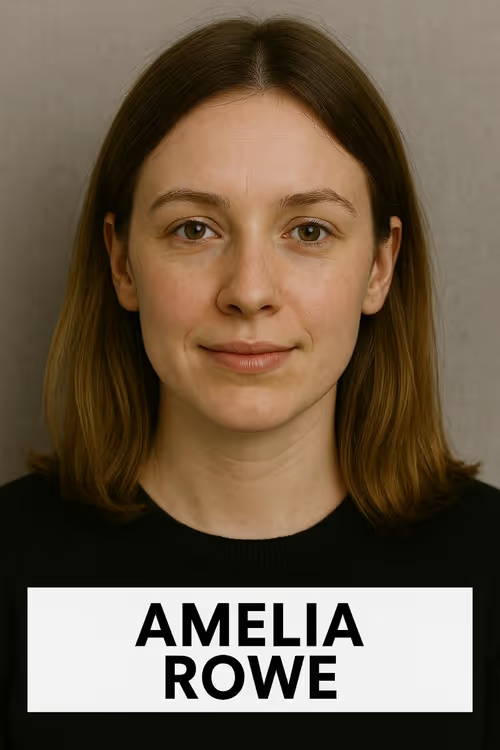
Amelia Rowe
Senior correspondent · Banking & Economy
Amelia spent eight years inside a sovereign wealth fund before deciding she'd rather write about institutional money than allocate it. She covers central banking, insurance, and the macro decisions that quietly choose which markets get the next decade. Sharp on monetary policy; impatient with anyone who confuses noise with signal. Based in London. Reach out at amelia.rowe@theplatinumcapital.com.