

Islamic Banking Growth Across Southeast Asia and Africa
Islamic banking assets across Southeast Asia and Africa are experiencing unprecedented expansion, with Sharia-compliant financial institutions now commanding significant market share in economies stretching from Kuala Lumpur to Nairobi, driven by surging Muslim middle-class wealth and progressive regulatory frameworks that are actively courting foreign capital. For sophisticated investors and sovereign wealth allocators seeking portfolio resilience beyond conventional markets, this structural shift represents one of the most compelling long-term opportunities of the decade, underpinned by an estimated 1.8 billion-strong consumer base and governments that are rewriting financial legislation to accelerate growth.…

GCC central banks held interest rates steady for a third consecutive time in June 2026, mirroring the US Federal Reserve's decision to keep its benchmark at 3.50%–3.75%. Unremarkable, on the surface. But beneath that rate stability, something far more consequential is reshaping the financial architecture of two of the world's fastest-growing regions. Islamic banking is no longer a niche offering appended to conventional balance sheets. Across Southeast Asia and sub-Saharan Africa, it is becoming the dominant framework through which governments, sovereign wealth vehicles, and private capital choose to deploy and raise funds. The timing is deliberate. The momentum is measurable.
A Structural Shift, Not a Cyclical Trend
Global Islamic finance assets are projected to surpass USD 6.7 trillion by the end of 2026, according to the Islamic Financial Services Board's most recent stability report. The growth is not uniform. It is concentrated. Malaysia and Indonesia together account for the largest share of Islamic banking assets outside the Gulf, while Nigeria, Kenya, and Morocco are rapidly closing the gap. In Indonesia, Bank Syariah Indonesia — the state-backed megabank formed through the merger of three government-owned Islamic lenders — now holds over USD 18 billion in assets and recently expanded its retail sukuk issuance programme targeting domestic middle-income savers. In Malaysia, the Islamic banking sector already commands more than 45% of total domestic banking assets. A figure that would have seemed ambitious a decade ago.
What separates this cycle from earlier waves of Islamic finance expansion is the sophistication of the instruments involved. This is no longer purely about deposit accounts and personal finance structured on murabaha. Family offices from Kuala Lumpur to Lagos are now structuring private equity co-investments through musharaka frameworks. Infrastructure developers in Vietnam and the Philippines are actively exploring sukuk as an alternative to dollar-denominated bond issuance — particularly as the Fed's dot plot, revised upward in June 2026, signals that US rate cuts are unlikely before early 2027. The instrument set has matured. So has the investor base.
The GCC as Capital Architect
Gulf institutions are driving cross-border Islamic finance flows. Saudi Arabia's Al Rajhi Bank — the world's largest Islamic bank by assets — has accelerated its international advisory presence in Malaysia and Indonesia. Abu Dhabi Islamic Bank has formalised partnerships with Kenyan and Nigerian financial institutions to co-structure trade finance facilities under shariah-compliant frameworks. UAE's Emirates Islamic reported a 14% increase in cross-border transaction volumes in Q1 2026, with Southeast Asia accounting for the largest share of new institutional mandates. That is a significant shift in where Gulf capital is hunting for yield.
This Gulf-to-Asia-to-Africa capital corridor is being reinforced at the sovereign level. The Saudi-backed Islamic Development Bank disbursed over USD 3.1 billion in financing across member states in the first half of 2026, with infrastructure and financial sector development projects in Senegal, Uganda, and Bangladesh absorbing a meaningful portion. Qatar's central bank confirmed its Repo Rate at 4.10% and Lending Rate at 4.35% as of June 18, 2026, while separately working with the Qatar Financial Centre to position Doha as a sukuk structuring hub for African sovereign issuers. The commercial logic is clear. So is the diplomatic calculus.
Africa's Window Is Opening
Africa's Islamic banking story is still early. But the foundations are being laid with purpose, not aspiration. Morocco's Participative Banking sector — the country's regulatory term for Islamic finance — has seen cumulative financing volumes exceed MAD 90 billion since full liberalisation, with CIH Bank and Attijariwafa Bank both expanding their participative windows. Egypt's Faisal Islamic Bank of Egypt, one of the continent's oldest shariah-compliant institutions, has renewed its capital base and is pursuing digital infrastructure upgrades to serve a younger, more mobile-first demographic across Cairo and Alexandria.
Nigeria presents perhaps the most compelling growth argument. Few outside the region have paid close attention. They should. With a Muslim population exceeding 95 million and a significant unbanked population, the opportunity for shariah-compliant retail and SME banking is vast. Jaiz Bank — Nigeria's first full-fledged Islamic bank — has grown its asset base to over NGN 500 billion and is actively pursuing a commercial paper issuance programme that would deepen the country's nascent sukuk market. The Nigerian government's sovereign sukuk programme has now raised over NGN 1 trillion across multiple issuances for infrastructure financing. Demand exists. The government is serious about institutionalising the framework. Both matter.
Private Wealth and the Shariah Premium
For family offices and private investors in the USD 10 million to USD 500 million range — particularly those based in the Gulf, Malaysia, and increasingly East Africa — Islamic finance is not simply a matter of religious compliance. It has become a credible risk management framework. The profit-and-loss sharing structures inherent in Islamic finance impose a discipline that purely debt-driven models do not. The numbers tell a complicated story. UAE's ten largest listed banks reported an 11.1% quarter-on-quarter increase in net income in Q1 2026, with return on equity rising to 18.7%. Within those figures, the underlying asset quality of Islamic books has held up notably well against conventional peers operating in the same markets.
Wealthy families across Southeast Asia are increasingly using waqf structures — endowments with deep roots in Islamic jurisprudence — to ring-fence philanthropic and legacy capital. Singapore's Warees Investments, the commercial arm of Majlis Ugama Islam Singapura, has been a quiet pioneer here, demonstrating that waqf assets can generate competitive risk-adjusted returns while fulfilling social objectives. Family office advisors in Dubai and Riyadh are now studying this model seriously as a vehicle for generational wealth transfer with a values-aligned overlay. The structure is old. The application is new.
What Sophisticated Investors Should Watch
The next 18 months will define the cross-border Islamic capital markets story. If Federal Reserve Chairman Kevin Warsh proceeds with even one rate hike — which FOMC minutes from July 2026 suggest is possible as early as September — dollar-pegged GCC borrowing costs will rise further. That makes shariah-compliant sukuk considerably more attractive as an alternative fixed-income vehicle for investors seeking yield without direct exposure to US monetary policy cycles. Watch Indonesia's planned sovereign green sukuk, expected in Q3 2026 with a target size of USD 2 billion. It will serve as a closely watched benchmark for how markets price ESG-linked Islamic instruments from emerging market sovereigns. The pricing outcome will matter well beyond Jakarta.
For private investors and family offices with capital to deploy across Southeast Asia or Africa, the entry point has rarely been more structurally sound. Regulatory frameworks are maturing. Institutional pipelines are deepening. Gulf capital — patient, strategically motivated, increasingly sophisticated — is moving in the same direction. That alignment does not last indefinitely. The principals who move now, while the architecture is still being written, will define the next generation of Islamic finance's geography. The window is open. It will not stay that way.
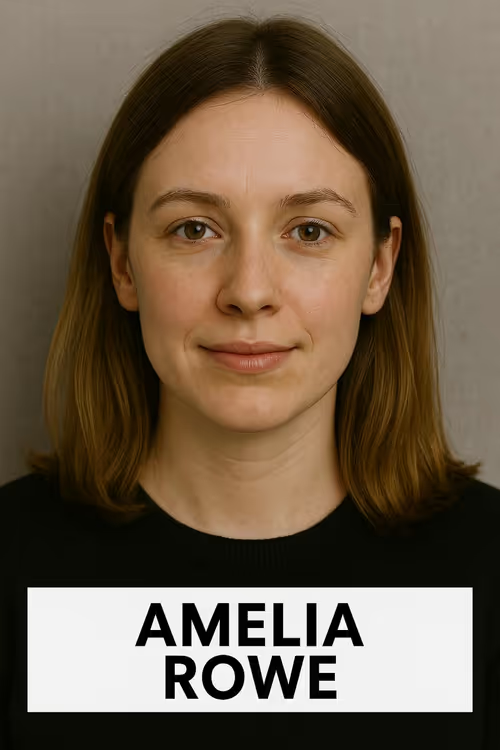
Written by
Amelia Rowe
Senior correspondent · Banking & Economy
Amelia spent eight years inside a sovereign wealth fund before deciding she'd rather write about institutional money than allocate it. She covers central banking, insurance, and the macro decisions that quietly choose which markets get the next decade. Sharp on monetary policy; impatient with anyone who confuses noise with signal. Based in London. Reach out at amelia.rowe@theplatinumcapital.com.