

Life Insurance Innovation in a Post-Pandemic World
The seismic disruptions of the pandemic era have permanently reshaped how high-net-worth individuals and institutional stakeholders perceive mortality risk, liquidity protection, and long-term wealth preservation, accelerating a structural transformation across global life insurance markets that few could have anticipated. Forward-thinking family offices and sovereign-aligned investors are now positioning life insurance not merely as a legacy instrument, but as a sophisticated, yield-generating asset class embedded within diversified capital strategies designed to withstand generational volatility.…

The life insurance industry entered 2020 under-appreciated and, in many markets, under-purchased. It exited the pandemic years fundamentally altered — not just in product design or distribution, but in how individuals across the Gulf, emerging Asia, and Africa think about mortality, wealth transfer, and long-term financial security. What is unfolding now, in 2026, is something more consequential than a post-crisis rebound. This is a structural reimagination of what life insurance is for, who it serves, and how it integrates into serious wealth planning at the highest levels.
From Safety Net to Wealth Architecture
For decades, insurers sold life products in emerging markets as protection tools for the middle class — income replacement, a buffer against unexpected death. That framing is becoming obsolete among the audience that matters most to the sector's profitability: ultra-high-net-worth families, family office principals, and private investors managing between USD 50 million and USD 500 million in assets across the GCC, Southeast Asia, and Sub-Saharan Africa.
In the UAE and Saudi Arabia, sophisticated private clients are increasingly deploying whole-of-life and universal life structures not as insurance per se, but as tax-efficient vehicles for intergenerational wealth transfer, liquidity management, and estate equalisation across multiple jurisdictions. A family office managing assets across Dubai, Riyadh, and Singapore might use a USD 20 million life policy issued through a Cayman or Bermuda platform to fund a trust structure that bypasses probate entirely. This is not marginal behaviour. It is becoming standard practice among next-generation wealth holders who watched the pandemic expose the fragility of unstructured estate plans.
Zurich International, Generali, and several Bermuda-domiciled carriers have been expanding their private placement life insurance offerings across the Gulf and Southeast Asia precisely because demand from family offices has outpaced their existing product shelves. The numbers tell a complicated story. CBRE and Swiss Re data suggest life insurance penetration in the GCC remains below 1% of GDP — a fraction of the 4–6% seen in mature markets — which, combined with rising wealth and regulatory reform, represents one of the most compelling untapped opportunities in global financial services.
Takaful's Moment — and Its Rating Reckoning
No serious analysis of life insurance innovation in Muslim-majority markets across the Gulf, Central Asia, and Southeast Asia can ignore Takaful — the Sharia-compliant cooperative insurance model that has been gaining institutional credibility at a pace the sector has not seen before. The 14th annual International Takaful Summit, convening in London in June 2026, made this trajectory explicit. One of its most significant sessions featured AM Best Senior Director Mahesh Mistry, whose address — "Credit Rating View on Sustainability, Climate Change and Corporate Social Responsibility within (Re)Takaful" — signals a meaningful shift in how rating agencies now evaluate Takaful operators.
That shift has direct consequences for how capital gets allocated. When AM Best formally integrates ESG metrics into Takaful credit ratings, it changes the cost of capital for operators, affects their reinsurance terms, and — critically — reshapes how wealthy families in Malaysia, Qatar, Bahrain, and Indonesia evaluate which Takaful providers can genuinely protect multigenerational assets. Operators with weak governance or opaque climate risk exposure will face ratings pressure. Those who adapt quickly will attract institutional reinsurance capacity and, by extension, the confidence of high-net-worth policyholders who now demand the same ESG rigour from their insurers that they apply to their investment portfolios. Few outside the Takaful specialist community have been tracking this closely. They should be.
Geopolitical Risk Is Repricing the Entire Industry
The structural shift in life insurance innovation cannot be separated from the broader repricing of risk that has swept through Gulf financial markets in 2025 and 2026. The maritime insurance market offers the most dramatic illustration. Hull war cover for vessels transiting the Strait of Hormuz reached up to 1% of vessel value for seven-day transits in 2026 — a fourfold increase from pre-conflict levels of approximately 0.25%. In March 2026, the US International Development Finance Corporation announced a revolving reinsurance facility of up to USD 40 billion to backstop Gulf maritime insurance, with Chubb serving as lead underwriter. Three months later, Lloyd's and Chubb jointly launched a USD 400 million war-risk consortium specifically for Strait of Hormuz transits — USD 200 million allocated to hull and P&I coverage, USD 200 million to cargo risk.
JPMorgan energy analysts estimated that roughly 329 vessels were operating in the Persian Gulf at the height of the disruption, each requiring hull, liability, and pollution coverage — implying approximately USD 352 billion in insurance exposure that private markets were struggling to absorb without government backstops. That is a significant number. For life insurers and reinsurers operating in the region, the message is unambiguous: geopolitical volatility is now a core underwriting variable, not a tail risk. Family offices and private investors operating across the Gulf must factor this new risk premium into how they evaluate insurer solvency and the long-term viability of their life insurance structures.
Technology and Distribution: The Quiet Revolution
War-risk headlines dominate market commentary. The more durable innovation in life insurance, though, is happening at the distribution layer — and most of it is quiet. Across Vietnam, Indonesia, the Philippines, and increasingly Nigeria and Kenya, embedded insurance platforms are integrating life coverage into banking apps, payroll systems, and e-commerce ecosystems, reaching segments that traditional agency models never touched. Indonesia's OJK regulatory framework, updated in 2025, now provides clearer licensing pathways for digital-first life insurers. Nigeria's NAICOM has signalled its intent to expand microinsurance frameworks that could serve the country's vast unbanked population.
For family offices and private investors, this matters less as a personal purchasing decision and more as an investment thesis. The insurtech and embedded insurance space across Southeast Asia and Africa is attracting serious venture and private equity capital. Deals in the USD 30 million to USD 150 million range are closing in markets that, five years ago, most institutional investors dismissed as too nascent. The post-pandemic demographic shift — younger populations in these markets now acutely aware of mortality risk — has created a durable demand curve that well-capitalised operators are positioned to monetise over decades. That runway is long, and it is largely uncontested.
What Sophisticated Wealth Holders Should Be Doing Now
For UHNW individuals, family office principals, and private investors across the Gulf, Central Asia, and Africa, the post-pandemic life insurance market presents both a planning imperative and a capital opportunity. On the planning side, the combination of rising geopolitical risk, evolving Takaful credit standards, and new private placement life insurance structures means existing policies and estate planning arrangements deserve a rigorous review — particularly where assets span multiple jurisdictions or involve succession across generations with different domiciles and tax exposures. The pandemic exposed fragile estate structures. The current environment is exposing something equally uncomfortable: how quickly the risk assumptions embedded in those structures can become outdated.
On the investment side, the global repricing of reinsurance capacity — driven by climate risk, conflict, and regulatory change — is creating asymmetric opportunities for investors with the sophistication to access insurance-linked securities, reinsurance sidecars, and specialist insurtech equity. The USD 40 billion DFC facility and the Lloyd's-Chubb consortium are not simply crisis-response mechanisms. They are markers of how structurally short the market is on risk capacity. Those who provide that capacity intelligently, rather than reactively, will define the next era of insurance profitability across the world's most dynamic emerging markets. The window is open. It will not stay open indefinitely.
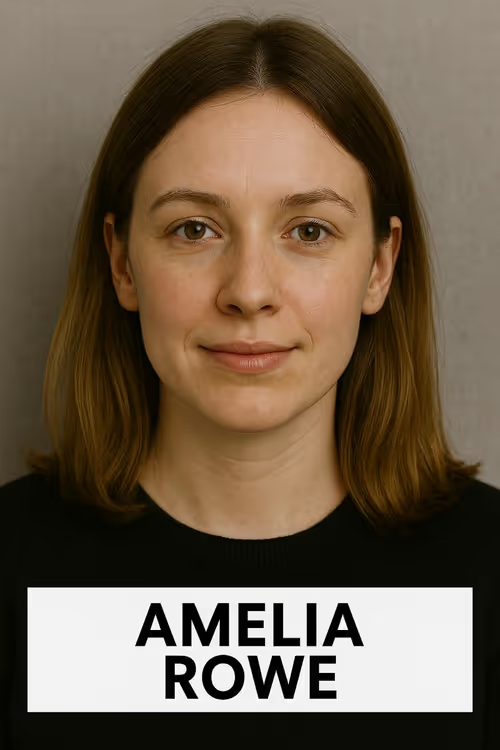
Written by
Amelia Rowe
Senior correspondent · Banking & Economy
Amelia spent eight years inside a sovereign wealth fund before deciding she'd rather write about institutional money than allocate it. She covers central banking, insurance, and the macro decisions that quietly choose which markets get the next decade. Sharp on monetary policy; impatient with anyone who confuses noise with signal. Based in London. Reach out at amelia.rowe@theplatinumcapital.com.