

Parametric Insurance: A New Approach to Risk Transfer
Parametric insurance is reshaping the architecture of risk transfer, offering sophisticated investors and sovereign entities a mechanism that settles claims based on predetermined triggers rather than assessed losses, eliminating the friction and opacity that have long undermined confidence in traditional indemnity models. For family offices and government treasuries navigating an era of compounding climate volatility and systemic uncertainty, this instrument represents not merely an insurance product but a strategic financial tool capable of delivering liquidity with the precision and speed that legacy structures have consistently failed to provide.…

When Cyclones Fytia and Gezani tore through Madagascar in February 2026, the government did not wait months for loss assessors, bureaucratic disbursements, or donor conferences. Within days, $29 million was flowing toward recovery efforts — triggered not by claims paperwork, but by rainfall data, hydrological models, and a parametric insurance contract signed just weeks earlier. That speed is not an anomaly. It is the entire point. Parametric insurance is rapidly redefining how sovereign governments, institutional investors, and private wealth holders transfer risk — and for markets across the Gulf, Africa, and Southeast Asia, the implications run deep.
What Parametric Insurance Actually Does Differently
Traditional indemnity insurance pays out based on verified losses. That process is slow, dispute-prone, and often breaks down entirely in regions where loss assessment infrastructure barely exists. Parametric insurance works differently. It pays when a predefined trigger is hit — a wind speed threshold, a rainfall index, a seismic measurement, a crop yield figure derived from satellite data. No claims adjuster. No negotiation. The payout is automatic, transparent, and often deposited within 30 days of the triggering event.
For high-net-worth individuals with significant asset exposure in emerging markets — agricultural estates in East Africa, coastal real estate in Southeast Asia, energy infrastructure across the Gulf — that structure offers something indemnity insurance rarely can: certainty of timing. When a cyclone strikes, liquidity matters far more than the eventual size of a settlement that may arrive 18 months later. Parametric products address that gap directly. The global parametric insurance market was valued at approximately $11.7 billion in 2023 and is projected to exceed $29 billion by 2031, driven largely by climate volatility and sovereign demand in emerging economies. That is a significant shift, and most private wealth managers in the Gulf have yet to fully register it.
Africa's Sovereign Breakthrough and the Madagascar Moment
The contract signed by the Republic of Madagascar with the African Risk Capacity in January 2026 was not simply a policy. It was the first sovereign parametric flood insurance product ever deployed on the African continent. Developed in close collaboration with JBA Risk Management, the structure relied on advanced hydrological modelling and scientific rainfall data to define trigger thresholds with precision. When the cyclones arrived, the mechanism performed exactly as designed.
Dr. Jean Chrysostome Ngabitsinze, Director General of the ARC Group, put it plainly: this represented a shift "from a reactive approach to one centred on anticipation." For investors and family offices with exposure to African sovereign debt, agricultural supply chains, or development finance instruments, that distinction carries real material weight. Governments that can finance disaster recovery rapidly are governments that hold their fiscal line — reducing the risk of emergency borrowing, budget reallocation, or delayed infrastructure spend that can quietly damage private investment returns across an entire economy. Few outside the region have connected those dots. They should.
ARC's ambitions extend further. Its Re-Takaful WAQF Facility — announced at the 7th Global Takaful and Re-Takaful Forum in Dubai and recognised with the Resilient Re-Takaful Finance Innovator Award — signals a deliberate effort to ensure Islamic-compliant structures are not left behind in the parametric shift. The ARC ReTak facility is specifically designed to ensure no community is excluded from climate resilience financing, a mandate with direct relevance for Muslim-majority populations across the Sahel, East Africa, and beyond.
Takaful's Climate Reckoning and the Rating Agency Signal
The integration of parametric mechanisms into the takaful sector is accelerating. The rating agencies are paying close attention. At the 14th International Takaful Summit, scheduled for 30 June to 2 July 2026 in London, Mahesh Mistry — Senior Director and Head of Analytics at AM Best's London office — will present a session titled "Credit Rating View on Sustainability, Climate Change and Corporate Social Responsibility within (Re)Takaful." The session will examine how climate change is reshaping the re-takaful model and what sustainability considerations now mean for long-term financial strength assessments.
This is not a peripheral conversation. AM Best is explicitly integrating ESG factors — climate event exposure, social inequality, governance quality — into its Best's Credit Rating Methodology. For GCC-based takaful operators, that represents a meaningful recalibration. Shariah-compliant insurers in Saudi Arabia, the UAE, Bahrain, and Qatar are now being evaluated not only on underwriting performance and surplus ratios, but on the robustness of their climate risk frameworks. The numbers tell a complicated story. Operators that have invested in parametric product capabilities and data-driven trigger design are likely to find themselves better positioned in future rating cycles. Those that have not are facing a competitive disadvantage they may not yet have priced in — a dynamic that sophisticated investors in the sector need to factor into portfolio assessments now, not later.
Application for Private Wealth and Family Offices
Parametric insurance is no longer a tool reserved for sovereign governments or multilateral development banks. Structuring has become sufficiently sophisticated that family offices, agricultural conglomerates, and private infrastructure owners can now access bespoke parametric covers across multiple asset classes. In Southeast Asia, rice and palm oil producers in Vietnam, Indonesia, and Thailand are increasingly using index-based agricultural insurance linked to satellite-derived vegetation indices — removing the subjectivity that made traditional crop insurance difficult to price and even harder to claim.
For Gulf-based family offices with diversified holdings across emerging markets, the strategic relevance runs in two directions. Parametric structures can provide direct balance sheet protection for operating assets in climate-exposed regions, delivering liquidity precisely when it is needed most. But the instruments themselves are also becoming an investable asset class. Insurance-linked securities — catastrophe bonds and parametric notes — offer yields that are largely uncorrelated with equity and credit markets, making them an attractive diversification tool for portfolios in the $50 million to $500 million range. Several Dubai and Riyadh-based family offices have already begun allocating to ILS funds. That trend is expected to accelerate as Gulf wealth managers build specialist capabilities in this space. The early movers will have a structural advantage.
The Road Ahead: Data, Trust, and Market Depth
The primary constraint on parametric insurance growth is not demand. It is data quality and trust in trigger design. In markets where historical weather records are incomplete or satellite coverage is inconsistent, basis risk remains a genuine challenge — the possibility that a payout does not occur despite real losses being suffered, or that it does occur when losses are minimal. Closing that gap requires sustained investment in hydrological modelling, partnerships with institutions such as JBA Risk Management, and regulatory frameworks that encourage product innovation without exposing policyholders to opaque trigger structures.
Governments in Central Asia — Kazakhstan and Uzbekistan in particular, both facing significant agricultural and flood risk — and across the GCC are increasingly in dialogue with multilateral institutions about developing sovereign parametric frameworks similar to what ARC has pioneered in Africa. The direction of travel is clear. Parametric insurance is moving from niche instrument to structural feature of climate-resilient capital allocation. Those who understand its mechanics today will be better placed to protect assets, access new yield sources, and advise the institutions that are only now beginning to ask the right questions.
Written by
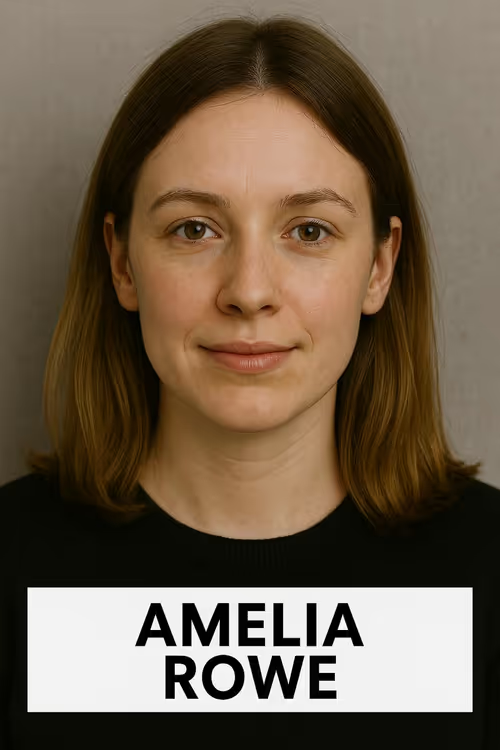
Amelia Rowe
Senior correspondent · Banking & Economy
Amelia spent eight years inside a sovereign wealth fund before deciding she'd rather write about institutional money than allocate it. She covers central banking, insurance, and the macro decisions that quietly choose which markets get the next decade. Sharp on monetary policy; impatient with anyone who confuses noise with signal. Based in London. Reach out at amelia.rowe@theplatinumcapital.com.