Abu Dhabi Securities Exchange: The Quiet Outperformer
While global markets wrestled with volatility and uncertainty, Abu Dhabi Securities Exchange delivered a masterclass in resilience, anchored by sovereign-backed heavyweights and a regulatory framework that has quietly earned the confidence of the world's most discerning institutional capital. For family offices and sovereign wealth managers reassessing their emerging market exposure, ADX represents not merely a regional opportunity but a structurally sound, increasingly liquid gateway to one of the planet's most strategically positioned economies.…

Tadawul commands the headlines. Dubai's markets toast trillion-dirham milestones. And through all of it, the Abu Dhabi Securities Exchange has been doing something quieter and, arguably, more consequential — building architecture. ADX is not the loudest exchange in the Gulf. It is increasingly one of the most important. For family offices, private investors, and sovereign-adjacent capital allocators watching this region with serious intent, Abu Dhabi's bourse deserves far more than a footnote.
A Market That Doesn't Need to Shout
ADX closed Q1 2026 with foreign investors accounting for 47.5% of total trading value. For any emerging market exchange, that number demands attention. For one that rarely courts the international financial press, it is remarkable. This is not retail-driven noise. The foreign participation skews heavily institutional — sovereign wealth funds, family offices with Gulf mandates, long-horizon asset managers who prize depth over dynamism. Market capitalisation now sits comfortably above Dh2.7 trillion, anchored by First Abu Dhabi Bank, International Holding Company, and ADNOC's constellation of subsidiaries, each representing a distinct vertical of Abu Dhabi's economic diversification strategy.
What separates ADX from its GCC peers is not size alone. It is the quality of what sits underneath. Many of the exchange's largest listed entities connect, directly or indirectly, to Abu Dhabi's sovereign ecosystem. That connection carries an implicit stability premium. For investors who have spent years watching emerging market equities whipsaw on geopolitical noise, that premium is not theoretical. It is pricing itself into long-term allocation decisions right now.
The Foreign Flow Story: More Than a Regional Trade
The broader GCC equity trend in early 2026 has been sharply positive. Net foreign buying across the region reached $1.47 billion in Q1 2026 — a dramatic reversal from the $313.5 million in net selling recorded in Q4 2025. Saudi Arabia led on headline numbers with $2.6 billion in net foreign inflows, partly driven by Riyadh's February 2026 decision to fully open the Tadawul Main Market to all categories of foreign investors, scrapping the old Qualified Foreign Investor framework entirely. That is a significant structural shift.
Some analysts assumed Tadawul's liberalisation would divert capital away from ADX. The opposite appears to be happening. Investors who enter the Gulf through Saudi Arabia's newly accessible front door tend to expand into Abu Dhabi within twelve to eighteen months — once they start mapping the ADNOC ecosystem, FAB's pan-African and Asian banking ambitions, or IHC's sprawling conglomerate structure. The two markets are growing more complementary in the minds of sophisticated allocators, not more competitive.
IHC, ADNOC, and the Listings That Reshaped the Exchange
Abu Dhabi has engineered its own market depth. Deliberately. The 2023 IPO of ADNOC Gas raised approximately $2.5 billion and brought an entirely new class of energy-focused institutional investor into the ADX ecosystem. ADNOC Logistics & Services followed the same playbook that same year. These were not privatisations of convenience. They were carefully sequenced listings designed to create sector clusters on the exchange that mirror the emirate's own economic priorities: energy transition, logistics, financial services, technology infrastructure.
Then there is IHC. Chaired by Sheikh Tahnoon bin Zayed Al Nahyan, International Holding Company remains the exchange's most closely watched bellwether. Its portfolio spans food, healthcare, real estate, and financial services across emerging markets from Africa to Southeast Asia. For investors in Nairobi, Lagos, Jakarta, or Tashkent who track where Gulf conglomerate capital moves, IHC's ADX listing functions as both a barometer and a roadmap. Its cross-border acquisitions have drawn parallel interest in ADX from investors in those same markets, who read the listing as a proxy for Gulf-led emerging market consolidation. Few outside the region have fully grasped that dynamic. They should.
Dubai's Milestone and What It Means for Abu Dhabi
The Dubai Financial Market crossed the Dh1 trillion market capitalisation threshold in early 2026, its General Index reaching 6,115.97 points. The milestone generated significant regional attention. A preliminary US-Iran peace agreement reduced geopolitical risk premiums across UAE-listed assets broadly, and DFM caught much of that tailwind. Foreign investors represented 54% of total trading value on DFM in Q1 2026. More telling: they accounted for 79% of new investor registrations — a clear signal that international participants are treating Dubai as a point of entry into UAE equities generally.
The numbers tell a complicated story for ADX. Dubai and Abu Dhabi run distinct exchanges under distinct regulatory frameworks. But investors based outside the region increasingly perceive them as a unified UAE capital markets offering. A family office in Kuala Lumpur or a high-net-worth investor in Casablanca researching UAE equities is unlikely to allocate to DFM while ignoring ADX. Dubai's milestone has raised the profile of UAE equities as an asset class. ADX collects directly on that.
What Sophisticated Investors Are Watching in 2026 and Beyond
Three dynamics deserve close attention from private investors and family offices considering ADX exposure right now. The exchange's derivatives market is expanding — growing institutional use of equity futures is improving ADX's risk management infrastructure in ways that make it accessible to larger, more sophisticated pools of capital. Simultaneously, ADX's push to attract non-UAE listings, particularly from Central Asia and Africa, is gradually broadening sector diversity beyond the current concentration in energy and financial services.
The third dynamic is the most consequential, and the least discussed. Abu Dhabi's continued capital deployment through Mubadala, ADQ, and ADIA into global markets — Vietnam, Indonesia, Egypt, Morocco — is generating a reciprocal effect. As Abu Dhabi's sovereign capital becomes a significant shareholder in companies across those markets, the managers of capital in those same countries grow increasingly motivated to understand ADX as an investment destination in return. Sovereign money flows out. Private and institutional money flows in. That two-way relationship is the quiet engine beneath ADX's steady ascent.
Investors who prefer to be early rather than fashionable will recognise what ADX continues to offer: structural depth, sovereign-grade anchor listings, and the kind of long-term institutional commitment that turns a bourse from a trading venue into a genuine store of value. The headline this quarter may belong to Riyadh or Dubai. The architecture belongs to Abu Dhabi.
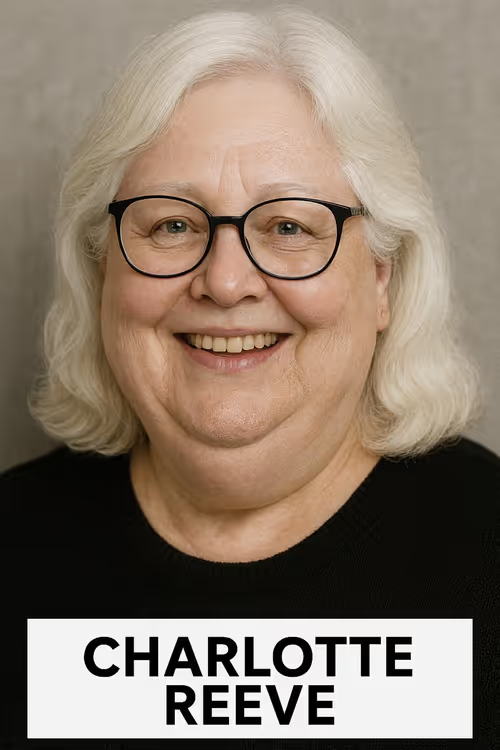
Written by
Charlotte Reeve
Senior correspondent · Capital Markets & Fintech
Charlotte cut her teeth on an equities desk before moving to the other side of the notebook. She covers capital markets, stock exchanges, and the fintech operators trying to disintermediate the banks that trained her. Sharpest on market microstructure and payments infrastructure; still reads a prospectus for fun. Based in Singapore. Reach out at charlotte.reeve@theplatinumcapital.com.