Tadawul Performance Drivers: Beyond Oil and Banks
As Saudi Arabia's capital markets mature beyond their hydrocarbon foundations, discerning investors are discovering that the real alpha on Tadawul lies in the structural transformation of sectors long overlooked — from healthcare and logistics to entertainment and technology — each quietly rewired by Vision 2030 spending mandates and a demographic dividend that demographers estimate will peak within this decade. Charlotte Reeve examines the nuanced performance architecture of the exchange, revealing how sophisticated allocators within family offices and sovereign vehicles are repositioning capital ahead of the next phase of Saudi Arabia's economic re-engineering.…

For years, the Tadawul All Share Index was shorthand for two things: the price of crude and the health of Saudi banking. That reading was never wrong, exactly — but it was always incomplete. In 2026, with the kingdom's capital markets undergoing their most significant structural transformation in a generation, that shorthand is becoming genuinely obsolete. Power infrastructure, education, construction, healthcare, and mining — sectors that rarely made headlines outside Riyadh — are drawing a different class of investor. And they are arriving with serious capital.
The Foreign Investor Signal
The numbers from early 2026 are not subtle. In January alone, foreign investors were net buyers of approximately SR5 billion — roughly $1.33 billion — the strongest single month of foreign buying since 2022. That surge came in direct anticipation of February 1, 2026, when Saudi Arabia's Capital Market Authority formally removed the Qualified Foreign Investor framework, opening the Tadawul Main Market to all categories of foreign participants without restriction. By late January, foreign-held shares had climbed to approximately $124.1 billion, representing nearly 13% of free-floating shares — the highest proportion since Saudi Aramco's landmark IPO in 2019.
That is a significant shift. By the end of May 2026, total foreign holding value stood at SAR 457.18 billion, with average daily value traded running at SAR 5.73 billion. These are not speculative flows chasing momentum. They reflect a deliberate repositioning by sovereign wealth funds, family office allocators, and private capital managers from the Gulf, Central Asia, and Southeast Asia — institutions that have been watching Tadawul's diversification story build for several years and are now acting on it with conviction.
The IPO Pipeline as a Sector Map
Foreign inflows tell you something about sentiment. The IPO pipeline tells you something more precise: where Saudi Arabia's private economy is actually generating value.
The CMA had 40 IPO applications under active review heading into 2026, with execution targets of 20 to 30 listings across the year. The sector spread — energy, healthcare, financial services, real estate, and mining — reflects a private sector that has matured well beyond its historical dependence on government contracts and petrochemical cycles. Six companies received CMA approval in early January 2026 alone: Saleh Abdul Aziz Al-Rashed & Sons Co., Alromansiah Co., Alandalus Education Co., Aldyar Alarabiya Co., Dar Albalad Business Solutions Co., and Mutlaq Al-Ghowairi Contracting Co. Education and business solutions sitting alongside legacy contracting and property names — that combination speaks directly to Vision 2030's influence on where domestic capital is being directed and which family-owned enterprises are choosing public markets as their next stage of growth.
One listing deserves particular attention from investors tracking infrastructure plays: Power Tower Company. The Saudi specialist in power transmission, substations, and renewable energy infrastructure announced plans in February 2026 to list on Tadawul's main market, appointing Yaqeen Capital as financial advisor and lead manager. PTC sits at the intersection of two of the kingdom's most capital-intensive priorities — grid modernisation and renewable deployment. For investors seeking exposure to Saudi Arabia's energy transition without carrying upstream oil risk, companies of this profile represent a structurally different proposition. Not a trade. A thesis.
Construction and Engineering: A New Market Category
Tadawul does not exist in isolation. Across the Gulf, construction and engineering companies are emerging as a distinct investable category rather than a footnote inside real estate. The Dubai Financial Market's welcome of ALEC Holdings PJSC — the UAE's largest-ever construction sector IPO — demonstrated the appetite that exists for well-managed, project-diversified engineering groups when they come to market with credible governance and dividend frameworks. ALEC's DFM debut set a reference point that Tadawul-listed peers are now being measured against.
For family offices and private investors who have historically viewed construction stocks as cyclical and opaque, the move toward regulated listings with transparent project portfolios and committed dividend policies changes the calculus. It converts an asset class once accessible largely through private placements or direct project co-investments into something that can sit cleanly alongside listed equities in a managed portfolio. The Gulf's megaproject pipeline — NEOM, Red Sea Project, Abu Dhabi's infrastructure expansion — means order books for the best-capitalised operators remain deep and visible several years forward. That kind of revenue visibility is rare anywhere.
Beyond the GCC: What Cross-Border Investors Are Watching
Few outside the region have fully registered this next point. They should.
Sophisticated allocators from Kazakhstan, Nigeria, Indonesia, and Vietnam who have been building Gulf equity exposure are increasingly looking past the headline index constituents. The real diversification story on Tadawul is playing out in the mid-cap and small-cap tiers. The Nomu parallel market, which operates under lighter listing requirements and supports emerging growth companies, has become a genuine entry point for smaller private firms — particularly in healthcare services, technology-adjacent businesses, and specialised manufacturing — that would not have considered public markets five years ago.
For investors in these regions, Tadawul offers something relatively rare: a large, liquid, regulated exchange in a jurisdiction with strong sovereign fundamentals, active state investment backing through the Public Investment Fund, and a clear multi-decade economic transformation programme. That combination is not easily replicated in most emerging markets. The honest comparison set for Saudi Arabia, in capital market terms, is increasingly South Korea or pre-liberalisation India — not the regional peer group.
What Comes Next for Positioned Capital
The 2026 IPO wave will not be uniform in quality. Among 20 to 30 potential listings, some will price aggressively and underperform post-lock-up. That is the nature of any active pipeline. Others — particularly those in power infrastructure, specialist healthcare, and mining — will attract long-term institutional anchors who provide price stability and signal genuine fundamental interest. For family offices and private investors building positions in Tadawul beyond the obvious banking and petrochemical names, sector selection and timing relative to the IPO calendar will be the primary drivers of alpha. The index won't tell you that. Knowing the pipeline will.
The broader read from early 2026 is that Tadawul has completed its transition from a domestic, oil-correlated market to an exchange with genuine cross-sector depth and international credibility. The foreign ownership data confirms this is not a local narrative being dressed up for export. Capital from the Gulf, Central Asia, Africa, and Southeast Asia is arriving with a longer time horizon and a cleaner thesis than the speculative flows that defined earlier periods of market openness. For investors who understand that the most interesting opportunities on any exchange are rarely the most obvious ones, Saudi Arabia's non-oil, non-bank sectors deserve serious attention now — not after the next wave of listings has already priced.
Written by
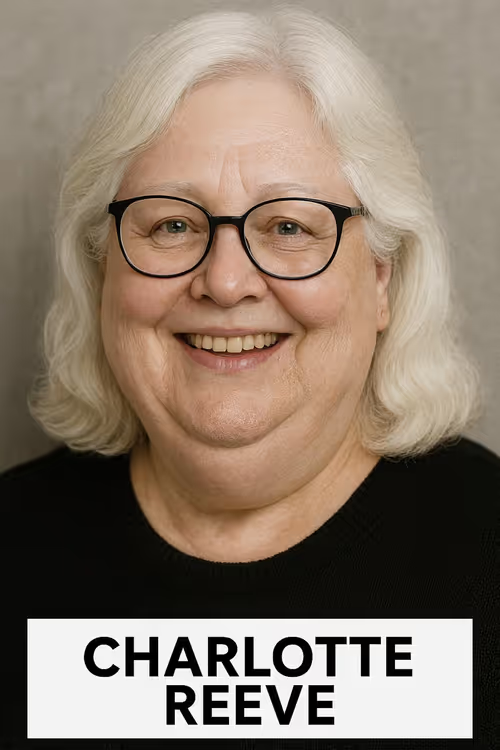
Charlotte Reeve
Senior correspondent · Capital Markets & Fintech
Charlotte cut her teeth on an equities desk before moving to the other side of the notebook. She covers capital markets, stock exchanges, and the fintech operators trying to disintermediate the banks that trained her. Sharpest on market microstructure and payments infrastructure; still reads a prospectus for fun. Based in Singapore. Reach out at charlotte.reeve@theplatinumcapital.com.