Lithium and Cobalt: The Battery Metal Supply Chain Exposed
As the global race to electrify transportation and power grids accelerates, the concentrated geography of lithium and cobalt reserves — spanning the lithium triangle of South America to the politically volatile corridors of the Democratic Republic of Congo — presents both extraordinary opportunity and systemic risk for those positioning capital in the energy transition. Understanding who controls the extraction, refining, and distribution chokepoints of these critical metals is no longer a matter of portfolio optimization alone, but a geopolitical imperative for institutional investors and sovereign decision-makers alike.…

The world's appetite for battery metals has never been more consequential — nor more precarious. As electric vehicle adoption climbs from Riyadh to Jakarta and the energy transition shifts from policy ambition to industrial reality, the supply chains underpinning lithium and cobalt have become one of the defining strategic fault lines of the mid-2020s. For family offices, sovereign-adjacent investors, and private capital allocators across the Gulf, Central Asia, and Southeast Asia, knowing where these metals come from — and who controls the chokepoints — is no longer a matter of intellectual curiosity. It is foundational to serious long-term portfolio construction.
A Supply Chain Built on Fragile Foundations
Lithium and cobalt are not rare in a geological sense. What makes them strategically dangerous is the extreme geographic concentration of their extraction and processing. Roughly 60% of the world's cobalt originates in the Democratic Republic of Congo, where artisanal mining conditions remain deeply unstable and Chinese offtake agreements — structured largely through entities connected to CMOC Group and Zhejiang Huayou Cobalt — have locked up the majority of bankable output for the better part of a decade. Lithium production, meanwhile, sits with the so-called Lithium Triangle of Argentina, Bolivia, and Chile, alongside Australia's hard-rock spodumene operations. China controls approximately 70% of global lithium chemical refining capacity. That means lithium mined in Australia frequently passes through Chinese processing before it ever reaches battery manufacturers in South Korea, Japan, or Europe.
The numbers tell a complicated story. The International Energy Agency estimates that lithium demand will need to increase by a factor of six by 2040 to meet net-zero scenarios, while cobalt demand could double within the same timeframe. Supply is expanding at a fraction of that pace — strangled by permitting delays, capital discipline, and the sheer technical complexity of bringing new mines to commercial production. The gap between what the world needs and what it can reliably produce is widening. Quietly, but unmistakably.
The Gulf's Strategic Pivot Into Battery Metals
The UAE's dramatic exit from OPEC on May 1, 2026 — ending a 59-year membership — sent a signal far beyond crude oil markets. ADNOC's decision to pump 4.1 million barrels per day in June against a former quota ceiling of 3.4 million was not merely a production story. It was a declaration that Abu Dhabi intends to manage its hydrocarbon wealth on its own terms, and to deploy that capital into the next generation of energy infrastructure — battery supply chains included. ADNOC's $150 billion investment programme, reaffirmed in late 2025, carries explicit downstream diversification components, several of which touch directly on critical minerals processing and battery-grade chemical production.
Saudi Arabia's position is equally instructive. The reopening of the Ras Tanura terminal on June 29, 2026 — the world's largest oil export port, shuttered since early March following the Strait of Hormuz disruption — exposed just how catastrophically vulnerable hydrocarbon-dependent economies remain to geopolitical shock. Saudi crude exports had fallen from over 7 million barrels per day in February to approximately 4 million during the closure. The IEA estimated cumulative supply losses across Middle Eastern producers exceeded 1.3 billion barrels. That interruption hardened the case, in Riyadh's investment community, for diversifying into metals and minerals that travel by land and rail rather than through vulnerable maritime chokepoints. The logic is difficult to argue with.
Central Asia and Africa: The Undercapitalised Opportunity
Two regions are drawing sustained attention from sophisticated investors. Few outside specialist circles have fully priced the opportunity. They should.
Kazakhstan, already among the world's top uranium producers, holds substantial lithium brine deposits that have attracted exploratory interest from European and South Korean industrial groups. Uzbekistan's state-owned mining conglomerate Uzmetkombinat has been quietly expanding its base metals processing capacity as Tashkent positions itself as a minerals corridor between China and European offtakers seeking supply chain alternatives. Neither country features prominently in mainstream commodity coverage. That gap is exactly where private investors operating with longer time horizons and direct-deal capabilities can move first.
Africa is more complex, but the structural shifts are real and accelerating. Zimbabwe holds the world's fifth-largest lithium reserves. In 2025, the government completed a phased ban on raw lithium ore exports, forcing value-added processing onshore — a move that has simultaneously drawn investment inquiries from Gulf sovereign vehicles and Chinese battery manufacturers. Morocco, already a dominant phosphate player through OCP Group, is actively building its position as a future node in the battery materials value chain, leveraging proximity to European automotive manufacturers and established chemical processing infrastructure. For family offices with operational experience in African markets, these are not speculative themes. They are investable industrial transitions with identifiable counterparties on both sides of the deal.
Who Controls the Processing Matters More Than Who Owns the Mine
This is the point that most generalist investors miss entirely. Mine ownership is only part of the value equation. The real margin — and the real strategic leverage — sits in chemical processing: converting spodumene into lithium hydroxide, or cobalt ore into battery-grade cobalt sulphate. China's dominance at this stage reflects two decades of patient industrial policy, subsidised energy, and offtake agreements that Western and Gulf-based investors were simply too slow to match. That advantage does not disappear overnight.
But the effort to close that gap is now state-sponsored across multiple jurisdictions. The European Union's Critical Raw Materials Act, which entered into force in 2024, sets binding domestic processing targets for strategic minerals. South Korea's POSCO Holdings has committed over $4 billion to lithium processing operations across Argentina and Australia. Indonesia — already the world's dominant nickel producer — is executing an explicit strategy to become a fully integrated battery supply chain hub, from raw ore through to cell assembly, with CATL and LG Energy Solution both having committed manufacturing capacity to the archipelago. That is a significant shift. For Gulf or Central Asian investors seeking co-investment entry points, these anchor industrial relationships offer structurally de-risked access to a supply chain being actively rebuilt outside Chinese control.
What Sophisticated Investors Should Be Watching Now
The battery metals thesis is not a trade. It is a decade-long industrial repositioning, with compounding returns available to those who move before the consensus does.
For private investors and family offices with USD 50 million or more in deployable capital, the most actionable positions currently involve direct equity stakes in mid-tier lithium and cobalt developers in politically manageable jurisdictions — Morocco, Namibia, Argentina's Jujuy province, and Western Australia's Pilbara region among the most compelling. Streaming and royalty structures, which provide commodity price upside without operational exposure, are increasingly available as junior miners face capital constraints that major institutions refuse to fill. Chemical processing joint ventures — particularly those structured with offtake guarantees from South Korean or Japanese battery manufacturers — offer returns that are partially de-correlated from spot metal prices. That combination of yield visibility and commodity optionality is rare.
The broader lesson of the Strait of Hormuz closure applies with equal force to battery metals. Supply chain concentration is a systemic risk. And systemic risks, when they crystallise, do not discriminate by asset class. The 1.3 billion barrels of lost Middle Eastern supply was a reminder of what happens when geography and geopolitics collide without a hedge in place. The investors who act now — while pricing still reflects scepticism rather than urgency — will be the ones defining the next generation of critical minerals wealth. The window exists. It will not stay open indefinitely.
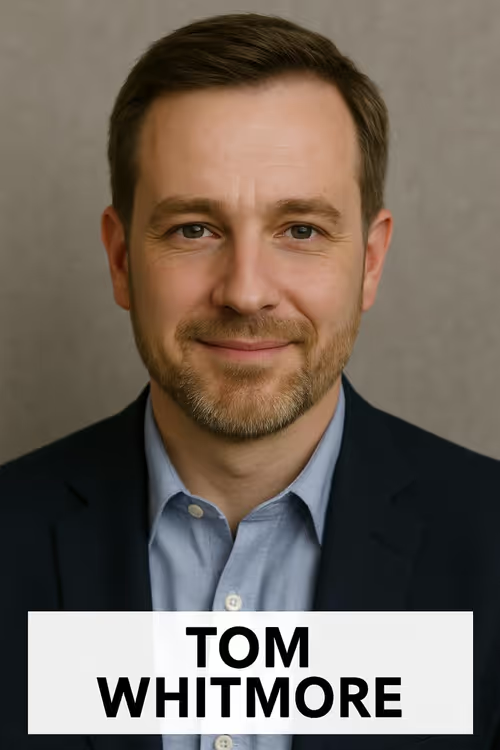
Written by
Tom Whitmore
Senior correspondent · Real Estate & Private Companies
Tom has interviewed most of the operators reshaping the Gulf skyline — and a few of the ones who tried and didn't. His beat is real estate, commodities, manufacturing, and the founder-led private companies that never bother to list. He knows which buildings and balance sheets survive a downturn before the spreadsheet does. Based in Dubai. Reach out at tom.whitmore@theplatinumcapital.com.