Family Office Direct Deals: Why the Gulf Prefers Ownership
Gulf family offices are increasingly bypassing traditional fund structures in favor of direct ownership stakes, driven by a generational shift toward control, legacy building, and the desire to embed wealth into tangible, strategically significant assets. This preference reflects not merely a financial calculus but a deeply cultural conviction that true prosperity is measured in what you own outright, not what you hold through an intermediary.…

When Abu Dhabi's MGX closed its debut artificial intelligence fund at $49 billion on July 1 — four billion dollars above its original target — the headline number was almost beside the point. The real signal was structural. The Gulf's wealthiest families and sovereign-linked vehicles are done being passive allocators. They want the asset. They want the board seat. They want the name on the door.
The Shift From Allocation to Ownership
For decades, the conventional model for Gulf wealth — sovereign, quasi-sovereign, or privately held — was simple enough. Capital flowed into blue-chip fund managers in New York and London, who deployed it across global portfolios and returned distributions years later. That model served its purpose during an era of capital accumulation. It no longer satisfies a generation of principals who have watched their peers in the United States and Europe build lasting institutional influence through direct control of assets. The patience has run out.
The shift is most visible at the institutional end. MGX — chaired by Sheikh Tahnoon bin Zayed Al Nahyan, Deputy Ruler of Abu Dhabi and the emirate's National Security Adviser — did not merely write cheques into AI funds. It co-led Anthropic's $30 billion raise in February 2026 and anchored OpenAI's $122 billion round in March. It joined the $40 billion consortium acquiring Aligned Data Centres. These are not portfolio positions. They are ownership stakes in the companies defining the next economic era, pursued with the precision and aggression of a private equity firm operating at sovereign scale. That is a qualitatively different posture.
What MGX does at the top of the market, Gulf family offices are replicating at their own scale. The logic is identical: own the asset directly, capture the full value creation cycle, retain governance rights, and eliminate the fee drag and opacity that come with intermediated fund structures. Why pay someone else to build someone else's legacy?
Why Direct Deals Suit the Gulf Temperament
The preference for direct ownership is not purely financial. It is cultural, strategic, and — for many prominent Gulf families — generational. Family office principals across Dubai, Riyadh, Doha, and Abu Dhabi describe the same frustrations with traditional fund investing: the loss of information flow, the inability to influence operational decisions, the difficulty of connecting financial returns to visible, legacy-building outcomes.
Direct deals solve all three simultaneously. A Kuwaiti family deploying $50 million directly into a regional healthcare platform knows its executives, reviews its quarterly figures, and can point to clinics bearing its investment as evidence of tangible economic contribution. That visibility matters. A Saudi family office that takes a direct stake in a GCC-focused education group is building an asset that may employ hundreds of compatriots and align with Vision 2030 priorities — a consideration that carries real weight when family reputation and government relationships are deeply intertwined.
CedarBridge Capital Partners, currently deploying capital from its third vehicle, CedarBridge High Growth III, has built its entire model around this dynamic. The $150 million fund — which completed its first close in late 2025 and is targeting final close before year-end 2026 — focuses on platform investments in education, healthcare, and consumer services across the GCC, with up to 35 percent of capital earmarked for complementary opportunities in the UK and Europe. Its portfolio already includes Kids First Group, the largest early childhood education provider in the UAE, and The Grooming Company Holding, a globally scaled beauty services operator. These are not passive positions. CedarBridge builds operating platforms — exactly the kind of structure that resonates with Gulf family investors who want recurring revenue, operational influence, and genuine sector expertise rather than financial engineering dressed up as strategy.
The Architecture of a Modern Gulf Family Office Deal
Anyone who assumes Gulf families structure direct investments the way institutional private equity does is working from the wrong map. The reality is considerably more bespoke. A typical mid-market direct deal in the GCC — sized between $20 million and $150 million — often begins not with a formal fund pitch but with a relationship. A trusted intermediary, a co-investor introduction through a majlis network, or a referral from a shared adviser brings the opportunity to the principal's attention. Due diligence moves at a speed that would alarm a conventional LP, but with depth that reflects the principal's direct industry knowledge. The process looks informal to outsiders. It rarely is.
Deal structures increasingly favour co-investment alongside specialist managers rather than purely independent deals. This gives family offices access to proprietary deal flow and sector expertise while they retain meaningful direct exposure and governance rights. The emergence of GCC-EU investment corridors — a structural feature of CedarBridge's latest fund — reflects the growing sophistication of Gulf families who hold operating businesses in both regions and want investment vehicles that bridge those ecosystems, not force an either-or allocation decision.
Across the Gulf, family office teams are professionalising at pace. Principals who managed wealth through a single trusted adviser a decade ago now operate with dedicated investment committees, in-house legal counsel, and sector-specific deal origination capabilities. In Riyadh, Dubai, and increasingly in Manama and Muscat, family offices are quietly recruiting talent from bulge-bracket banks and global asset managers — not to replicate institutional processes, but to sharpen direct deal execution. The war for that talent is already underway.
Regional Ripple Effects: From Kazakhstan to Nairobi
The Gulf's pivot toward direct ownership is reshaping deal flow well beyond the Arabian Peninsula. Few outside the region have tracked this carefully. They should. Family offices based in Abu Dhabi and Dubai have become consequential direct investors in Central Asian markets — particularly Kazakhstan and Uzbekistan, where infrastructure, agribusiness, and financial services are attracting patient Gulf capital from principals comfortable with illiquidity premiums and long investment horizons. In Africa, Gulf family capital is surfacing directly in Kenyan fintech platforms, Nigerian consumer businesses, and Egyptian logistics operators, typically through bilateral relationships rather than fund intermediation.
The numbers tell a complicated story, but the logic is straightforward. Gulf families with cross-border commercial histories in trading, construction, logistics, and real estate are more willing to underwrite emerging market risk than their Western institutional counterparts. They have operated in ambiguous regulatory environments before. They understand the value of a well-placed local partner. And they recognise that direct ownership in high-growth markets, held patiently over a seven-to-ten year horizon, can generate the kind of compounded wealth and institutional influence that no fund allocation ever will.
What This Means for the Next Five Years
The trajectory is clear. Direct and co-investment deals will account for a steadily growing share of total deployed capital across Gulf family offices — at the expense of traditional blind-pool fund commitments. For wealth principals evaluating their own structures, the most immediate implication is operational. Direct deal capability requires investment in people, process, and relationships that cannot be acquired overnight. Families that begin building those capabilities now — whether by hiring experienced deal professionals, partnering with specialist regional managers, or joining structured co-investment syndicates — will hold decisive advantages as deal flow in the GCC, Africa, and Central Asia accelerates.
The Gulf does not merely want exposure to the next wave of global value creation. It wants ownership of it. That distinction will define which families emerge from this decade having built institutions — and which remain, however wealthy, as spectators to someone else's legacy.
Written by
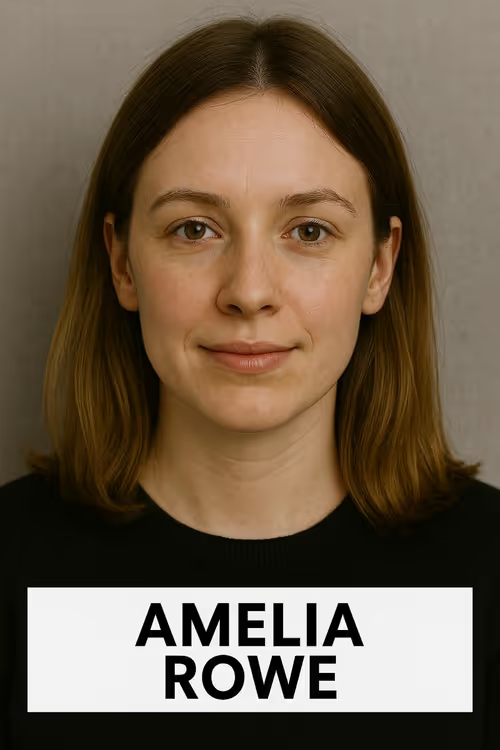
Amelia Rowe
Senior correspondent · Banking & Economy
Amelia spent eight years inside a sovereign wealth fund before deciding she'd rather write about institutional money than allocate it. She covers central banking, insurance, and the macro decisions that quietly choose which markets get the next decade. Sharp on monetary policy; impatient with anyone who confuses noise with signal. Based in London. Reach out at amelia.rowe@theplatinumcapital.com.