
Islamic Finance Growth: Beyond the Gulf
Islamic finance is no longer a regional phenomenon confined to the oil-rich corridors of the Gulf Cooperation Council — it has evolved into a sophisticated, trillion-dollar asset class reshaping capital markets from Kuala Lumpur to London, attracting institutional mandates that rival the most established conventional financial instruments. For discerning investors and sovereign wealth strategists seeking ethical yield, structural resilience, and access to the fastest-growing consumer economies on earth, the global expansion of Shariah-compliant finance represents not merely an alternative allocation, but an increasingly indispensable pillar of modern portfolio architecture.…

For decades, Islamic finance was treated as a regional product — a financial system rooted in Quranic principle, useful within the Gulf and parts of Southeast Asia, but unlikely to travel far beyond its cultural heartland. That assumption is now being dismantled, deal by deal, market by market. In 2026, Islamic finance is not simply expanding. It is redefining where serious capital moves and how it gets there. From Almaty to Nairobi, from Jakarta to Sarajevo, Sharia-compliant instruments are attracting investors who carry no religious obligation to use them — only a financial incentive.
A System Built for This Moment
Islamic finance has always carried structural characteristics that happen to perform well when conventional markets are under stress. The prohibition on interest, the requirement for asset-backed transactions, the principle of risk-sharing between parties — together, these create a system that leans toward stability precisely during the credit cycles that punish leverage hardest. With interest rate volatility still unresolved across major Western economies in 2026, and with institutional capital increasingly attentive to ESG-aligned instruments, sukuk have found a receptive audience well outside the Muslim world. That is a significant shift — and it is accelerating.
Global sukuk issuance surpassed $270 billion in 2025, according to the Islamic Financial Services Board, with non-Muslim-majority jurisdictions claiming a growing share of that volume. The United Kingdom, which has issued sovereign sukuk since 2014, remains the benchmark for Western market adoption. But the more consequential growth is happening elsewhere — in emerging markets that combine large Muslim populations, rising middle classes, and historically underbanked economies. In those contexts, Islamic finance is not an ethical preference. It is a structural necessity.
Central Asia and the Caspian Corridor
Kazakhstan has become the most institutionally serious Islamic finance market in Central Asia. The Astana International Financial Centre has actively positioned itself as the regional hub for Sharia-compliant capital — dedicated Islamic finance courts, a growing pipeline of sukuk listings, bilateral agreements with Gulf institutions including Abu Dhabi Islamic Bank and Kuwait Finance House. The architecture is real. Uzbekistan, further along in its privatisation drive, is building Islamic microfinance frameworks to pull rural agricultural communities into the formal financial system. Nearly 70 percent of the country's population lives outside major urban centres. The gap between that reality and conventional banking infrastructure is exactly where Islamic finance enters.
Azerbaijan sits at the intersection of the Caspian energy economy and the South Caucasus. It passed enabling Islamic banking legislation in 2023, and the International Bank of Azerbaijan's Islamic window has since begun retail operations — the country's first licensed Sharia-compliant institution. For Gulf family offices carrying existing exposure to energy infrastructure or logistics assets across the region, that regulatory progress opens co-investment pathways that were simply unavailable three years ago. Few outside the region have noticed. They should.
Africa: Where the Volume Will Come From
The most underappreciated dimension of this expansion is Sub-Saharan Africa. Nigeria, home to the largest Muslim population on the continent, has had a licensed Islamic banking sector since the Central Bank of Nigeria approved non-interest banking guidelines in 2011. Jaiz Bank, the country's first full-fledged Islamic bank, has expanded steadily — though penetration remains low relative to the addressable market. The more immediate opportunity is in sovereign sukuk issuance. Nigeria's federal government has used sukuk to finance road infrastructure, with cumulative issuances exceeding ₦750 billion. The instrument works in a domestic naira-denominated context without requiring cross-border capital flows. That matters.
Kenya and South Africa are moving along parallel tracks. The Capital Markets Authority of Kenya published a Sharia-compliant capital markets framework in 2024, and the Nairobi Securities Exchange has been in discussions with Gulf-based advisors on sukuk listing standards. South Africa, which issued its debut sovereign sukuk in 2014, brings something the others are still building — a sophisticated investor base and a legal system capable of handling the trust structures that sukuk transactions require. That positions it as a likely conduit for Islamic capital entering the broader Southern African Development Community region. For UAE or Saudi-based investors seeking African exposure, the yield premiums on offer are ones that domestic Gulf instruments cannot match.
The Gulf as Originator, Not Just Consumer
Any serious reading of Islamic finance's global expansion starts with the Gulf — not as a passive beneficiary of a trend, but as its primary engine. The transactions reshaping Saudi Arabia's economy in 2026 tell the story directly. The Public Investment Fund's strategic divestment of assets to private sector players including Kingdom Holding Company, and large-scale hospitality investment structures such as the $1 billion AYARA platform launched by Patel Family Office and Abdel Hadi A. Al-Qahtani & Sons — these deals are increasingly structured with Sharia-compliant financing mechanisms as the default, not the fallback. As PIF recalibrates its 2026–2030 strategy toward profitable domestic investment and greater private sector participation, Islamic finance is the institutional grammar of those transactions.
Gulf family offices are simultaneously reassessing their capital allocation priorities. The numbers tell a complicated story. According to the UBS Global Family Office Report 2026 — which surveyed 307 family offices across more than 30 markets, averaging $2.7 billion in net worth — more than half of Middle East family offices believe they are overexposed to the US dollar. That concern is directly accelerating interest in alternative structures. Sharia-compliant real assets, infrastructure sukuk, and equity partnerships built on mudarabah principles offer a meaningful hedge against dollar concentration risk while staying within a framework that Gulf-based principals already know and trust.
Southeast Asia and the Standards Question
Malaysia has long been the global reference point for Islamic finance regulation, and its influence over how the industry develops in newer markets deserves more credit than it typically receives. Bank Negara Malaysia and the Securities Commission have spent decades building the legal, accounting, and supervisory infrastructure that makes cross-border Islamic transactions enforceable. Indonesia — home to the world's largest Muslim population and a government that has made Islamic finance a pillar of its national financial architecture — is scaling rapidly. Its sovereign wealth fund, the Indonesia Investment Authority, has explored sukuk-linked co-investment structures with Gulf sovereign funds. The bilateral logic is obvious. The execution is catching up.
The outstanding challenge is standardisation, and it is not a minor one. A sukuk structured under Malaysian standards does not automatically receive recognition under Gulf Accounting and Auditing Organisation for Islamic Financial Institutions guidelines. That fragmentation adds transaction cost and legal complexity — enough to deter institutional investors who would otherwise participate. Progress on harmonisation, driven by bodies including the Islamic Financial Services Board and the Accounting and Auditing Organisation for Islamic Financial Institutions, will determine how quickly Islamic finance achieves the scale needed to compete with conventional instruments in global capital markets. Not as an alternative. As a genuine equivalent.
For private investors, family offices, and sovereign-linked capital across the GCC, Central Asia, and Africa, the direction of travel is unambiguous. Islamic finance is no longer a constraint on deal-making or a concession to domestic politics. It is becoming the preferred structural language for a significant and growing share of cross-border capital — and it rewards those who understand its mechanics before the broader market catches on.
Written by
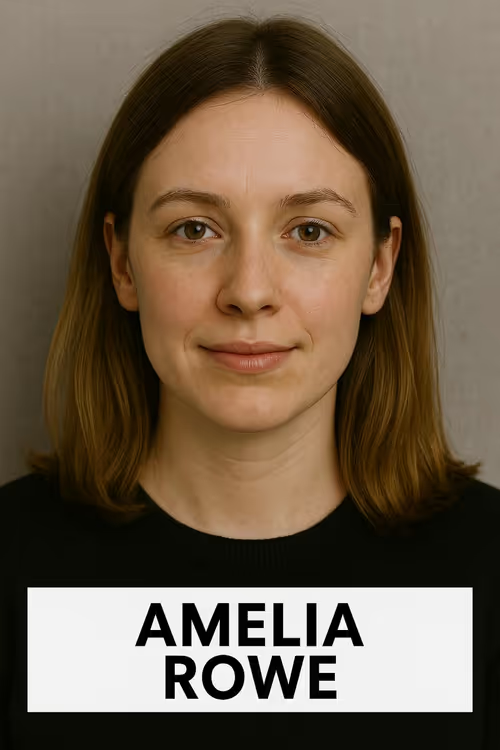
Amelia Rowe
Senior correspondent · Banking & Economy
Amelia spent eight years inside a sovereign wealth fund before deciding she'd rather write about institutional money than allocate it. She covers central banking, insurance, and the macro decisions that quietly choose which markets get the next decade. Sharp on monetary policy; impatient with anyone who confuses noise with signal. Based in London. Reach out at amelia.rowe@theplatinumcapital.com.