

Flood Insurance: Why the Public Sector Cannot Do It Alone
As climate-driven flood events accelerate in both frequency and severity, the financial exposure facing public sector insurance programs has grown to a scale that no government balance sheet can sustainably absorb alone. Forward-thinking family offices and institutional investors stand at a rare inflection point, where deploying private capital into parametric flood instruments and public-private reinsurance structures offers not only compelling risk-adjusted returns, but a decisive role in reshaping the architecture of global climate resilience.…

When floodwaters swept through large parts of the UAE in April 2024, the images were hard to forget — submerged highways, grounded aircraft, data centres running on emergency power. For a country that had spent billions building world-class infrastructure over several decades, the event was a brutal reminder that sovereign wealth does not buy immunity from extreme weather. The clean-up bill ran into the hundreds of millions of dollars, and a significant portion landed squarely on governments and uninsured private owners. That gap — between what the public sector can absorb and what private markets have historically refused to price — is now the defining fault line in global climate finance. Closing it requires a structural rethink, not another government backstop.
The Sovereign Burden Is Becoming Unsustainable
Flood risk has long defaulted to the public sector by political necessity. When private insurers withdraw — and they do, with increasing frequency — governments step in as insurer of last resort, absorbing losses that were never properly priced into their fiscal frameworks. The result is a quiet but compounding liability accumulating on national balance sheets across the Gulf, Africa, and Southeast Asia. In Nigeria, repeated flooding along the Niger Delta has cost the federal government an estimated USD 9 billion in cumulative economic damage over the past decade. The vast majority was uninsured. In Vietnam, annual flood losses average between 1.5% and 2% of GDP according to World Bank estimates — a permanent structural drag that continuously crowds out capital from productive investment.
The pattern repeats across the GCC. Saudi Arabia, Oman, and the UAE have each absorbed catastrophic flash flooding events in recent years, and the standard government response — emergency relief, infrastructure repair, ex-gratia payments — remains fiscally reactive rather than strategically managed. For family offices and private investors carrying significant real estate, agricultural, and infrastructure exposure in these markets, the absence of bankable flood insurance is not merely an inconvenience. It is an unquantified risk sitting inside their portfolios right now.
Parametric Structures Are Filling the Void
The most credible near-term answer to the flood insurance gap is not indemnity-based coverage. That model depends on claims assessment, legal adjudication, and insurer appetite — three things increasingly difficult to guarantee in high-frequency loss markets. Parametric insurance pays out automatically when a predefined trigger such as rainfall levels or river height is breached. It strips out moral hazard, cuts claims friction, and — critically — produces a product that can actually be priced and structured for markets where traditional insurance penetration remains low.
The African Risk Capacity Group has demonstrated that parametric structures can work at sovereign scale. ARC Limited's non-profit parametric climate facility, launched in late 2025 and now active across multiple African Union member states in 2026, marks a genuine inflection point. The REPAIR programme — Regional Emergency Preparedness and Access to Inclusive Recovery — has already disbursed over USD 22.3 million to Malawi and Mozambique, with payments processed within seven days of the trigger event being confirmed. Seven days. That speed of capital deployment, at the moment governments and communities are still in active crisis, is precisely what separates a functional risk transfer mechanism from a theoretical one. Early liquidity prevents the spiral of distressed asset sales and debt accumulation that typically follows a major flood event. The speed itself carries measurable economic value.
Shariah-Compliant Innovation Is Expanding the Market
One structural barrier to flood insurance penetration across Muslim-majority markets — which cover large portions of TPC's priority geographies, from Indonesia and Malaysia to Egypt, Morocco, and the Sahel — has been the incompatibility of conventional insurance products with Islamic finance principles. The ARC Group's decision to develop a Shariah-compliant parametric takaful facility is not merely an ethical accommodation. It is a market-opening move. It unlocks sovereign and community-level climate protection for populations that would otherwise remain entirely self-insured against flood risk. That is a substantial addressable market that conventional insurers have effectively ceded.
This development arrives as takaful operators in the Gulf undergo their own significant governance recalibration. SALAMA — the Dubai-listed Islamic Arab Insurance Company — elected new board leadership in July 2026 under chairman Humaid Mohammad Obaid Alqutami, following a period of capital restructuring. The reconstitution of its audit, risk, and investment committees signals a renewed institutional focus on sustainable underwriting over volume growth. For the broader takaful sector, SALAMA's reset carries a clear message: climate risk products demand robust internal governance frameworks before any credible offer can reach sovereign or institutional clients.
Private Capital Is Beginning to Move
Sophisticated investors are increasingly reading climate risk insurance as infrastructure — a utility-like function that underpins economic activity and asset values across entire sectors. Tawuniya, the Saudi joint-stock insurer listed on the Tadawul, made that logic explicit when it led the oversubscribed USD 2.8 million funding round in UAE-based agricultural risk platform Maalexi in June 2026, alongside Global Ventures. Maalexi is building a regulated real-world asset exchange for cross-border agricultural trade — directly targeting food supply chain vulnerability, one of the most acute climate-correlated risks in the GCC given its near-total dependence on food imports. Few outside the region have tracked this closely. They should.
Tawuniya's Chief Investment Officer Fahad Bin Muammar framed the investment in explicitly systemic terms, describing Maalexi as "a disciplined, risk-focused platform that connects physical agricultural trade with emerging digital asset infrastructure." That framing matters more than the round size. It signals that leading Gulf insurers are not simply writing policies against climate risk — they are investing in the data infrastructure and market mechanisms that make accurate climate risk pricing possible at scale. This is the upstream investment in risk intelligence that the public sector has chronically underfunded.
What Wealthy Investors and Family Offices Should Act On Now
The numbers tell a complicated story, and private capital needs to read both sides of it carefully. On the liability side, real estate holdings in coastal Vietnam, agricultural investments in East Africa, and infrastructure positions across the Gulf carry embedded flood risk that is almost certainly not adequately insured. Parametric cover — structured at the asset or portfolio level — is now available through a growing number of specialist reinsurers and development finance-backed facilities. The pricing, while not trivial, is significantly lower than the expected value of an uninsured loss event.
On the opportunity side, the climate risk insurance sector across emerging markets is acutely undercapitalised relative to the economic exposure it is being asked to absorb. Swiss Re estimates the global protection gap for flood risk alone at over USD 280 billion annually — and the majority of that gap sits in the markets where TPC's readership is most active. Blended finance structures, catastrophe bond platforms, and takaful-compatible parametric facilities are all seeking patient, sophisticated capital from investors who understand these markets and can hold long-duration risk without flinching. The public sector built the runway. Private capital now has to fly the plane.
Written by
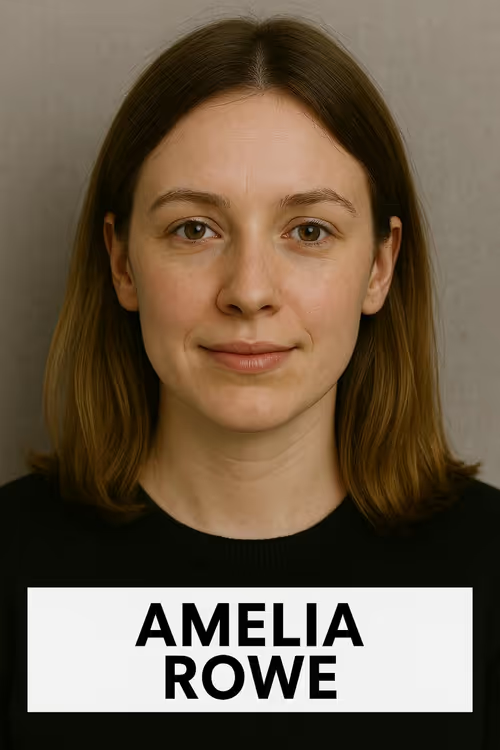
Amelia Rowe
Senior correspondent · Banking & Economy
Amelia spent eight years inside a sovereign wealth fund before deciding she'd rather write about institutional money than allocate it. She covers central banking, insurance, and the macro decisions that quietly choose which markets get the next decade. Sharp on monetary policy; impatient with anyone who confuses noise with signal. Based in London. Reach out at amelia.rowe@theplatinumcapital.com.