

Insurance M&A: Who Is Buying What and Why
The insurance sector is witnessing an unprecedented wave of strategic consolidation, as private equity giants, sovereign wealth funds, and well-capitalised incumbents compete fiercely to acquire underwriting platforms, distribution networks, and embedded technology assets that promise durable, recurring cash flows in an era of persistent macroeconomic uncertainty. Understanding who is deploying capital, at what valuations, and toward which sub-sectors — from specialty lines and reinsurance to insurtech and life run-off portfolios — has become an essential discipline for sophisticated investors seeking asymmetric returns and portfolio resilience in 2024 and beyond.…

The global insurance sector is in the middle of one of its most consequential consolidation runs in a generation. Across the Gulf, Africa, and Southeast Asia, deal flow is accelerating — driven not by distress, but by ambition. Insurers flush with record profits are buying distribution platforms, technology assets, and niche underwriters. At the same time, sovereign-linked capital and family office principals are taking meaningful stakes in Takaful operators and climate risk vehicles that, five years ago, barely registered on institutional radars. The question is no longer whether M&A will reshape insurance markets in emerging economies. The question is who is moving fastest, and why.
The GCC Surplus Problem — And Its Elegant Solution
The GCC Takaful market generated USD 17.1 billion in gross written contributions in 2024, up 15.1% year-on-year, with aggregate net profits across the region reaching approximately USD 1.1 billion. Saudi Arabia alone accounted for 87.3% of those profits. That kind of earnings concentration leaves the Kingdom's leading insurers with a pointed strategic question: where does the capital go next?
For operators like Tawuniya, Saudi Arabia's largest insurer by revenue, the answer has been deliberate. The company posted SAR 1.10 billion in net profit for 2025, with insurance revenues climbing 17.13% to SAR 21.40 billion. Rather than returning excess capital to shareholders, Tawuniya has been positioning itself as an active strategic investor — most recently leading an oversubscribed investment round of USD 2.8 million in Maalexi, a UAE-based agricultural trade finance platform, alongside Global Ventures. The deal is small in absolute terms. The intent behind it is not. It signals that large Gulf insurers are deliberately building exposure to climate-adjacent asset classes, agri-finance, and parametric risk transfer — sectors where M&A activity is expected to intensify through 2027.
Tawuniya's concurrent upgrade of its MSCI ESG rating to 'A' and its formal alignment with the Principles for Responsible Investment are not incidental to this strategy. In the current deal environment, ESG credibility functions as acquisition currency — opening doors to international co-investors, green capital markets, and sovereign partnership structures that would otherwise stay shut.
What Buyers Are Actually Looking For
Across MENA, the most active insurance acquirers share a consistent target profile: companies that solve distribution bottlenecks, own proprietary data, or hold regulatory licences in underpenetrated markets. Pure balance-sheet plays are increasingly rare. Strategic logic now dominates.
In the UAE and Qatar, the consolidation of mid-size conventional insurers has been grinding forward since the post-pandemic restructuring cycle of 2021 to 2023. What changed in 2025 is buyer composition. Family offices from the Gulf — particularly those managing generational wealth across Kuwait, Bahrain, and the UAE — are now appearing on cap tables of regional insurers as principal investors, not passive allocators. Several prominent family office principals have disclosed positions in Takaful operators, drawn by the combination of Shariah-compliant income streams, strong underwriting margins, and relatively low correlation with broader equity markets. That is a significant shift from even three years ago.
Southeast Asia presents a similar dynamic, though structurally different. Indonesia's insurance penetration remains below 2% of GDP. Malaysia's Takaful sector — more mature — still offers meaningful consolidation opportunity below the top three operators. Private equity groups from Singapore and Abu Dhabi have been quietly assembling stakes in Filipino and Vietnamese general insurers, where regulatory liberalisation has opened previously restricted foreign ownership thresholds. For family offices with USD 50 million or more in deployable capital, direct minority stakes in regional insurers now offer the kind of risk-adjusted returns that listed equities in these markets simply cannot replicate cleanly.
Africa's Climate Risk Moment — and the Takaful Entry Point
Perhaps the most structurally important insurance M&A development of 2026 is also the least covered in mainstream financial media. Few outside the specialist reinsurance community have noticed. They should.
African Risk Capacity Limited — the commercial affiliate of the African Union's ARC Group — launched a first-of-its-kind WAQF ReTakaful Facility at the 7th Global Takaful and Re-Takaful Forum in Dubai, where it received the Resilient Re-Takaful Finance Innovator Award. The facility enables African governments, insurers, and communities to access parametric climate risk coverage structured under Islamic principles. This is a genuine structural innovation, not a rebranding exercise.
The commercial implications are real. The WAQF mechanism creates a non-profit vehicle into which Gulf-based Takaful operators, sovereign wealth funds, and philanthropic capital can contribute — generating a pool of climate protection capacity that conventional reinsurance has been unwilling or unable to price efficiently for African sovereign clients. The numbers tell a complicated story: conventional reinsurers have chronically underpriced African climate exposure, then retreated when losses mounted. ARC's structure sidesteps that dynamic entirely. For GCC insurers looking to deploy surplus capital with reputational and ESG upside, the facility offers a compelling entry into African risk markets without requiring direct underwriting exposure to individual African policyholders.
Several Bahrain-based and Dubai-based Takaful reinsurers are understood to be in preliminary discussions on participation structures. The facility is also attracting interest from development finance institutions and next-generation philanthropists who want measurable climate impact with structured risk management behind it — an audience TPC readers will recognise immediately.
The Reinsurance Layer — Where the Real Leverage Lives
No serious analysis of insurance M&A skips reinsurance. Deal multiples are highest here. Strategic rationale is most complex. The global retakaful market remains undersupplied relative to demand from growing Takaful operators across Saudi Arabia, Malaysia, Indonesia, and increasingly West and East Africa. That supply constraint has made retakaful capacity a genuine strategic asset — one acquirers will pay significant premiums to control.
Lloyd's of London syndicates have been selectively entering partnerships with Gulf-based Takaful operators to build hybrid capacity structures. Bermuda-based reinsurers with emerging market books are fielding acquisition interest from GCC-linked investment groups. For investors assessing where insurance M&A creates durable value through 2030, retakaful is where the structural supply-demand imbalance is sharpest, and where pricing power will compound most reliably. That is not a subtle distinction.
What This Means for Family Offices and Private Investors
The insurance M&A wave running across the Gulf, Africa, and Southeast Asia is not a cyclical uptick. It reflects a fundamental repricing of risk transfer infrastructure in markets that are urbanising rapidly, building regulatory frameworks that attract international capital, and carrying climate exposures that conventional markets have consistently underpriced. The window is open. It will not stay that way.
For family office principals and private investors with the capital and patience to operate in these markets, the optimal entry points are narrowing. Direct stakes in profitable Takaful operators — particularly those with strong distribution networks and ESG ratings that attract co-investment — offer both income and strategic optionality. Participation in structured climate risk facilities, such as ARC's WAQF mechanism, delivers a blended return profile that aligns philanthropic intent with commercial discipline. The consolidation phase has started. The most consequential positions will be taken in the next eighteen months.
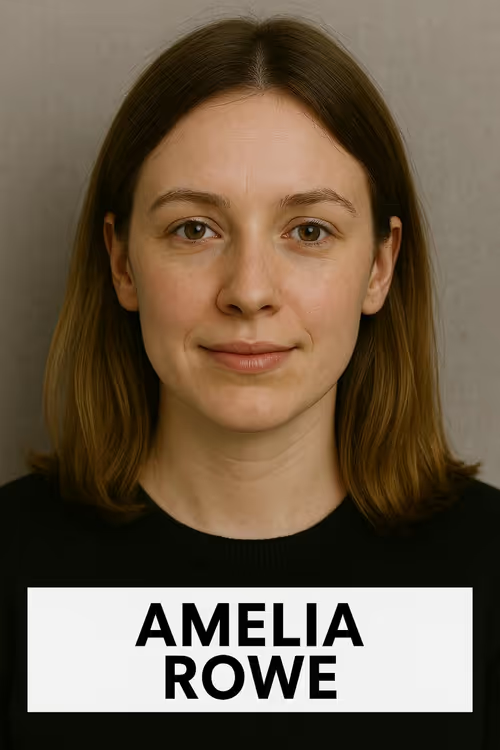
Written by
Amelia Rowe
Senior correspondent · Banking & Economy
Amelia spent eight years inside a sovereign wealth fund before deciding she'd rather write about institutional money than allocate it. She covers central banking, insurance, and the macro decisions that quietly choose which markets get the next decade. Sharp on monetary policy; impatient with anyone who confuses noise with signal. Based in London. Reach out at amelia.rowe@theplatinumcapital.com.