

Saudi Insurance Consolidation: The Market Reshaping Under Vision 2030
Saudi Arabia's insurance sector is undergoing its most consequential structural transformation in a generation, as Vision 2030's sweeping regulatory mandates accelerate mergers among the Kingdom's fragmented mid-tier carriers, compressing the market toward a leaner constellation of financially fortified entities capable of absorbing sovereign-scale risk. For family offices and institutional investors positioning capital across the Gulf, the consolidation curve presents a narrow but lucrative window to acquire strategic stakes in carriers that will emerge as dominant underwriters in a market projected to surpass $25 billion in gross written premiums within the decade.…

Saudi Arabia's insurance sector is rewriting its own rulebook — and doing so faster than most outside observers have registered. Consolidation, regulatory pressure, and a genuine push into new product lines are redrawing the competitive map. For sophisticated investors who understand where value is forming, the timing matters enormously.
A Market at Inflection Point
The numbers tell a complicated story. Across the GCC, gross written premiums grew at a compound annual rate of 10.8% between 2019 and 2024, reaching USD 44.7 billion. By 2030, that figure is projected to hit USD 61.8 billion, according to Alpen Capital's GCC Insurance Industry Report published in May 2026. Saudi Arabia drives that trajectory. The kingdom accounts for the lion's share of both premium volumes and profitability — and within the Takaful segment specifically, Saudi insurers generated 87.3% of the GCC's aggregate net profit in 2024, a figure that rose to approximately USD 1.1 billion across the bloc, up from USD 940 million the year prior.
These are not marginal gains. They reflect a deliberate rewiring of how the kingdom's financial architecture is being constructed for the next decade. Vision 2030's financial services pillar has placed insurance squarely at the centre of Saudi Arabia's ambition to build a more diversified, sophisticated economy. SAMA — the Saudi Central Bank — has progressively raised minimum capital thresholds and tightened governance requirements. The intent is transparent: eliminate underperforming entities, concentrate the market around better-capitalised players, and force a professionalisation of the sector that organic growth alone would never have delivered. For investors watching from Riyadh, Dubai, Almaty, or Nairobi, the signal is consistent. Scale matters. And the window for value-accretive positioning is now.
Consolidation Is No Longer Optional
Saudi Arabia currently licenses more than 30 insurers. Regulators and analysts alike regard that number as structurally excessive. SAMA's recapitalisation directives and stricter solvency frameworks have turned "consolidate or exit" from theoretical pressure into boardroom reality. Several smaller insurers have struggled to meet updated capital adequacy ratios. Conversations that would have been unthinkable five years ago are now happening at the ownership level.
This is not a uniquely Saudi dynamic — but Saudi Arabia is playing it at greater scale and with more strategic intent than anywhere else in the Gulf. In Bahrain, Solidarity Bahrain's acquisition of Bahrain National Insurance for USD 208.3 million in 2026 stands as one of the most significant insurance M&A transactions the region has produced — a clean domestic consolidation that signals both appetite and precedent. In the UAE, the integration of the Insurance Authority into the Central Bank accelerated a thinning of the competitive field, particularly among Takaful operators unable to sustain the compliance burden of heightened oversight. Saudi Arabia is following the same arc. At considerably greater scale.
For family offices and private investors, the consolidation wave presents a specific opportunity: identifying mid-tier Saudi insurers with strong renewal books, loyal corporate client relationships, and clean balance sheets. These are assets that strategic acquirers or larger regional groups would pay a meaningful premium to absorb. The deal pipeline is not yet fully visible in public markets. Those with direct relationships inside the kingdom's financial community, however, are already aware of conversations in progress.
Takaful's Structural Advantage
Saudi Arabia's insurance market is, by design and by culture, a Takaful market. Islamic insurance is not a niche product in the kingdom — it is the primary vehicle through which insurance is distributed and consumed. The GCC holds the largest Takaful market in the world, accounting for 59.9% of global gross written contributions in 2024, equivalent to USD 17.1 billion, growing at 15.1% year-on-year. Saudi Arabia's dominance within that figure is structural, not cyclical.
What is changing is the sophistication of what operators are actually selling. Takaful providers are moving beyond motor and health into more complex risk transfer products: group life, trade credit, engineering, and increasingly, climate-linked protection. The innovation emerging from adjacent markets is worth watching. African Risk Capacity Limited — the commercial affiliate of the African Union's risk pooling mechanism — launched Shariah-compliant climate resilience solutions in 2026, directly connecting the Takaful framework to parametric coverage for drought, floods, and tropical cyclones across 39 African member states. That is a significant structural linkage. Gulf operators, including Saudi Takaful companies with cross-border ambitions, have taken note.
For high-net-worth investors and family offices with philanthropic or impact-oriented mandates, this convergence of Takaful and climate risk is particularly relevant. Deploying capital into Shariah-compliant insurance vehicles that simultaneously address climate resilience across Africa, Central Asia, and Southeast Asia offers a genuine alignment of financial return and values-based investing. That alignment was not available at scale three years ago. It is now.
Corporate Lines and the Infrastructure Boom
NEOM. The Red Sea Project. Diriyah. King Salman Park. Vision 2030's giga-projects collectively represent the largest concentration of infrastructure development capital anywhere in the world right now. Each carries enormous insurance requirements across construction, engineering, liability, and operational risk lines. Domestic capacity cannot fully underwrite these risks alone — which is precisely why Lloyd's of London, AXA XL, and specialist reinsurers are deepening their Saudi market presence. But the domestic opportunity, as a co-insurance partner, a fronting insurer, or a distribution intermediary, remains substantial for well-positioned local players.
Saudi Re, the kingdom's dedicated reinsurance company, sits at the centre of that equation. Its mandate is to ensure that more of the premium volume generated by these mega-developments stays onshore rather than flowing abroad to international reinsurers. Its growing capitalisation and expanded treaty relationships are not accidental — they reflect SAMA's broader intent to build a genuinely self-sustaining insurance ecosystem, one where Saudi Arabia functions as a regional risk management hub rather than simply a premium source for foreign balance sheets.
The Investor Calculus for 2026 and Beyond
Three themes define the forward opportunity for private investors, family offices, and institutional allocators assessing this sector. First, M&A participation — whether through direct stakes in consolidating entities, co-investment alongside strategic acquirers, or listed equity positions in Tadawul-quoted insurers trading at discounts to embedded book value. Second, Takaful product innovation, particularly in commercial and specialty lines where margins remain far more attractive than the commoditised motor and compulsory health segments. Third, the reinsurance and risk retention story, where growing domestic capacity creates a long-duration investment case tied directly to Vision 2030's infrastructure pipeline.
The Saudi insurance market in 2026 is not a passive, organic growth story. It is an actively managed structural reform — backed by sovereign intent, regulatory muscle, and a USD 61.8 billion market target by the end of the decade. The investors who move thoughtfully, and early, will find themselves well-positioned in one of the Gulf's most consequential financial sector transformations of this generation.
Written by
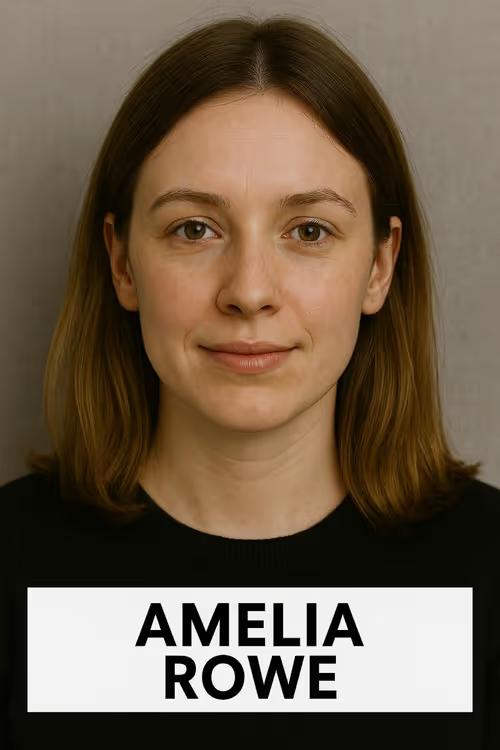
Amelia Rowe
Senior correspondent · Banking & Economy
Amelia spent eight years inside a sovereign wealth fund before deciding she'd rather write about institutional money than allocate it. She covers central banking, insurance, and the macro decisions that quietly choose which markets get the next decade. Sharp on monetary policy; impatient with anyone who confuses noise with signal. Based in London. Reach out at amelia.rowe@theplatinumcapital.com.


