Venture Capital in Saudi Arabia: The Funds Behind the Boom
Saudi Arabia's venture capital ecosystem has undergone a structural transformation, with sovereign-backed vehicles such as the Saudi Venture Capital Company and a wave of homegrown funds deploying billions of riyals into sectors ranging from fintech and logistics to deep tech and food security. For sophisticated investors and family offices seeking asymmetric growth opportunities in one of the world's most capital-rich reform economies, understanding the architecture of these funds — their mandates, co-investment structures, and alignment with Vision 2030 — is no longer optional; it is a prerequisite for meaningful participation in the region's most consequential capital story.…

Saudi Arabia's venture capital ecosystem has transformed so fast that even seasoned Gulf investors have had to tear up their assumptions. A decade ago, this was a market defined by cautious family conglomerate bets and government-linked holding companies moving slowly. Today it ranks among the most actively funded startup environments in the Arab world. In 2025, Saudi-based and Saudi-focused venture funds deployed an estimated $2.3 billion across early and growth-stage companies. Measured against the Kingdom's non-oil GDP targets under Vision 2030, that figure stops looking like momentum and starts looking like something closer to a structural fact.
The Institutional Architecture Behind the Numbers
The engine here is not purely private. The Public Investment Fund — with more than $700 billion in assets under management — has seeded and anchored several domestic venture platforms, directly and through subsidiaries. That involvement has acted like gravity. Regional co-investors followed. International fund managers seeking local validation followed. Family offices that historically parked capital in real estate or listed equities followed. When the sovereign wealth fund signals conviction in a sector, private capital in Saudi Arabia tends to move in the same direction. Since at least 2021, that signal has pointed consistently toward technology, fintech, and logistics.
STV — formerly Saudi Technology Ventures — remains the most prominent homegrown institutional fund in the Kingdom. It closed its second fund at $500 million in 2022 and has continued deploying into regional technology companies building toward genuine scale. Wa'ed Ventures, the venture arm of Saudi Aramco, occupies a different but complementary position: energy transition technologies, industrial innovation, a strategic mandate that sits alongside rather than competes with the purely financial returns game. Together, these two platforms have built a credible mid-market venture architecture — one that neither depends entirely on foreign capital nor operates in ignorance of global institutional norms. That combination matters more than it might appear.
The Abu Dhabi Effect and Its Saudi Reverberations
You cannot make sense of what is happening across the Gulf without looking at Abu Dhabi. The ambitions of sovereign and quasi-sovereign investors there have reached a different order of magnitude entirely. MGX, the Abu Dhabi-backed artificial intelligence investment firm chaired by Sheikh Tahnoon bin Zayed, closed its Fund I at $49 billion in July 2026 — beating its initial $45 billion target and cementing the UAE as the region's most capitalised technology investment platform. The fund co-led OpenAI's $122 billion raise in March 2026 and participated in Anthropic's $65 billion Series H in May, alongside earlier involvement in Elon Musk's xAI vehicle. For Saudi fund managers watching from Riyadh, the MGX trajectory functions simultaneously as inspiration and competitive benchmark. That is a significant shift in how regional capital thinks about itself.
Then there is AC Limited. Bloomberg's July 2026 reporting on the discreet family office of UAE President Sheikh Mohamed bin Zayed Al Nahyan illustrated just how sophisticated Abu Dhabi's private capital infrastructure has become — operating in parallel with, rather than subordinate to, its institutional vehicles. AC Limited backed Ardian's record $30 billion secondaries fund, participated in the nearly $700 million listing of the Uzbek national investment fund, and took positions ranging from McLaren to an early-stage cancer diagnostics startup. Private credit. Sovereign listings in Central Asia. Deep technology. Few portfolios anywhere in the world span that range with equal conviction. Saudi family offices have noticed, and many are now actively working to replicate that breadth as their own governance structures mature.
Where Saudi Venture Capital Is Actually Going
The sectoral picture has shifted. Saudi venture investment in 2025 and into 2026 has moved away from the fintech-heavy patterns of earlier years. Payments infrastructure and embedded finance remain active — the Saudi Central Bank's progressive licensing framework and the national push toward cashless transactions have seen to that. But the more significant capital flows now run toward logistics technology, health technology, and education platforms. The demographic rationale is straightforward and compelling: more than 60 percent of the Saudi population is under 35, and smartphone penetration sits above 95 percent. Those numbers create addressable markets large enough to justify institutional-grade venture bets, not angel-stage experimentation.
The proof-of-concept companies are already on the board. Foodics, the Riyadh-headquartered restaurant management platform, and Tamara, the buy-now-pay-later provider that crossed the $1 billion valuation mark, have demonstrated that the Saudi market can produce high-growth, capital-efficient businesses. Their trajectories have directly influenced how Gulf family office LPs think about allocation. Several have begun directing five to ten percent of investable capital toward domestic and regional venture — a shift that would have read as aggressive even three years ago. Regional funds operating across the GCC, including CedarBridge Capital Partners, which completed the first close of its CBHG III vehicle in November 2025 targeting education, healthcare, and consumer services, have drawn meaningfully from this reallocation trend among family-backed capital pools.
Foreign Capital, Local Conditions
International venture firms arrived in Riyadh with varying degrees of seriousness. Several tier-one Silicon Valley managers opened offices in the King Abdullah Financial District, drawn by sovereign co-investment economics and the scale of Vision 2030-linked procurement pipelines. The ones that built durable deal flow hired locally and structured their terms around Saudi market realities — longer hold periods, genuine sensitivity to reputational considerations in portfolio company governance, and the kind of regulatory relationships that take years to build with bodies like the Communications, Space and Technology Commission and the Financial Sector Development Program. The ones that treated Riyadh as a satellite office have largely struggled.
That dynamic has reinforced the position of regional general partners who combine international training with genuine local market knowledge. It has also hardened a two-tier market: well-capitalised funds with sovereign or quasi-sovereign anchor LPs operating at the growth equity end, and a more fragmented cohort of smaller managers working pre-Series A, where institutional discipline remains uneven but the return potential is correspondingly higher. Both tiers have a role. But they require very different due diligence from the LPs considering them.
The Forward Calculus for Private Investors
For family offices and private investors with serious capital to deploy, Saudi Arabia's venture market in 2026 offers a structurally more attractive entry point than the headline enthusiasm sometimes implies. Early-stage valuations have moderated from their 2021 and 2022 peaks. The regulatory architecture has improved substantially — the Capital Market Authority has expanded its framework for venture capital fund licensing, and clearer exit pathways now exist, including secondary market mechanisms and direct listings on Tadawul's Nomu platform. The infrastructure, in other words, is catching up to the ambition.
The real test over the next five years is execution. Can Saudi-focused funds deliver full-cycle returns — from initial check through actual exit — that justify the asset class's current positioning within Gulf institutional portfolios? The capital is present. Deal flow is deepening. But track records in venture are built slowly, and the managers who will define this market's reputation are still in the middle of proving what they can do. Which of them have built organisations resilient enough to convert a historic moment of national economic ambition into durable, compounding returns? That question does not yet have an answer. It will, and sooner than many expect.
Written by
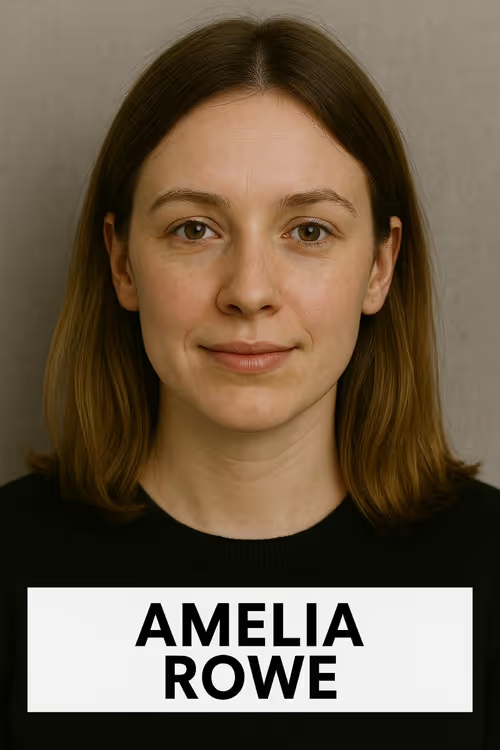
Amelia Rowe
Senior correspondent · Banking & Economy
Amelia spent eight years inside a sovereign wealth fund before deciding she'd rather write about institutional money than allocate it. She covers central banking, insurance, and the macro decisions that quietly choose which markets get the next decade. Sharp on monetary policy; impatient with anyone who confuses noise with signal. Based in London. Reach out at amelia.rowe@theplatinumcapital.com.