
Debt Capital Markets: Spreads, Issuance, and Investor Appetite
As debt capital markets navigate an era of recalibrated monetary policy and shifting sovereign risk premiums, the interplay between credit spreads and issuance volumes has emerged as the defining tension shaping institutional portfolio strategy across developed and emerging economies alike. Family offices and sovereign wealth managers who grasp the nuanced mechanics of investor appetite — from investment-grade corporate paper to high-yield instruments — will be best positioned to capitalize on the structural dislocations that persistently reward disciplined, yield-focused capital allocation.…
The first quarter of 2026 has delivered a striking verdict on global investor appetite. Despite rate uncertainty in the West and geopolitical recalibration across key emerging markets, the Gulf's debt capital markets are not merely holding their ground — they are setting the pace. The GCC recorded its strongest Q1 issuance figures in recent memory. Sustainable debt instruments are pulling in a new class of mandate-driven capital. For private investors, family offices, and sovereign allocators, the signals demand close attention.
Saudi Arabia and the GCC's Issuance Engine
Saudi Arabia's dominance of GCC debt markets in Q1 2026 was no accident. The Kingdom drove a surge that pushed total regional issuance well past $54 billion for the quarter, with Saudi entities alone accounting for more than $32 billion of that volume. That figure reflects both sovereign ambition and a widening pool of corporate borrowers tapping international markets under the Vision 2030 financial architecture. The UAE followed with $13.57 billion across 36 offerings — a result that positions Dubai and Abu Dhabi as parallel debt origination centres, not secondary players.
Kuwait-based research house Markaz recorded that conventional issuances represented 65.2% of total GCC volume in Q1, consistent with the prior year's preferences. The market's structural composition is stabilising even as total volumes grow. US dollar-denominated instruments dominated at $46.78 billion, roughly 85% of total issuance. Saudi riyal-denominated paper contributed an additional $4.04 billion — a number that reflects genuine local currency market development, attracting both domestic pension funds and global investors seeking riyal exposure with sovereign backing.
The corporate debt pipeline is no longer confined to sovereigns and quasi-sovereigns. That is a significant shift. For family offices and private investors across the Gulf, it creates real pricing opportunities, particularly in the three-to-seven year maturity band where spreads have remained constructive relative to equivalent-rated paper out of emerging Europe or Southeast Asia.
Spreads Under Pressure — But Selectively
Spread compression has defined GCC debt markets through early 2026. Sustained oversubscription across investment-grade issues and a persistent shortage of high-quality regional paper relative to available capital have together tightened Saudi investment-grade corporate spreads by an estimated 25 to 40 basis points since late 2025. UAE bank paper — particularly from the tier-one names — is now pricing at levels that assign near-sovereign status in investor perception. The market has effectively made a judgment about these institutions.
But the compression is not uniform. Lower-rated credits and debut issuers are still encountering meaningful spread requirements, and deal selection has become more consequential as a result. The withdrawal of Mutlaq Al Ghowairi Contracting Company's planned Tadawul listing in June — pulled after last-minute consultations with financial advisors — is a reminder that appetite, while broad, is not unconditional. HSBC, which currently holds a portfolio of 45 M&A and IPO mandates across the Gulf, has indicated that its clients are largely deferring listing activity to Q4 2026, following the signing of the US-Iran peace agreement and the need for at least one quarter to re-establish investor confidence. That pipeline — which includes Saudi Arabia's Arabian Dyar and the UAE's Dubai Investment Parks — will place real pressure on primary market bandwidth later in the year, potentially widening new-issue concessions for deals competing simultaneously for the same institutional allocations.
Sophisticated investors in Kazakhstan, Nigeria, or Vietnam who watch GCC bond markets as a regional benchmark should take note. Spread behaviour in 2026 is increasingly issuer-specific rather than macro-driven. Broad EM spread trends no longer do the analytical work. Credit-by-credit analysis does.
Sustainable Debt Finds Its Mandate
Emirates NBD's $1 billion dual-tranche green and blue bond issuance ranks among the most structurally significant transactions in the Gulf's sustainable debt story this year. The Dubai-based lender bifurcated proceeds — directing capital toward both green infrastructure and blue economy projects. That decision reflects a maturing approach to use-of-proceeds frameworks that is beginning to shape how regional issuers price and market sustainable instruments across the board.
Globally, green and sustainability-linked sukuk issuance has accelerated in parallel, with Malaysian and Indonesian sovereign and quasi-sovereign entities reinforcing Southeast Asia's position as the primary sukuk innovation corridor. The Gulf's entry into blue bond territory, though, signals something more deliberate — an intent to compete not just on volume but on thematic depth. That matters particularly as Gulf sovereign wealth funds face ESG-linked mandates from co-investors and LP partners in Europe and North America. The capital demanding these structures is not going away.
Family offices with philanthropic mandates, or next-generation principals pushing ESG integration into portfolio strategy, should study the pricing dynamics here carefully. Early data suggests ESG-labelled Gulf paper is achieving 5 to 12 basis point pricing advantages over equivalent conventional instruments. A greenium of that size is modest. It is also real, it represents a measurable cost-of-capital benefit for issuers, and the demand depth behind it shows no sign of reversing.
The SpaceX Effect: Sovereign Capital and the IPO Premium
The June 2026 Nasdaq listing of SpaceX at a $1.75 trillion valuation introduced a different dimension to the GCC capital markets conversation. Not debt — equity. Specifically, the strategic deployment of sovereign and ultra-high-net-worth capital into transformational equity at a scale that commands attention. Saudi Arabia's Public Investment Fund and the Kuwait Investment Authority each placed orders reportedly ranging from $1 billion to $5 billion. The Qatar Investment Authority, which manages approximately $580 billion in assets, was positioned to make a substantial commitment of its own. Kingdom Holding, the investment vehicle of Prince Alwaleed bin Talal, disclosed a SpaceX position valued at $10.6 billion at the IPO price. That single figure exceeds the combined total Q1 2026 bond issuance of Oman and Kuwait. Few outside the region have fully registered what that signals. They should.
The consequences for debt capital markets are indirect but real. Large-scale equity allocations by Gulf sovereign funds recalibrate the opportunity cost calculus against which fixed income returns are measured. When Gulf family offices and private investors watch their sovereign counterparts committing billions to high-conviction equity at scale, the pressure on debt instruments to deliver competitive risk-adjusted returns intensifies. That dynamic will shape new issuance pricing expectations through the second half of 2026. Issuers and arrangers who ignore it are pricing deals into a market they no longer fully understand.
What Investors Should Position For
Three intersecting forces will define GCC debt capital markets through Q3 and Q4 2026. A heavy pipeline of deferred IPOs and bond mandates seeking simultaneous execution windows. Sustained demand from Asian and European allocators for Gulf investment-grade paper. And a growing sustainable debt premium that rewards issuers who have invested in credible frameworks — and penalises those who have not.
For private investors and family office principals across the Gulf, Central Asia, and Africa, the actionable read is precision over breadth. Buying GCC debt broadly for yield pickup against US Treasuries is a trade that belongs to an earlier cycle. This market now differentiates — issuer quality, tenor, and ESG classification each carry measurable pricing consequences. Those who position ahead of the Q4 pipeline, particularly in the two-to-five year investment-grade segment from UAE and Saudi corporate issuers, stand to benefit from both yield and potential secondary market appreciation as new-issue concessions tighten post-execution. The Gulf's debt markets have matured past their emergence phase. What comes next rewards investors who read the details. The headline figures alone will not be enough.
Written by
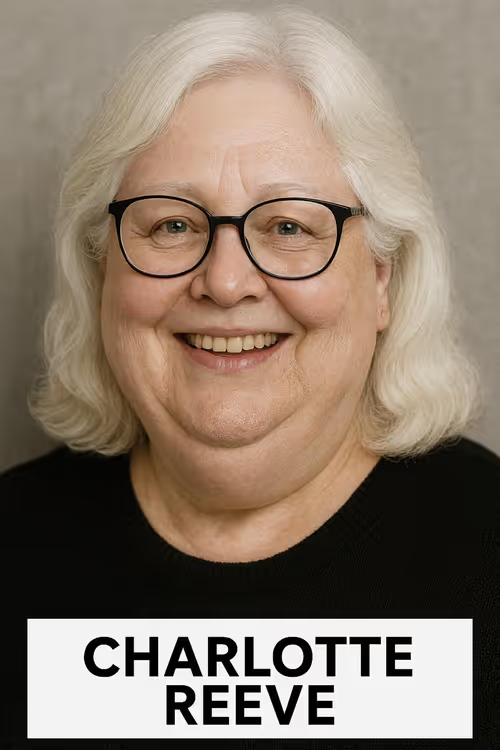
Charlotte Reeve
Senior correspondent · Capital Markets & Fintech
Charlotte cut her teeth on an equities desk before moving to the other side of the notebook. She covers capital markets, stock exchanges, and the fintech operators trying to disintermediate the banks that trained her. Sharpest on market microstructure and payments infrastructure; still reads a prospectus for fun. Based in Singapore. Reach out at charlotte.reeve@theplatinumcapital.com.