

Family Offices and the Shift Toward Alternative Investments
Family offices are increasingly redirecting capital away from traditional equity and fixed-income portfolios, channeling unprecedented allocations into private equity, venture capital, real estate, and infrastructure assets in pursuit of superior risk-adjusted returns. This structural reallocation reflects a broader conviction among ultra-high-net-worth stewards that illiquidity premiums and direct deal access now represent the most defensible edge in an era of compressed public market yields and heightened macroeconomic uncertainty.…
The Quiet Revolution in Family Office Portfolios
When the Abu Dhabi-based Al Fahim Group disclosed in February 2026 that it had shifted 62 percent of its family office portfolio into alternative assets — up from 41 percent just three years earlier — it told us something far more consequential than a single allocation decision. Across the Gulf, Asia, and Latin America, ultra-wealthy families are systematically dismantling the traditional 60/40 equity-bond model that governed private wealth for decades. In its place: a complex mosaic of private equity, real assets, venture capital, and direct co-investments that would have been unrecognizable to their predecessors.
The numbers bear this out. The 2026 Global Family Office Report published by UBS in March found that alternative investments now constitute 52 percent of average family office portfolios worldwide — the first time the figure has breached the halfway mark. In the Gulf Cooperation Council states, that figure climbs to 58 percent. This isn't a tactical response to interest rate uncertainty or equity market jitters. It's a structural reimagining of how generational wealth gets preserved, grown, and deployed.
Gulf Family Offices Lead the Charge
The Gulf region has become the epicenter of this transformation. Dubai's family office registrations surged 37 percent year-on-year in the first quarter of 2026, according to data from the Dubai International Financial Centre, bringing the total number of registered single-family offices past 920. Riyadh isn't far behind. Saudi Arabia's Family Office Association reported 214 newly established entities in 2025, with early 2026 figures suggesting the pace is accelerating under the Kingdom's Vision 2030 framework.
These are not passive holders of sovereign-linked bonds. The Olayan Group, one of the region's most established multi-generational enterprises, expanded its direct investment arm in January 2026 with a $400 million commitment to late-stage technology companies across Southeast Asia and India. Kuwait's Alghanim Industries disclosed a dedicated $250 million allocation to climate infrastructure projects spanning hydrogen production in Oman and solar manufacturing in Morocco. That is a significant shift from even five years ago.
The motivations run deeper than a single thesis. Gulf families want to diversify revenue streams away from hydrocarbon dependence — a strategic imperative that aligns neatly with alternative asset classes offering long-duration, inflation-resistant returns. But there's also a generational dimension at work. Younger family members, many educated at Western business schools, are importing Silicon Valley's appetite for venture capital and technology-driven disruption into traditionally conservative portfolios.
Private Credit and Infrastructure: The New Anchors
Within the alternatives universe, two asset classes are attracting disproportionate attention: private credit and infrastructure. KKR's latest fundraise for its Asia-Pacific infrastructure fund closed at $6.4 billion in March 2026 and drew commitments from at least 18 family offices across the Middle East and South Asia, according to people familiar with the matter. Brookfield Asset Management reported that family office capital now accounts for 14 percent of its global infrastructure fundraising, up from 8 percent in 2023.
Private credit has become the preferred fixed-income substitute. As traditional bank lending continues to retreat under Basel III endgame requirements, family offices have stepped into the void with enthusiasm. Ares Management's $3.7 billion emerging market direct lending fund, launched in late 2025, was oversubscribed by February 2026, with Gulf-based family offices contributing an estimated $800 million. The math isn't complicated: yields of 11 to 14 percent with senior secured positioning beat public market bonds yielding half as much.
Mumtalakat, Bahrain's sovereign wealth fund, has been quietly co-investing alongside family offices in regional private credit deals — a model that blurs the traditional boundary between institutional and private capital. Few outside the region have noticed. But this convergence is creating deal structures that were previously the exclusive domain of large pension funds and insurance companies.
Emerging Markets as the New Frontier
The geographical diversification of family office capital is equally striking. India has become a primary beneficiary. The Shapoorji Pallonji Group's family office arm committed $300 million to Indian real estate and logistics assets in early 2026, while Singapore-based multi-family office Raffles Family Office opened a dedicated Mumbai desk in January to service demand from both local and Gulf-based families seeking Indian exposure.
Brazil and Mexico are drawing fresh attention. Patria Investments, the Latin American alternative asset manager in which Blackstone holds a significant stake, reported that family office commitments to its funds grew 43 percent in 2025 — a trajectory that has continued into the current year. Brazilian agribusiness and Mexican nearshoring logistics have emerged as particularly attractive themes.
Then there's Africa. The Chandaria family, whose industrial conglomerate spans Kenya, Tanzania, and India, established a $150 million venture and growth equity fund in Nairobi in February 2026, targeting fintech and healthcare startups across East Africa. This kind of on-the-ground deployment, led by families with deep regional knowledge, often outperforms institutional capital that parachutes in without local context.
Risks, Governance, and the Liquidity Question
The rush into alternatives is not without peril. Illiquidity is the primary structural risk, and it's a serious one. A family office with 60 percent of its portfolio locked in seven- to ten-year fund commitments faces genuine vulnerability during periods of capital call acceleration or unexpected family liquidity needs. The collapse of several smaller family offices in Southeast Asia during the 2025 real estate correction — when forced asset sales erased years of gains — should give everyone pause.
Governance is another pressing concern. Many Gulf and Asian family offices operate without the institutional infrastructure required to evaluate complex alternative strategies. Ernst & Young's 2026 Family Office Governance Survey found that only 34 percent of single-family offices in the GCC employ a dedicated chief investment officer, and fewer than half have formal investment committees. The gap between ambition and operational capability is real. In some cases, it's dangerous.
Several multi-family office platforms have stepped in to fill this deficit. Singapore's ARIS Wealth and Dubai's Virtuzone Family Office Services both reported client growth exceeding 50 percent in the twelve months to March 2026, offering outsourced due diligence, portfolio construction, and risk management services that individual families struggle to build on their own.
A Permanent Reallocation, Not a Cycle
The weight of evidence points to a structural shift, not a cyclical one. Demographic succession, the institutionalization of family wealth across the Gulf and Asia, the maturation of private markets infrastructure in emerging economies, persistent yield compression in public fixed income — all of these forces push in the same direction. Goldman Sachs projected in its April 2026 wealth management outlook that family office allocations to alternatives globally will reach 60 percent by 2030.
What makes this moment distinct isn't simply the volume of capital moving into private markets. It's the sophistication. Gulf families are no longer passive limited partners writing checks to brand-name fund managers. They are co-investing, building direct deal capabilities, and in many cases competing with the very institutions that once managed their money. The implications for asset managers, capital markets, and the emerging economies set to receive this capital are profound — and only beginning to be understood.
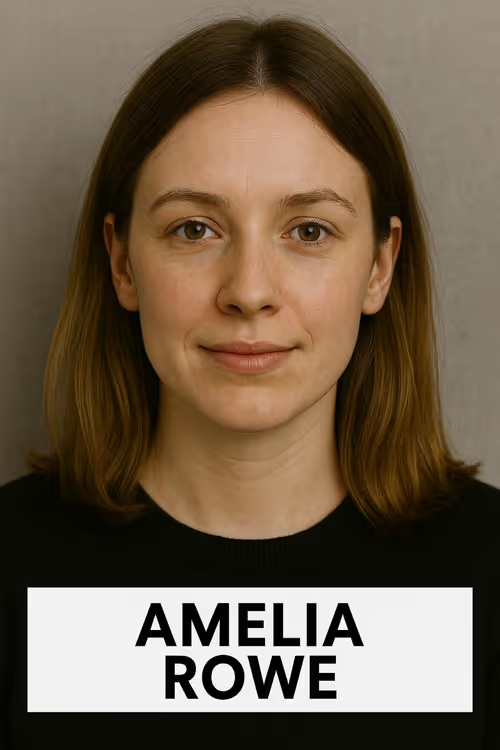
Amelia Rowe is a senior journalist at The Platinum Capital covering finance, private wealth, and emerging markets.
Written by
Amelia Rowe
Senior correspondent · Banking & Economy
Amelia spent eight years inside a sovereign wealth fund before deciding she'd rather write about institutional money than allocate it. She covers central banking, insurance, and the macro decisions that quietly choose which markets get the next decade. Sharp on monetary policy; impatient with anyone who confuses noise with signal. Based in London. Reach out at amelia.rowe@theplatinumcapital.com.