Gulf Mediation Diplomacy: The Economic Dividends of Neutrality
As Gulf states increasingly position themselves as indispensable arbiters in global conflicts — from Ukraine to Sudan — their calculated neutrality is generating a far more lucrative return than mere goodwill: preferential trade corridors, sovereign wealth fund access, and infrastructure mandates that competitors locked into rigid alliance structures simply cannot reach. For discerning capital allocators and sovereign decision-makers, understanding the financial architecture underpinning this diplomatic posture has shifted from geopolitical curiosity to fiduciary imperative.…

In the summer of 2026, missile strikes temporarily shuttered Qatar's Ras Laffan facility — one of the world's most consequential pieces of energy infrastructure — while a new geopolitical axis quietly took shape in Cairo. In that moment, the Gulf's most durable strategic asset came into sharper relief than it ever had. That asset is not oil. It is not sovereign capital. It is the carefully cultivated, institutionally embedded practice of neutrality — and the economic dividends it generates are now measurable in the billions.
The Architecture of Strategic Ambiguity
Gulf mediation diplomacy is not neutrality in the passive sense. It is an active, resource-intensive foreign policy posture that demands simultaneous relationships with actors who regard each other as enemies. Qatar has perfected this. Its Al Udeid Air Base hosts the forward headquarters of US Central Command. Its diplomatic corps, meanwhile, maintained functional ties with Tehran through years of regional estrangement. That dual positioning — once a vulnerability that Riyadh and Abu Dhabi exploited during the 2017 blockade — has since become the defining credential of Qatar's international standing.
When Iran's strikes destabilised the region in mid-2026, it was precisely Qatar's channel to Tehran that elevated Doha to the front rank of conflict mediation. The June 21 meeting in Cairo — convening Saudi Foreign Minister Faisal bin Farhan, Turkey's Hakan Fidan, Pakistan's Ishaq Dar, and Egypt's Badr Abdel Ati — marked a visible redistribution of regional influence. Qatar, once excluded from the very councils of Gulf decision-making, now sits at the table as a credible broker. The economic case for that seat has never been stronger.
FDI as a Confidence Signal
The numbers in Invest Qatar's 2025 annual report offer the clearest market signal yet that diplomatic credibility and investor confidence move in tandem. Total foreign direct investment into Qatar reached $3.4 billion in 2025, across 373 projects — a 52 percent increase from the 245 projects recorded in 2024. The UAE alone committed $814 million across 73 of those projects, surpassing both the United States and the United Kingdom to become Qatar's single largest source of foreign capital. Combined with Saudi Arabia's contribution, Gulf neighbours supplied nearly one-third of all inflows.
That figure carries meaning well beyond the balance sheet. In a year when Iranian strikes cut Qatar's LNG export capacity by an estimated 17 percent, the UAE chose to accelerate investment rather than retreat. That is a significant shift. It reflects a sophisticated calculation: that Qatar's mediating position makes it more stable, not less. For family offices and private investors across the Gulf, this is the kind of institutional signal that precedes a broader reallocation of capital. The UAE and Saudi Arabia combined invested $1.1 billion into Qatar in a single year. That is not coincidence. It is thesis-driven capital.
Technology Investment as Geopolitical Insurance
The Gulf's embrace of large-scale technology investment adds another dimension to the neutrality dividend. Saudi Arabia, the UAE, and Qatar have collectively committed approximately $2.5 trillion to US technology infrastructure — a figure confirmed in a February 2026 Foreign Policy analysis that characterised a substantial share of that capital as geopolitical insurance rather than conventional business strategy. The logic is direct: anchor your economy into the infrastructure of the world's dominant technology powers, and you create mutual dependencies that function as security guarantees no treaty can fully replicate.
The specifics matter. Google has $10 billion riding on Saudi AI infrastructure. Microsoft has committed $7.9 billion to UAE data centre development. Amazon holds $5.3 billion in Saudi data centres. In December 2025, Qatar's sovereign AI vehicle Qai partnered with Brookfield to form a $20 billion AI infrastructure joint venture — one of the largest of its kind anywhere in the world. These are not passive financial flows. They are the scaffolding of a new form of diplomacy, one in which economic interdependence substitutes for military alliance. For Qatar and the UAE particularly, the technology investment strategy and the mediation strategy are two expressions of the same underlying doctrine: remain indispensable to multiple powers simultaneously.
The Emerging Axis and the UAE's Calculated Distance
The UAE's conspicuous absence from the Cairo grouping — which brought together Saudi Arabia, Qatar, Egypt, Pakistan, and Turkey under their respective foreign ministers — is itself a form of strategic positioning. Few outside the region have registered what that absence signals. They should. Abu Dhabi has historically favoured bilateral relationships and direct economic leverage over multilateral forums where its influence risks dilution. Its $814 million investment into Qatar in 2025, executed in parallel with Qatar's deepening role in the Cairo axis, suggests the UAE is pursuing influence through capital rather than coalition membership.
The divergence between Abu Dhabi and Riyadh's diplomatic methods deserves close attention. Saudi Arabia's alliance with Qatar represents a remarkable reversal from 2017, when Riyadh led the blockade that severed diplomatic and economic ties with Doha. The reconciliation, formalised in 2021 and now operating at full strategic depth, has redrawn the internal geometry of Gulf power. For investors with exposure to the region — whether through real estate in Dubai, sovereign bond positions, or private equity stakes in Saudi Vision 2030 vehicles — the Riyadh-Doha realignment is a structural shift. Not a tactical one.
What This Means for Capital Allocation in 2026 and Beyond
For family offices, private investors, and sovereign-adjacent capital pools operating across the Gulf, Central Asia, and emerging markets, the lessons of Gulf mediation diplomacy are increasingly relevant to how portfolios get built. States that maintain functional relationships across geopolitical fault lines — with Washington and Beijing, with Tehran and Tel Aviv's Western allies, with Moscow and Brussels — are demonstrating a form of institutional resilience that translates directly into investment stability. Qatar absorbed a significant production shock at Ras Laffan and simultaneously attracted a record 373 foreign investment projects in the same year. The numbers tell a complicated story, but the direction is unambiguous.
The practical implication for sophisticated investors is this: neutrality is now a yield-generating asset class in its own right. Countries that occupy the mediating position — Qatar in the Gulf, Turkey in Eurasia, Kazakhstan in Central Asia — are attracting disproportionate capital flows from parties seeking stable, non-aligned infrastructure for their own economic ambitions. The Gulf's $2.5 trillion technology commitment to the United States did not diminish its relationships with China or Russia. It deepened its indispensability to all of them. That is not a foreign policy posture. It is a business model — and its returns, as the 2025 FDI data confirms, are now firmly in the black.
Written by
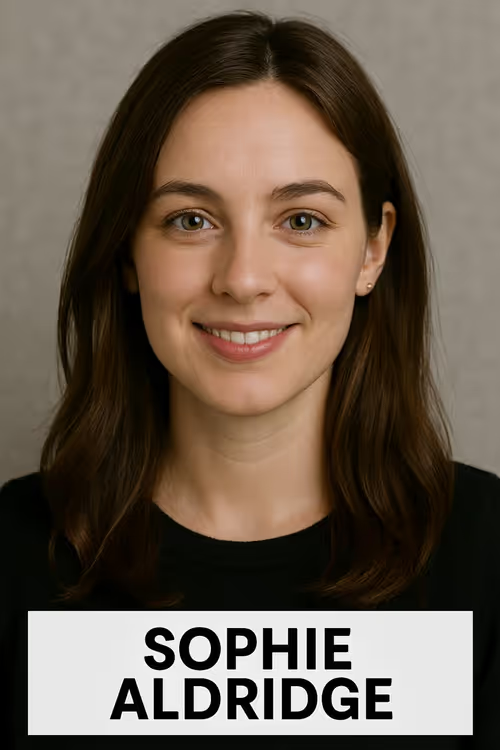
Sophie Aldridge
Global Economics Editor · Geopolitics
Sophie spent a decade advising governments on trade policy before deciding the story was more interesting than the memo. She covers global economics, geopolitics, and the power transitions reshaping emerging markets. Sharpest on sanctions, supply chains, and the politics behind the price of everything. Based in Washington, D.C. Reach out at sophie.aldridge@theplatinumcapital.com.