

Real Estate Private Credit: Filling the Lending Gap
As traditional banks retreat from complex real estate financing amid tightening regulatory constraints and elevated interest rate volatility, private credit has emerged as the dominant force reshaping how landmark assets and large-scale developments secure capital across global markets. For family offices, sovereign wealth managers, and sophisticated investors seeking yield with structural protections, real estate private credit now represents one of the most compelling risk-adjusted opportunities in an increasingly fragmented lending landscape.…

When AHS Properties acquired the Shangri-La Dubai for Dh1.1 billion in early 2026, the deal closed before most of the market even knew it was live. When Arabian Acres structured a Dh400 million beachfront land transaction in March — 113,000 square feet of one of the Gulf's last contiguous coastal plots — the firm described the window to act as exceptionally narrow. These are not isolated moments of boldness. They are symptoms of a market moving faster than conventional bank lending can accommodate. And into that gap, real estate private credit has quietly built one of the most consequential financing ecosystems in global property today.
The Gap That Banks Left Behind
After the regulatory tightening that reshaped global banking post-2008, and again following the stress events of 2022 and 2023, traditional lenders retreated from complexity. Development finance. Transitional assets. Deals requiring speed or structural creativity. All became too difficult, too capital-intensive, too slow to approve. In the Gulf specifically — where transaction timelines can compress dramatically and where a single off-market beachfront parcel might carry a billion-dirham development projection — the mismatch between what banks offer and what developers actually need has become permanent. Not cyclical. Permanent.
Private credit moved into that space. Real estate private credit — bridge loans, mezzanine financing, preferred equity, whole loans — now functions as the connective tissue between ambitious capital allocation and execution on the ground. Globally, the private credit market crossed USD 2.1 trillion in assets under management by the end of 2025, according to Preqin, with real estate-backed strategies accounting for an estimated USD 400 to 500 billion of that total. Gulf-linked strategies have grown disproportionately fast within that figure.
Dubai and Riyadh: Where Speed Demands Alternative Capital
Knight Frank's Wealth Report 2026, published in April, confirmed what anyone operating inside Dubai already knew. The emirate recorded a 25.1% surge in luxury property values, cementing its position as the world's leading market for transactions above USD 10 million. The report projects the number of ultra-high-net-worth individuals in the UAE will rise from 4,851 to 6,588 by 2031. A 36% increase in a single half-decade. That is not a rising tide. That is a structural demographic shift in where global wealth concentrates — and it creates demand for real estate capital that bank credit committees, with their layers of review and sign-off, simply cannot serve in time.
Abbas Sajwani, founder and CEO of AHS Properties, built a portfolio spanning Palm Jumeirah, Emirates Hills, and Sheikh Zayed Road in under five years. From founding in 2021 to a Dh1.1 billion hotel acquisition — that velocity is not achievable through conventional term lending alone. Across the market, developers of comparable ambition are turning to private credit providers who can underwrite within days, price risk with precision, and fund without the delays that cost positions. The Arabian Acres beachfront deal makes the point cleanly: in super-prime Dubai, hesitation is capital destruction.
The Structure of the Opportunity
Real estate private credit is not a single thing. The most sophisticated family offices and private investors accessing this market are deploying across a spectrum of instruments, each with a distinct risk-return profile. Senior bridge lending — short-duration, first-lien secured against prime assets — typically generates net returns of 8% to 12% per annum in Gulf-adjacent strategies, with strong asset coverage providing meaningful downside protection. Mezzanine debt, sitting between senior debt and equity in the capital stack, commands higher yields, often 12% to 18%, in exchange for subordinated positioning. Preferred equity structures, increasingly common in ultra-luxury development in Dubai and in the nascent luxury residential pipeline emerging from Riyadh's Vision 2030 projects, offer equity-like participation with contractual return preferences.
For family offices managing between USD 100 million and USD 1 billion in assets across the Gulf, Central Asia, and Southeast Asia, real estate private credit offers something institutional public markets cannot replicate: genuine illiquidity premium, low correlation to listed equities, and hard asset exposure in jurisdictions where real estate is performing as a primary wealth-preservation vehicle. The numbers tell a complicated story for anyone watching currency pressure in Kazakhstan, Nigeria, or Malaysia. Allocators from all three markets are moving into dirham- and riyal-denominated credit strategies. The reasoning is straightforward. The hedge is structural.
Risk, Discipline, and the Premium on Expertise
The returns are real. So are the risks. Experienced allocators understand the difference between a well-structured private credit position and undisciplined yield-chasing dressed in similar clothing. The most significant risk in real estate private credit is not interest rate movement — most Gulf-linked strategies carry floating rate structures that provide inherent protection against that. The real risks are asset quality, underwriting rigour, and borrower covenant discipline. In a market experiencing the kind of price appreciation Dubai has sustained, overleveraged developers can start treating private credit as a substitute for the equity they should be putting in themselves. That is a warning sign. Credible private credit managers counter it through loan-to-value discipline — typically lending at 55% to 70% of current value on prime assets — and through senior security positions that protect recovery in stress scenarios.
Origination quality matters enormously. The best private credit platforms operating in the Gulf today maintain direct relationships with developers, family-owned construction groups, and land-owning families whose assets never reach public brokerage channels. That access — to off-market collateral, to borrowers who value discretion, to deal flow that institutional banks and public funds never see — is the genuine competitive advantage separating return-generating strategies from the rest. Few outside the region fully appreciate how much of the real transaction activity moves through those private channels. They should.
Positioning for Sophisticated Allocators
The conditions supporting real estate private credit in the Gulf are not cyclical. Bank regulatory capital requirements will not loosen meaningfully. Development ambition in Dubai and Riyadh will not contract. The UHNWI population in the UAE alone will grow by more than a third within five years, and Vision 2030 is generating an entirely new category of large-scale residential and hospitality development in Saudi Arabia that will require patient, flexible capital at every stage of the capital stack. The demand side is not going away.
For private investors, family office principals, and sovereign-adjacent capital allocators across the Gulf, Central Asia, and Africa, the relevant question is no longer whether to access real estate private credit. The asset class has earned its place in sophisticated portfolios. The question is how to access it — with underwriting rigour, jurisdictional expertise, and origination depth that the current moment demands. In a market where a 160-metre beachfront parcel in Dubai disappears within days, the capital that moves with conviction and structure will keep defining the terms. Everything else will read about it afterwards.
Written by
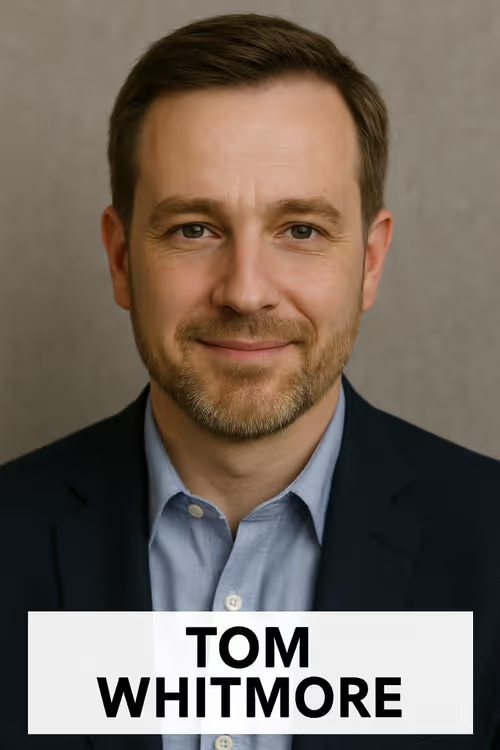
Tom Whitmore
Senior correspondent · Real Estate & Private Companies
Tom has interviewed most of the operators reshaping the Gulf skyline — and a few of the ones who tried and didn't. His beat is real estate, commodities, manufacturing, and the founder-led private companies that never bother to list. He knows which buildings and balance sheets survive a downturn before the spreadsheet does. Based in Dubai. Reach out at tom.whitmore@theplatinumcapital.com.