

Riyadh's Commercial Property Market and Vision 2030
Riyadh's commercial property market is undergoing a structural transformation of historic proportions, driven by Vision 2030's relentless push to position the Saudi capital as the preeminent business hub of the Middle East, attracting sovereign wealth, multinational headquarters, and institutional capital at a pace that is redefining regional investment hierarchies. For discerning investors and family offices seeking long-term asset appreciation in a market still in the early stages of its maturity curve, the convergence of regulatory reform, infrastructure expenditure exceeding half a trillion dollars, and surging corporate demand presents a generational opportunity that few emerging gateway cities have offered with comparable strategic clarity.…

Riyadh is no longer preparing for transformation. It is mid-execution. Cranes punctuate the expanding commercial districts of the Saudi capital with the regularity of punctuation marks, and capital is flowing at a pace that would have seemed wildly optimistic five years ago. The announcement in May 2026 of the Dar Al Salam real estate fund — a $400 million (SAR 1.5 billion) vehicle co-established by Riyad Capital, Naif AlRajhi Investment Company, and Princess Munira bint Abdullah bin Faisal Al Saud — crystallised what serious investors have understood for some time: Riyadh's commercial property market is not a speculative play. It is a structural bet on one of the most deliberate urban reinventions in modern economic history.
A Market Built on Institutional Conviction
The Dar Al Salam fund, reported by AGBI on May 11, 2026, is instructive precisely because of who is sitting at the table. Riyad Capital, one of Saudi Arabia's most respected asset managers, brings institutional credibility. Naif AlRajhi Investment Company carries deep local market knowledge rooted in one of the Kingdom's most influential financial families. And the participation of a Saudi royal family member signals an explicit alignment between private capital and national development priorities. That alignment is not incidental — it is the architecture of the deal. The fund's mixed-use project spans 32,000 square metres and sits just 250 metres from Al-Takhassusi Metro Station, a location that tells you exactly how seriously Riyadh's developers are treating transit-oriented density as the spine of long-term commercial value.
This is not opportunistic capital in motion. When family investment offices, sovereign-adjacent entities, and institutional asset managers co-anchor a fund of this scale, they are collectively signalling that Riyadh's commercial property cycle has entered consolidation — not speculation. For private investors and family offices monitoring the Gulf, that distinction matters enormously.
Vision 2030 as a Commercial Property Catalyst
Riyadh's commercial real estate market cannot be read without understanding the policy architecture beneath it. Vision 2030, now well past its halfway point, has reoriented the Saudi economy with deliberate force. The government's targets — raising non-oil GDP contribution, expanding tourism receipts to over $100 billion annually, growing the share of entertainment, hospitality, and professional services — carry direct consequences for commercial property demand across office, retail, hospitality, and mixed-use formats. These are not aspirational numbers. They are procurement orders for physical space.
Riyadh alone is projected to require an additional 4.5 million square metres of commercial office space by 2030 to absorb the influx of regional headquarters, international firms, and government-linked entities expanding their footprint in the Kingdom. The Saudi government's Regional Headquarters Programme — offering significant incentives for multinationals to base their Middle East operations in Riyadh rather than Dubai — has already pulled in over 200 companies. Each of them needs Grade A office accommodation in districts such as King Abdullah Financial District, Olaya, and the capital's rapidly maturing eastern corridors.
The Dubai Comparison — and Why It Matters for Regional Investors
Riyadh's trajectory gets benchmarked against Dubai constantly. The comparison has limits, but it is analytically useful. Dubai's commercial and luxury real estate market in 2026 continues to set the regional standard for deal scale and investor appetite. In March 2026, Arabian Acres acquired a Dh400 million Jumeirah beachfront site spanning over 113,000 square feet and 160 metres of private Gulf frontage — a transaction projected to yield a gross development value exceeding Dh1 billion through three ultra-luxury villa developments. Separately, luxury developer AHS Properties — founded by Abbas Sajwani in 2021 — acquired the Shangri-La Dubai hotel on Sheikh Zayed Road for Dh1.1 billion, consolidating what has become one of the more aggressive institutional portfolios in Dubai's premium segment.
These transactions matter to Riyadh watchers for a specific reason. They confirm the appetite of Gulf-based capital for large-format, high-conviction real estate positions. Family offices already active in Dubai are increasingly treating Riyadh not as an alternative but as a complement — a second allocation within a coherent Gulf real estate strategy. The risk profile differs. The return timeline differs. The tenant base differs. But the underlying driver — state-backed urban expansion with demographic tailwinds — runs through both markets.
Where Commercial Demand Is Concentrating
Within Riyadh, commercial investment is not spreading evenly. King Abdullah Financial District has become the address of choice for financial services, legal, and consulting firms, with infrastructure built explicitly for institutional occupiers. Occupancy rates in KAFD's premium towers have moved materially — some estimates place Grade A vacancy below 12 percent as of early 2026, a sharp tightening from the mid-20s percentages recorded just three years prior. That is a significant shift, and it has happened quietly.
The northern corridor, anchored by King Salman Road and extending toward the emerging Diriyah Gate development, is pulling in hospitality and mixed-use capital. Diriyah Gate alone represents a $63 billion masterplan and will generate sustained commercial and retail property demand across a multi-decade horizon. Transit-oriented micro-markets, meanwhile — as the Dar Al Salam fund's positioning near Al-Takhassusi Metro Station makes plain — are attracting developer attention as Riyadh's metro network reaches critical mass in ridership and urban integration.
What Forward-Looking Investors Should Consider
For family offices, private investors, and institutional allocators watching the Gulf from Southeast Asia, Central Asia, or Africa, Riyadh's commercial property market in 2026 offers a genuinely differentiated opportunity set. Entry points for structured fund participation — as Dar Al Salam illustrates — sit in the $50 million to $400 million range for co-investment or anchor positions. Direct development plays in secondary commercial districts can be structured at lower thresholds.
Three factors deserve close attention. First, the regulatory environment under Vision 2030 has moved consistently toward foreign investor facilitation — ownership structures, profit repatriation, and dispute resolution frameworks have all improved, and the direction of travel has been consistent. Second, the tenant base is diversifying well beyond government-linked entities, with private sector services, technology, and entertainment companies now accounting for a growing share of commercial leasing activity. Third — and this is the number that tends to end conversations — Riyadh's population is currently approaching 8 million and projected to reach 15 to 17 million by 2030 under official planning scenarios. That kind of demographic pressure sustains commercial property demand regardless of where oil trades in any given quarter.
The capital entering Riyadh today through vehicles like Dar Al Salam is not chasing a cycle. It is buying position in a city that, by the end of this decade, will look fundamentally different from the one that exists today. The window for early-stage participation is still open. It will not stay that way indefinitely.
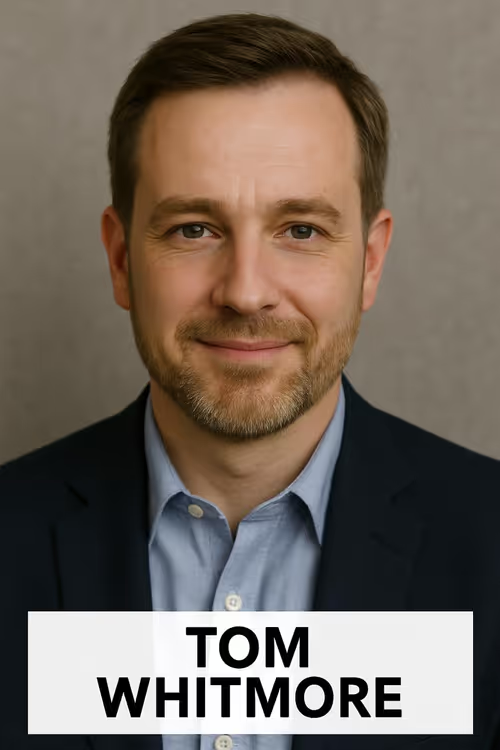
Written by
Tom Whitmore
Senior correspondent · Real Estate & Private Companies
Tom has interviewed most of the operators reshaping the Gulf skyline — and a few of the ones who tried and didn't. His beat is real estate, commodities, manufacturing, and the founder-led private companies that never bother to list. He knows which buildings and balance sheets survive a downturn before the spreadsheet does. Based in Dubai. Reach out at tom.whitmore@theplatinumcapital.com.