

Rola Abu-Manneh: Standard Chartered UAE CEO Redefines Regional Banking
Under Rola Abu-Manneh's stewardship, Standard Chartered UAE has evolved from a traditional correspondent bank into a sophisticated financial architecture serving the region's most complex cross-border capital flows, positioning Dubai as an indispensable corridor between East and West. Her disciplined approach to relationship-driven banking, combined with an acute understanding of sovereign wealth dynamics and emerging market connectivity, has redefined what institutional leadership looks like in an era where Gulf financial centers are aggressively competing for global relevance.…

In a region where banking leadership has long been defined by institutional scale and sovereign backing, Rola Abu-Manneh has carved a different kind of position — one built on market intelligence, client trust, and a disciplined approach to international capital. As Chief Executive Officer of Standard Chartered UAE, Abu-Manneh oversees one of the most strategically significant franchises in the Gulf, sitting at the intersection of East-West trade flows, sovereign wealth deployment, and the accelerating internationalisation of GCC balance sheets. Her influence extends well beyond the bank's UAE headquarters. It shapes how a global institution with a 160-year emerging market heritage positions itself inside one of the world's most competitive financial centres.
Steady Rates, Sharper Strategy
The GCC's monetary environment in mid-2026 has rewarded institutions that prepared for prolonged rate stability rather than betting on cuts. Gulf central banks have held benchmark rates steady for a third consecutive period, mirroring the US Federal Reserve's decision to keep its rate between 4.25% and 4.5%. The window for repricing loan books has narrowed. But net interest margins for well-capitalised banks remain supportive — and Standard Chartered UAE is well-capitalised.
The bank's corporate and institutional client base skews toward multinational treasuries, sovereign-linked entities, and large regional conglomerates. These clients tend to hold more durable deposit relationships than the customers of retail-heavy competitors. Revised market expectations now point to a smaller Fed rate cut in 2026 than initially projected, which hands Abu-Manneh's team an additional tailwind for margin preservation through the second half of the year.
She has used this period of monetary consolidation to push harder into fee-based and advisory revenues — areas far less sensitive to rate movements and far more reflective of what Standard Chartered's global network actually delivers. That is a structurally sound move for a franchise whose competitive edge lies not in domestic deposit gathering but in cross-border execution. The bank is not trying to out-muscle Emirates NBD on its home turf. It is playing a different game entirely.
Operating Inside a $1.47 Trillion Banking System
The UAE banking sector has reached a scale that commands serious international attention. Total banking assets now stand at Dh5.56 trillion — roughly $1.47 trillion — according to the Central Bank of the UAE's most recent figures. Nearly $250 billion sits in reserve balances at the central bank itself. That is a level of systemic liquidity depth that few emerging market peers can match, and few do.
The CBUAE's $270 billion Financial Institution Resilience Package, launched in March 2026 under Governor Khaled Balama and chaired by Sheikh Mansour bin Zayed Al Nahyan, signals something important: the sovereign is not a passive observer of financial system stability. It is an active custodian. For international banks operating in the UAE, that framework provides a credible backstop and a clear regulatory posture.
Standard Chartered operates inside this environment not as a challenger to domestic giants but as a specialist bridge. It connects UAE-based capital to markets in South and Southeast Asia, Sub-Saharan Africa, and the broader emerging world — markets where few Gulf-headquartered institutions have comparable on-the-ground infrastructure. That positioning has grown more valuable as UAE family offices and sovereign-linked funds expand allocations into Vietnam, Indonesia, Nigeria, and Kenya. Abu-Manneh has been a consistent and credible voice articulating exactly this network proposition to institutional clients and regulators alike. People listen.
Debt Capital Markets and the Bond Rally Dividend
Late June 2026 delivered a striking signal from GCC bond markets. More than $7.5 billion in regional debt priced within a single week, as easing geopolitical pressures reignited appetite from international fixed-income investors. The numbers tell a complicated story — but the headline is clear enough. Investor demand for high-grade Gulf paper remained structurally intact even through a period of genuine global macro uncertainty. Sophisticated GCC issuers had been positioning for exactly this moment.
Standard Chartered, with its established debt capital markets franchise and direct access to Asian and European institutional investor bases, is well-placed to take a meaningful share of that activity as issuance pipelines build through the second half of the year. Abu-Manneh's tenure has coincided with a deliberate broadening of the bank's advisory mandate — across corporate bond issuance, sukuk structuring, and liability management transactions for both private sector issuers and government-related entities. This is not accidental. It reflects a strategic investment in the UAE's growing role as the primary debt issuance hub for the wider MENASA corridor, a corridor that Standard Chartered knows better than almost any institution operating in Dubai today.
Growth Moderation and the 2027 Opportunity
The Central Bank of the UAE's June 2026 Quarterly Economic Report projected GDP growth of 1.7% for the current year — a moderation shaped by pressures on trade, shipping, and private sector confidence. Then comes the sharp rebound: 9.8% in 2027, underpinned by higher oil production and non-oil sector expansion. Inflation stays contained at 2.3% in 2026, easing further to 1.9% the year after. For any executive running a medium-term investment mandate, those numbers frame a clear near-term challenge and a significant medium-term opportunity in the same breath.
Abu-Manneh has been deliberate about managing through the 2026 moderation without retreating from client commitments or scaling back regional infrastructure. That discipline matters. Institutions that maintain origination capacity and relationship depth through softer cycles consistently find themselves better positioned when credit growth accelerates again. The UAE's non-oil economy keeps expanding — anchored by financial services, logistics, technology, and professional services. If the 2027 rebound materialises at the projected rate, it would represent one of the more significant growth pulses in Gulf banking since the post-pandemic recovery. That is not a moment you want to enter under-resourced.
What This Means for Private Capital and Family Offices
For family office principals, private investors, and wealth managers operating in or through the UAE, the strategic direction Abu-Manneh has set at Standard Chartered carries real practical implications. The bank's emphasis on cross-border capital flows, emerging market credit, and international transaction banking makes it a meaningful institutional counterpart for clients whose portfolios span multiple jurisdictions. Families with assets or operating businesses across the Gulf, South Asia, East Africa, or Southeast Asia benefit from a correspondent banking relationship where the network depth is genuine — not aspirational, not a slide in a pitch deck.
The UAE now hosts an estimated $500 billion in managed private assets, and that figure is still growing. Few outside the region have fully absorbed what that means for the competitive structure of international banking here. They should. As demand intensifies for institutions that can operate credibly across both the institutional and ultra-high-net-worth client spectrum, Rola Abu-Manneh's Standard Chartered UAE sits squarely at that intersection — a bank with global reach, a CEO with regional authority, and a market that is, by any credible measure, still early in its financial maturity.
Written by
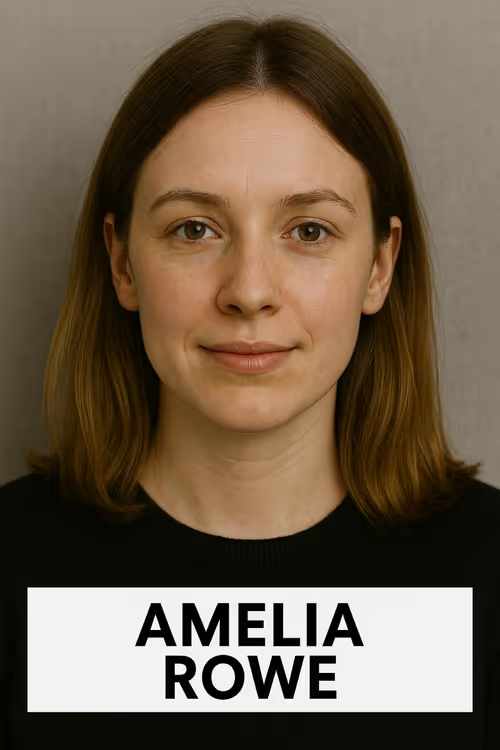
Amelia Rowe
Senior correspondent · Banking & Economy
Amelia spent eight years inside a sovereign wealth fund before deciding she'd rather write about institutional money than allocate it. She covers central banking, insurance, and the macro decisions that quietly choose which markets get the next decade. Sharp on monetary policy; impatient with anyone who confuses noise with signal. Based in London. Reach out at amelia.rowe@theplatinumcapital.com.