
Sovereign Wealth Funds and Their Expanding Global Influence
Sovereign wealth funds, once regarded as passive custodians of national reserves, have evolved into formidable architects of the global economic order, deploying trillions of dollars across strategic sectors from artificial intelligence and green infrastructure to private equity and sovereign debt. For family offices, institutional investors, and policymakers navigating an increasingly multipolar financial landscape, understanding the investment mandates and geopolitical motivations driving these state-backed giants is no longer optional — it is an imperative that will define the next generation of capital allocation.…

Sovereign wealth funds were once patient, largely passive vehicles — repositories of commodity windfalls managed at arm's length from global markets. That era is over. In 2026, the world's largest state-backed investment vehicles are operating with the strategic aggression of the most sophisticated private equity firms, deploying capital across asset classes, geographies, and technologies at a speed and selectivity that is reshaping the architecture of global finance. For family offices, private investors, and emerging market governments watching from the sidelines, the message is unambiguous: sovereign wealth funds are no longer just allocators. They are agenda-setters.
Scale, Speed, and Strategic Ambition
The numbers alone command attention. The world's sovereign wealth funds collectively manage in excess of $12 trillion in assets, with Gulf-based vehicles accounting for a disproportionate — and growing — share of that figure. Abu Dhabi Investment Authority, Mubadala, and Saudi Arabia's Public Investment Fund have each undergone significant strategic transformation over the past three years, moving away from diversified passive portfolios toward concentrated, high-conviction bets on sectors they believe will define the next two decades: artificial intelligence infrastructure, clean energy, logistics, and advanced manufacturing.
PIF, with assets now exceeding $700 billion, is the most visible symbol of this shift. Its investments span giga-projects inside the Kingdom, strategic stakes in global technology firms, and co-investment relationships with some of the world's largest private equity sponsors. What sets PIF apart from its predecessors is not merely scale — it is intentionality. Every allocation ties explicitly to Vision 2030's domestic economic objectives, making PIF simultaneously a sovereign investor and a national development instrument. That is a genuinely unusual combination, and markets have not fully priced in what it means at scale.
The Gulf as the New Centre of Deal-Making Gravity
The pull of Gulf capital is now undeniable, and it extends well beyond the sovereign tier. The March 2026 partnership between the Texas-based Patel Family Office and Dammam's Abdelmalik Tariq Al-Qahtani Co. — an affiliate of the respected Abdel Hadi A. Al-Qahtani & Sons group — to launch the AYARA hotel platform is a precise illustration of how sovereign-led economic strategy creates downstream investment opportunity at scale. The $1 billion agreement targets the delivery of up to 50 internationally branded business hotels across Riyadh, Jeddah, Dammam, the Red Sea region, and NEOM by 2029. Between 5,000 and 7,000 rooms. Among the largest individual hotel investment transactions in Saudi Arabia to date.
The deal was signed at the FII PRIORITY Summit in Miami. That detail matters. It reflects a broader dynamic playing out in boardrooms from London to Singapore: sovereign-backed master plans — in this case, Vision 2030's aggressive push to grow tourism and business travel — are functioning as de facto invitation letters to global private capital. Where sovereign wealth funds build the framework, family offices and private investors are finding the investable opportunity. Corporate travel inside the Kingdom alone is projected to grow substantially as international business activity intensifies around NEOM and the Red Sea development zones. AYARA is not a speculative bet. It is a precisely positioned answer to a demand curve already in motion.
GP-Stakes and the Institutionalisation of Private Markets Access
The expanding influence of Gulf-anchored capital is equally visible in the structural evolution of private markets. On March 6, 2026, Bahrain-based Investcorp closed its second GP-stakes fund at $1.25 billion in total commitments — including $155 million allocated to co-investments — marking a 75 percent increase over its predecessor vehicle. The close brings Investcorp's total assets under management within its GP-staking unit to more than $2.4 billion. That cements its position as one of the most active practitioners of a strategy that was, until recently, dominated almost exclusively by North American institutions. Few outside the region noticed that shift coming. They should have.
GP-stakes investing — the acquisition of minority equity positions in private investment management firms — offers a structurally compelling proposition: exposure to long-duration management fee streams, carried interest participation, and diversification across multiple fund strategies through a single vehicle. For sovereign wealth funds and large family offices seeking to deepen relationships with best-in-class private equity managers while generating recurring income, the logic is hard to argue with. Investcorp raised $1.1 billion in limited partner commitments for this vehicle, drawing from a genuinely global investor base. Gulf-origin alternative asset platforms are no longer simply regional champions. They are competing directly with the world's most established private markets firms — and winning mandates to prove it.
Currency Diversification and the Dollar's Diminishing Primacy
Perhaps the most consequential strategic shift underway among Gulf investors in 2026 is the quiet but accelerating move away from dollar concentration. According to the UBS Global Family Office Report 2026 — published May 28, drawing on surveys of 307 family offices globally — more than half of Middle East family offices now believe they are overexposed to the US dollar. Nearly a third are actively planning to increase diversification across multiple currencies. The Swiss franc and euro are the preferred alternatives.
This is not a marginal reallocation. For family offices managing portfolios in the hundreds of millions — and in several cases, billions — even a modest reduction in dollar exposure represents significant flows into non-North American assets. The drivers are well understood within the community: geopolitical uncertainty, fiscal trajectory concerns in the United States, and a growing recognition that concentration in a single reserve currency carries systemic risk that sectoral diversification alone cannot address. Sovereign wealth funds across the Gulf, operating with longer time horizons and greater political insulation, are already ahead of the family office community on this transition. But the direction of travel is now aligned. Watch what that convergence does to allocation flows over the next 24 months.
What This Means for Private Investors and Emerging Market Allocators
For wealthy individuals, family office principals, and institutional investors operating across the GCC, Central Asia, Africa, and Southeast Asia, the expanding role of sovereign wealth funds carries direct and actionable implications. Sovereign capital is flowing into markets — Vietnam, Indonesia, Morocco, Kazakhstan — where investment infrastructure is maturing but international private capital remains underweight. Where sovereign funds lead, valuations follow. Co-investment windows tend to close fast.
The more nuanced opportunity lies in positioning ahead of sovereign-driven sector pivots. Saudi Arabia's hospitality build-out, evidenced by the AYARA platform, is one example. Gulf sovereign funds' deepening commitment to AI infrastructure, logistics corridors, and clean energy across Africa and Southeast Asia is another. Private investors who understand where sovereign capital is moving — and who carry the relationships, local knowledge, and execution capability to move alongside it — hold a structural advantage that no amount of public market sophistication can replicate. The age of sovereign wealth as a passive force is finished. The age of sovereign wealth as the defining current of global capital markets has already begun.
Written by
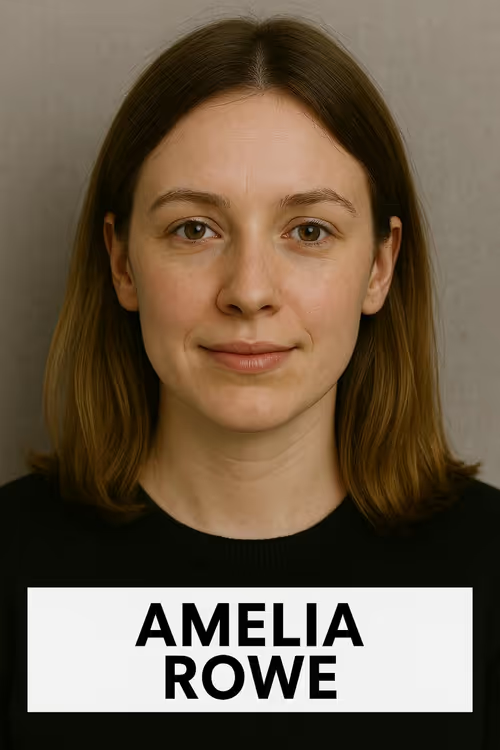
Amelia Rowe
Senior correspondent · Banking & Economy
Amelia spent eight years inside a sovereign wealth fund before deciding she'd rather write about institutional money than allocate it. She covers central banking, insurance, and the macro decisions that quietly choose which markets get the next decade. Sharp on monetary policy; impatient with anyone who confuses noise with signal. Based in London. Reach out at amelia.rowe@theplatinumcapital.com.