

Deutsche Bank And Commerzbank Reopen €38bn German Banking Merger Talks At Berlin Government Encouragement
Deutsche Bank and Commerzbank formally reopened structured exploratory merger discussions on Thursday — confirmed in parallel disclosures issued in Frankfurt by both banks under Chairman Alexander Wynaendts and CEO Christian Sewing for Deutsche Bank, and Chairman Jens Weidmann an…

Deutsche Bank and Commerzbank formally reopened structured exploratory merger discussions on Thursday — confirmed in parallel disclosures issued in Frankfurt by both banks under Chairman Alexander Wynaendts and CEO Christian Sewing for Deutsche Bank, and Chairman Jens Weidmann and CEO Bettina Orlopp for Commerzbank — marking the third attempt at constructing the long-anticipated German national-champion banking combination since the 2019 collapse of the original Olaf Scholz-Treasury-led merger framework and the more limited 2024 capital-cooperation discussions that did not progress beyond the initial scoping phase.
The renewed discussion architecture, formally articulated in the joint statement released Thursday morning following an emergency Berlin meeting with Finance Minister Lindner and Chancellor's Office representatives, comprises a structured six-month exploratory phase across which the two boards are mandated to evaluate the strategic, financial, and operational case for an all-share combination valued at approximately €38 billion at the prevailing market-capitalisation framework. The post-combination entity would create the largest European bank by total assets at approximately €2.3 trillion, comfortably exceeding BNP Paribas, HSBC, and Santander on the equivalent measure.
The German federal government's role in catalysing the Thursday reopening is the more politically significant dimension. Berlin still retains approximately 12% of Commerzbank's equity through the post-2008-financial-crisis stake that has never been fully unwound, providing the federal government with direct standing in any combination discussion. Chancellor Friedrich Merz's coalition has been increasingly vocal across the post-2025 government-formation cycle about the strategic-vulnerability dynamic created by the absence of a German national-champion bank at a scale competitive with the post-2008 consolidation cycle outcomes in France, Spain, the Netherlands, and the UK.
The competitive context is meaningful. The European banking-sector consolidation cycle has progressively accelerated across the post-2023 window — anchored on the BBVA-Sabadell combination (closed Q4 2024, €11 billion), the UniCredit-Commerzbank stake-building cycle that ultimately did not progress to a combination (UniCredit ultimately divested in late 2025), the BPCE-La Banque Postale merger in France (closed Q1 2025, €18 billion), and the Nordea-Danske Bank exploratory discussions that have been at the substantively advanced stage since H2 2025. The Thursday Deutsche-Commerzbank reopening is the largest single potential transaction in the cycle and substantively reshapes the European banking-sector competitive architecture.
For investors and operators across the global banking, capital-markets, and European-financial-services landscape, the Thursday Deutsche-Commerzbank exploratory-discussion reopening is the clearest single confirmation that the substantial post-2023 European-banking consolidation cycle has continued to compound and that the German banking-sector strategic-positioning recalibration has finally entered a substantive transaction-construction phase. The principal forward variable through the rest of the year is the rate of progression on the structural-and-financial-evaluation phase — with the exploratory phase formally targeted to complete by end-November 2026, ahead of any binding-agreement framework that would be presented to both boards across the Q1 2027 envelope.
Written by
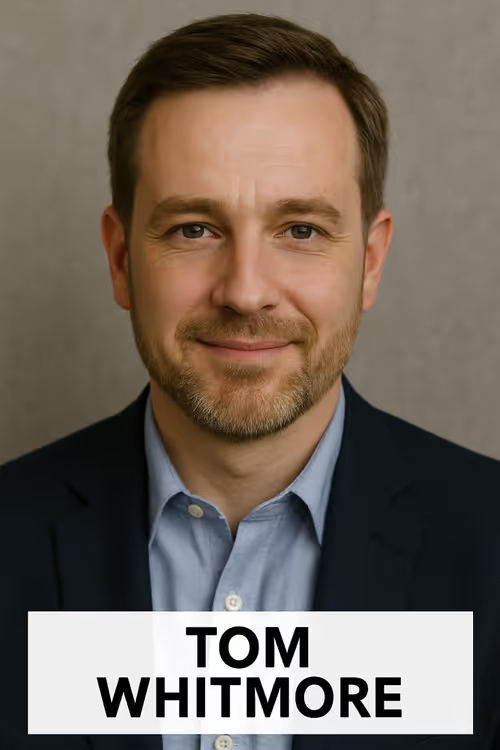
Tom Whitmore
Senior correspondent · Real Estate & Private Companies
Tom has interviewed most of the operators reshaping the Gulf skyline — and a few of the ones who tried and didn't. His beat is real estate, commodities, manufacturing, and the founder-led private companies that never bother to list. He knows which buildings and balance sheets survive a downturn before the spreadsheet does. Based in Dubai. Reach out at tom.whitmore@theplatinumcapital.com.