
LNG Market Dynamics After Europe's Energy Restructuring
Europe's aggressive pivot away from Russian pipeline gas has permanently redrawn the global LNG trade map, forcing long-term supply contracts to migrate toward Atlantic Basin terminals while pushing spot market premiums to levels that reward only the most strategically positioned buyers. For sovereign wealth managers and family offices with exposure to energy infrastructure, the resulting structural tightness across European regasification capacity presents both a generational arbitrage opportunity and a sobering reminder that energy security now commands a geopolitical premium no model fully anticipated.…
Russia's invasion of Ukraine in 2022 broke the European energy market open. Four years on, the fractures have not healed — they have hardened into something new. The geopolitical turbulence of mid-2026 has added fresh pressure, forcing buyers, sellers, and infrastructure investors to tear up assumptions that looked solid just twelve months ago. For private capital allocators, family offices, and sovereign-adjacent investors with energy exposure, this is a structural inflection point. It is also a genuinely rare window.
Europe's Appetite Has Not Diminished — It Has Matured
When Europe scrambled to replace Russian pipeline gas in 2022, the initial response was panic buying at almost any price. What came next was something more durable. Floating storage and regasification units went up rapidly across Germany, the Netherlands, Italy, and the Adriatic coast. Long-term supply agreements were locked in with the United States, Qatar, and Norway. Russian supply dependency was systematically dismantled. By mid-2026, Europe is no longer a distressed buyer. It is experienced, price-sensitive, and strategically demanding — and that shift changes the calculus for every producer upstream.
European LNG imports have stabilised at roughly 120 billion cubic metres per year. That is down marginally from the emergency peak of 2023, but structurally elevated against pre-crisis norms. The more telling signal is contractual. Buyers led by TotalEnergies, Shell, and Germany's Securing Energy for Europe GmbH have moved decisively toward 10- to 15-year offtake agreements, abandoning the spot market exposure that burned them so badly before. That preference for contract certainty is reshaping the economics of new LNG projects globally — particularly mid-scale developments in East Africa, the Eastern Mediterranean, and Central Asia.
Hormuz Volatility Has Accelerated the LNG Repricing Cycle
The headline energy story of 2026 has been crude oil. But its indirect effect on LNG markets deserves equal attention — and has received far less of it.
When the US-Israeli military campaign against Iran triggered the closure of the Strait of Hormuz in late February, the immediate shock hit oil. Brent surged past $100 per barrel before briefly touching $126. LNG spot prices moved in near lockstep. Asian spot LNG — priced in part on crude oil indexation — spiked to approximately $18 per million British thermal units in late March, a level not sustained since the winter of 2022. The numbers tell a complicated story about how tightly these markets have become coupled.
The June 18 memorandum of understanding between Washington and Tehran brought temporary relief. Brent averaged $85 per barrel in June and fell below $70 by July 1 as Hormuz reopened. Spot LNG retreated accordingly, dropping to around $11 per MMBtu in early July. Then President Trump announced a reimposed blockade on Iranian vessels. Crude climbed back above $77. LNG traders are pricing in a renewed risk premium. For investors in LNG infrastructure and trading operations, that volatility is not noise — it is now a structural feature of this market, and it consistently rewards those holding diversified supply chains and long-term contracted positions.
Qatar and the Gulf's Strategic Advantage in a Fragmented Market
No producer has leveraged Europe's structural demand shift more effectively than Qatar. QatarEnergy's North Field expansion programme targets an increase in LNG production capacity from 77 million tonnes per annum to 142 MTPA by the end of the decade. It was designed precisely for a moment like this. With long-term supply agreements already locked in across Germany, France, Belgium, and the United Kingdom, Qatar sits largely immune to the spot market turbulence punishing shorter-term traders. That is a significant strategic advantage.
The UAE is running a parallel play in gas. Abu Dhabi National Energy Company — TAQA — and ADNOC LNG are expanding their upstream gas integration programmes, targeting European and South Asian demand simultaneously. ADNOC's recent announcement of a $5 billion investment in downstream gas infrastructure signals something important: Abu Dhabi is not positioning itself as a molecule supplier. It is building toward vertically integrated energy partnership. European governments, still raw from their experience of single-supplier dependency on Russia, respond to that distinction very differently than they once might have. The UAE's exit from the OPEC+ alliance in late April 2026 — freeing its production capacity to follow its own strategic interests — only adds flexibility to that positioning.
Central Asia and Africa: The Next Tier of Supply Contenders
Few outside the region have tracked this closely. They should.
Kazakhstan is quietly advancing LNG ambitions alongside its measured re-engagement with the broader hydrocarbons alliance — including an OPEC+ output increase of 10,000 barrels per day from August. The Kashagan and Tengiz fields hold vast associated gas reserves that infrastructure constraints have historically forced operators to reinject or flare. Proposed LNG conversion facilities along the Caspian corridor — backed in part by European offtake interest — are now attracting serious feasibility capital. KazMunayGas is in active discussions with European developers and Japanese trading houses including Mitsui and JERA. The direction of travel is clear.
In Africa, Tanzania's Lindi LNG project has re-emerged as a viable prospect after years of delays driven by financing complexity and community land negotiations. Renewed engagement between the Tanzanian government and a consortium including Shell and Equinor has injected fresh momentum. The project targets 15 MTPA of export capacity and has drawn preliminary interest from European buyers actively seeking geographic diversification away from the Hormuz corridor. Meanwhile, Nigeria's NLNG Train 7 — which reached final investment decision in 2021 — is now approaching first cargo and will add approximately 8 MTPA to Atlantic Basin supply. That tightens competition for European contract slots that looked abundant just two years ago.
What This Means for Private Capital and Family Offices
The LNG opportunity is not the oil opportunity. That distinction matters enormously for how private capital should approach it.
Crude is subject to OPEC+ output decisions and near-term geopolitical price swings — the fifth consecutive production increase announced on July 5 alone adds nearly 188,000 barrels per day from August. LNG value creation operates on a different clock. It is long-cycle, infrastructure-weighted, and considerably more defensible once contracted positions are established. Returns are less dramatic in the short run. They are also far more predictable.
Mid-scale LNG infrastructure in Southeast Asia represents arguably the most compelling entry point for private capital not chasing the headline risk of frontier exploration. Vietnam, Indonesia, and the Philippines are all accelerating gas-to-power transitions at pace. Regasification terminal stakes, FSRU leasing structures, and LNG trading book participation through established platforms offer risk-adjusted profiles that look increasingly attractive relative to conventional fixed income at current yield levels. Investors in the Gulf, Central Asia, and East Africa — who already understand how commodity cycles actually behave — are particularly well-placed to evaluate these structures without illusions.
Europe restructured its energy dependency out of necessity. The rest of the world is now rebuilding its LNG supply architecture by strategic choice. That distinction is where the value sits — and where patient, well-advised private capital will find its most durable returns over the next decade.
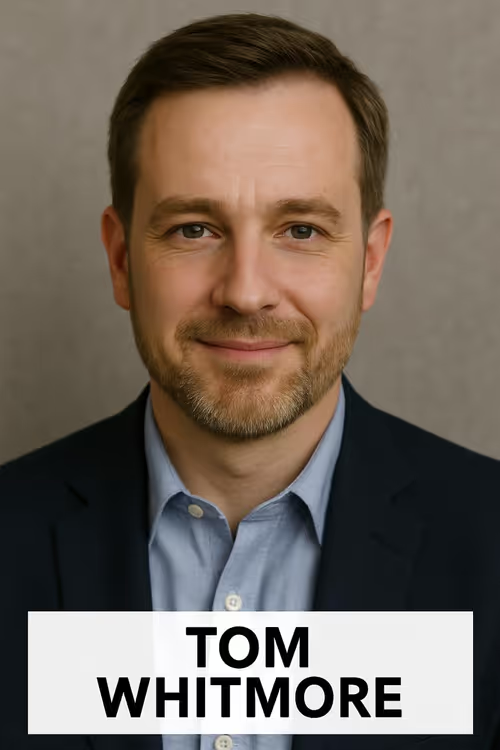
Written by
Tom Whitmore
Senior correspondent · Real Estate & Private Companies
Tom has interviewed most of the operators reshaping the Gulf skyline — and a few of the ones who tried and didn't. His beat is real estate, commodities, manufacturing, and the founder-led private companies that never bother to list. He knows which buildings and balance sheets survive a downturn before the spreadsheet does. Based in Dubai. Reach out at tom.whitmore@theplatinumcapital.com.