

LVMH Posts Record Q1 Revenue As Chinese Luxury Demand Surges Past Pre-COVID Peak Across All Divisions
LVMH Moët Hennessy Louis Vuitton reported record first-quarter revenue of €24.8 billion on Thursday — a 14% year-on-year increase at constant exchange rates and substantially ahead of the consensus analyst estimate of €23.1 billion — confirming that the post-2025 Chinese luxury-d…

LVMH Moët Hennessy Louis Vuitton reported record first-quarter revenue of €24.8 billion on Thursday — a 14% year-on-year increase at constant exchange rates and substantially ahead of the consensus analyst estimate of €23.1 billion — confirming that the post-2025 Chinese luxury-demand recovery has accelerated into a full-cycle surge across the group's Fashion & Leather Goods, Wines & Spirits, Watches & Jewellery, and Selective Retailing divisions, and that the global luxury market's structural growth trajectory has re-engaged at a pace that the most optimistic institutional-investor framing had been anticipating.
The divisional breakdown, articulated in the group's revenue release published Thursday morning in Paris, shows the Fashion & Leather Goods division — anchored on Louis Vuitton, Christian Dior Couture, Celine, Givenchy, and Loewe — delivering €12.1 billion in Q1 revenue, up 17% at constant exchange rates and the strongest quarterly growth rate the division has recorded since Q1 2022's post-lockdown reopening surge. The Watches & Jewellery division — comprising TAG Heuer, Hublot, Zenith, Bulgari, Chaumet, and Fred — delivered €2.9 billion, up 19%, with Bulgari's Rome-anchored high-jewellery collections and the continued strong commercial trajectory of TAG Heuer's connected-and-sport watch portfolio both contributing meaningfully to the outperformance.
The China-and-Asia-Pacific context is the principal demand-side anchor for the Thursday results. Mainland Chinese luxury consumption — which had been the dominant driver of global luxury-market growth across the 2015–2021 period before the post-2022 policy-uncertainty and economic-confidence headwind produced a meaningful demand softening — has recovered to and surpassed the pre-COVID peak on LVMH's internal consumption tracking across the Q1 2026 window, with Chinese consumers accounting for approximately 38% of the group's aggregate Q1 revenue on nationality-of-buyer measure. The recovery has been particularly pronounced in the high-jewellery, leather-goods, and cognac categories.
The wider global-luxury-market context is meaningful. The Q1 LVMH results are the most substantive single data-point confirmation of the cyclical recovery trajectory that the institutional-investor community has been building positions around across the 2025–2026 window. Competitor results across Hermès (Q1 revenue up 12% at constant exchange rates), Richemont (Q4 FY2026 revenue up 16%), and Kering (Q1 revenue up 8%, recovering from 2025 underperformance) have all collectively confirmed that the Chinese demand recovery and the continued strong European, US, and Middle Eastern luxury-consumption environment are simultaneously supportive of a multi-year structural-growth reinstatement for the global luxury sector.
For investors and operators across the global luxury-goods and consumer-discretionary landscape, the Thursday LVMH record Q1 revenue print is the clearest single confirmation that the substantial post-2025-anchored Chinese-demand-recovery cycle has continued to compound at a pace that substantially validates the most constructive institutional-investor thesis — and that the structural demand-growth tailwinds from the progressive expansion of the global high-net-worth and aspirational-luxury consumer base continue to provide the multi-year revenue-growth framework that the sector's premium-valuation architecture requires. The principal forward variable through the rest of the year is whether the Chinese domestic-consumption confidence environment sustains the current recovery trajectory through the remainder of the year.
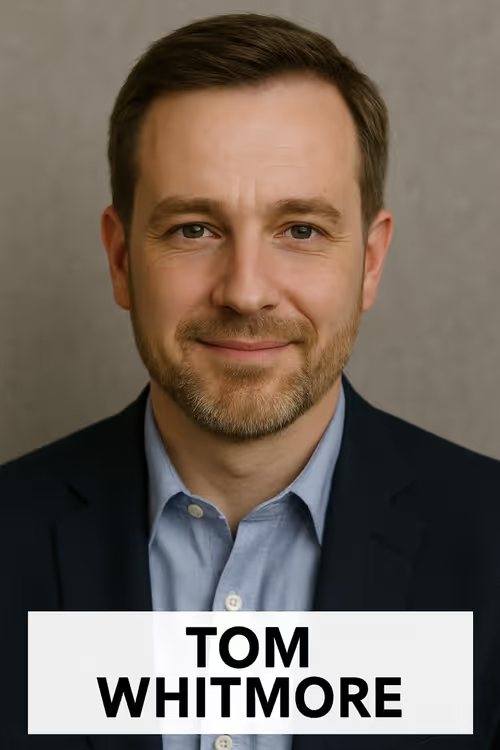
Written by
Tom Whitmore
Senior correspondent · Real Estate & Private Companies
Tom has interviewed most of the operators reshaping the Gulf skyline — and a few of the ones who tried and didn't. His beat is real estate, commodities, manufacturing, and the founder-led private companies that never bother to list. He knows which buildings and balance sheets survive a downturn before the spreadsheet does. Based in Dubai. Reach out at tom.whitmore@theplatinumcapital.com.

