

Africa Mobile Money Giants and Their Next Act
Africa's mobile money titans — from M-Pesa's sprawling East African dominance to Wave's insurgent West African expansion — are no longer content to serve as digital wallets for the unbanked, and are quietly repositioning themselves as full-spectrum financial infrastructure powering trade finance, cross-border settlements, and sovereign payment corridors. For the discerning capital allocator watching frontier markets, the next 36 months will determine whether these platforms consolidate into a handful of continent-scale financial utilities commanding premium valuations, or fracture under the weight of regulatory pressure and intensifying competition from Gulf-backed challengers moving aggressively into the space.…
For a decade, Africa's mobile money platforms rewrote the rules of financial access — turning feature phones into bank accounts and street-corner agents into the continent's most effective distribution network. M-Pesa processed more than $314 billion in transactions across 2024. MTN Mobile Money operates in 16 markets with over 290 million registered users. Wave has compressed remittance costs to near zero across francophone West Africa. These are not emerging stories. They are established infrastructure plays — and their leaders know it. The question now is what comes next. The answer is moving faster than most outside observers appreciate.
From Payments Rails to Financial Ecosystems
The first generation of African mobile money was about access. The next is about depth. Safaricom's M-Pesa has spent the last 18 months aggressively expanding its suite of credit, insurance, and savings products — effectively building a super-app layer on top of what began as a peer-to-peer transfer tool. In Kenya, the platform now processes merchant payments, business payroll, and government disbursements. That vertical integration mirrors what Ant Group built in China, albeit with distinctly African structural constraints and, it should be said, some structural advantages that analysts in Shanghai would envy.
MTN Group's fintech ambitions are equally deliberate. The Johannesburg-listed operator formally separated its MoMo division as a distinct fintech business unit and has been pursuing a standalone valuation strategy ahead of what analysts expect will be a partial listing — potentially targeting a valuation between $5 billion and $7 billion. MTN MoMo's annualised transaction value crossed $260 billion in 2024. Its expansion into merchant acquiring, cross-border corridors, and API-based banking-as-a-service positions it not merely as a telco payments arm but as regulated financial infrastructure across sub-Saharan Africa. The distinction matters enormously to how markets will price it.
The Licensing Race Changes Everything
Regulators across the continent are tightening the framework. The giants are accelerating to secure position before smaller windows close. Nigeria's Central Bank has issued Payment Service Bank licences to a select group of operators, with MTN's MoMo PSB and Airtel Money among the most active. In Ghana, the Bank of Ghana's enhanced mobile money interoperability framework — now fully operational — has erased the last friction points between operator wallets. Basic transfers are commoditised. The fight now moves upstream into credit and wealth products.
That regulatory maturation is being watched closely beyond the continent. When Saudi Arabia's SAMA issued its first live open banking licences in March 2026 — moving from sandbox pilots to full commercial API-sharing between banks and fintechs — it validated a model that African operators had been piloting for years out of pure necessity. Few outside the region noticed. They should have. The African mobile money sector effectively invented open-loop interoperability long before it became a regulatory aspiration in more formalised markets. That experience is now a legitimate competitive asset as these platforms eye expansion into the Gulf, Southeast Asia, and the diaspora corridors connecting both.
The Diaspora Corridor and Cross-Border Opportunity
Remittances into sub-Saharan Africa exceeded $54 billion in 2024, according to World Bank data. The average cost of sending that money to the region still runs above 7.5% — more than double the UN Sustainable Development Goal target. That gap is the single largest commercial opportunity in African fintech today, and the mobile money giants are moving to own it.
Wave, backed by Sequoia and Stripe, has already demonstrated what near-zero-cost remittance infrastructure looks like in Senegal and Côte d'Ivoire. The incumbents are responding with scale. Safaricom and Vodacom's Global M-Pesa cross-border product now connects corridors across Tanzania, Ghana, Egypt, Ethiopia, and — critically — into European diaspora hubs. The numbers tell a complicated story about just how much fee economics remain on the table.
Meanwhile, blockchain-adjacent rails are adding competitive pressure from an unexpected direction. Ripple's live pilot with Riyad Bank's digital arm Jeel in Saudi Arabia — testing blockchain-based cross-border transfers within a regulatory framework — signals that Gulf financial institutions are building infrastructure that will eventually meet African mobile money networks at the corridor level. Family offices and private investors with holdings across both regions should note this clearly: the infrastructure connecting African diaspora capital back to the continent is being built right now. The entities building it will capture significant fee economics for years to come.
The Fintech Sophistication Gap — and Who Is Closing It
The contrast between African mobile money incumbents and the new generation of AI-native financial platforms is instructive rather than threatening. Mal, the Abu Dhabi-based Islamic digital bank, raised $230 million in seed funding in January 2026 — one of the largest fintech seed rounds globally — with a team drawn from Revolut and Nubank and a mandate to deploy AI across mobile-first product development. Mal's target markets include Indonesia, Bangladesh, and Pakistan. Precisely the corridors where African mobile money operators have already proven the mass-market, mobile-first model at scale.
What the African giants carry that AI-native challengers lack is trust infrastructure — agent networks, brand recognition among populations with legitimate historical reasons to distrust formal financial institutions, and regulatory relationships built across 15 years of operational presence. That is not a soft advantage. It is extraordinarily difficult to replicate. What they must now acquire is the product sophistication that platforms like Tabby — valued at $4.5 billion following its October 2025 secondary sale, and now licensed by the UAE Central Bank to hold customer funds and issue payment cards — are deploying at speed. Whether the convergence of these two models happens through partnership, acquisition, or raw competitive pressure will define African fintech's next chapter.
What Sophisticated Investors Should Watch
For family offices and private capital with exposure to emerging markets, the African mobile money story has shifted. This is no longer a development finance narrative. It is a mainstream capital markets conversation. MTN's anticipated MoMo partial listing, Safaricom's deepening financial services revenue as a share of total group income, and Wave's expected fundraising trajectory all represent investable moments — not thematic positions. The difference in portfolio construction terms is significant.
The sharper play, however, sits in the infrastructure layer: the payment processors, KYC platforms, credit scoring engines, and interoperability middleware that the giants depend on and increasingly acquire. Businesses serving M-Pesa's merchant network, or building credit products on top of MoMo's transaction data, are capturing margin exactly where African mobile money is growing fastest. For investors already active across the Gulf, Central Asia, or Southeast Asia — regions where digital payment penetration is accelerating hard — Africa's mobile money platforms offer a proven template and, increasingly, a direct investment opportunity as their structures grow more transparent and their governance more institutional. The platforms that moved Africa's money for the last decade are now positioning to move its wealth. That is a different business entirely.
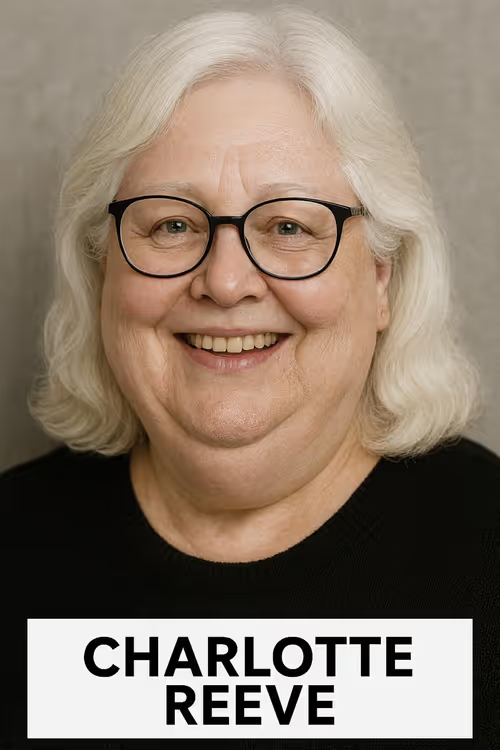
Written by
Charlotte Reeve
Senior correspondent · Capital Markets & Fintech
Charlotte cut her teeth on an equities desk before moving to the other side of the notebook. She covers capital markets, stock exchanges, and the fintech operators trying to disintermediate the banks that trained her. Sharpest on market microstructure and payments infrastructure; still reads a prospectus for fun. Based in Singapore. Reach out at charlotte.reeve@theplatinumcapital.com.