

UAE Digital Assets Regulation: Why Global Players Are Relocating
The UAE has emerged as the world's most strategically sophisticated jurisdiction for digital assets, with its dual regulatory framework spanning ADGM and VARA offering institutional-grade clarity that markets like the US and EU continue to frustrate with legislative ambiguity. For family offices and global capital allocators seeking both regulatory certainty and tax efficiency, the Emirates is no longer simply an alternative destination — it is rapidly becoming the definitive headquarters for serious digital asset operations.…

Something structural is happening in the global digital assets industry, and it is not subtle. Over the past eighteen months, a measurable cohort of trading firms, digital asset custodians, tokenisation platforms, and crypto-native family offices have quietly shifted their operational headquarters — or at minimum their licensing anchors — to the UAE. The regulatory clarity coming out of Abu Dhabi and Dubai is not merely attracting startups. It is pulling in institutions with billions under management, teams with deep capital markets pedigree, and founders who have already built and exited at scale. For the private investors and family offices watching this shift, the UAE is not just becoming a friendlier place to hold digital assets. It is becoming the dominant jurisdiction for structuring, issuing, and trading them.
The Regulatory Architecture That Changed the Calculation
The UAE built its digital assets framework on two parallel pillars. First: the Virtual Assets Regulatory Authority (VARA) in Dubai, which became fully operational in 2023 and has since issued dozens of full licences to exchanges, brokers, and advisors. Second: the Financial Services Regulatory Authority (FSRA) within Abu Dhabi Global Market (ADGM), which has run one of the most sophisticated crypto frameworks anywhere in the world since 2018. Together, they offer something most jurisdictions genuinely cannot — regulatory certainty paired with institutional credibility. Firms operating under VARA or FSRA authorisation are not working in a grey zone. They are regulated entities, carrying compliance obligations, capital requirements, and conduct standards that align closely with what institutional counterparties in London or Singapore demand before they will transact.
That distinction matters enormously for family offices and private investors in the USD 50 million to USD 500 million range who want digital asset exposure but cannot absorb the reputational or operational risk of dealing with unregulated entities. The UAE has effectively solved that problem. A tokenised fund, a digital asset custody arrangement, a blockchain-based structured product — all of it can now be established with legal enforceability, audited infrastructure, and a credible regulatory backstop. That combination did not exist here five years ago. It does now.
The Mal Moment: Abu Dhabi as the Capital of Islamic Fintech
The $230 million seed round raised by Mal in January 2026 — one of the largest fintech seed rounds recorded globally that quarter — crystallised something that had been building quietly for years. Abu Dhabi is positioning itself as the headquarters of AI-native, Sharia-compliant digital finance. That is a significant shift. Mal's round, led by Abu Dhabi-based BlueFive Capital, drew in a leadership team with operational experience at Revolut and Nubank — precisely the profile that would previously have defaulted to London or São Paulo without a second thought. They chose Abu Dhabi instead, and they are now in active licensing discussions across the UAE, Bangladesh, Indonesia, and Pakistan.
For digital assets specifically, the implications run deeper than a single fundraise. Mal's model — combining Islamic finance principles with AI-driven personalisation — maps directly onto the tokenisation opportunity. Sukuk tokenisation, Sharia-compliant digital wallets, blockchain-based profit-sharing instruments: these are natural extensions of what Mal is building. Abu Dhabi's regulatory environment, combined with its direct access to Gulf sovereign wealth capital, makes it the only jurisdiction in the world where all of those threads can realistically be pulled together at institutional scale. For family offices operating under Islamic finance mandates, this is not a niche development to file away. It is a signal about where product innovation will originate over the next decade.
Tabby's Licence and the Formalisation of Digital Finance Infrastructure
When the UAE Central Bank granted Tabby a Stored Value Facilities licence in 2026, the headline story focused on buy-now-pay-later evolving into something broader. The deeper signal was about the Central Bank itself. Specifically, its demonstrated willingness to build bespoke regulatory categories for high-growth digital finance companies that have outgrown single-product definitions. Tabby, now valued at $4.5 billion following its October 2025 secondary sale, can hold customer funds, issue payment cards, and build money management tools. CEO Hosam Arab has been explicit: the company's ambitions extend well beyond instalment payments.
For the digital assets sector, Tabby's licensing trajectory functions as a useful proxy for what the broader environment will tolerate. The UAE Central Bank has established a consistent pattern — engage with innovative business models, construct a bespoke regulatory category where necessary, and grant licences to companies that meet institutional standards. That stands in sharp contrast to the enforcement-first posture that has defined regulation in the United States, or the prolonged ambiguity that has stalled institutional adoption across parts of Europe. Global digital asset players have noticed the difference. The reallocation of talent and capital reflects it.
Saudi Arabia's Blockchain Turn and the GCC's Broader Signal
The UAE does not operate in isolation. The broader GCC is moving in the same direction — and that regional coherence reinforces the investment case considerably. In March 2026, SAMA issued its first live open banking licences, transitioning from sandbox pilots to full commercial operations. That step will accelerate data-sharing infrastructure and make digital asset onboarding meaningfully more efficient for Saudi-based investors. Separately, Riyad Bank's digital arm Jeel entered a live pilot with Ripple for blockchain-based cross-border transfers and tokenisation, operating within a defined regulatory framework rather than as another proof of concept collecting dust in a presentation deck.
The most consequential development, though, came in August 2025. Saudi Awwal Bank executed the first blockchain-based Islamic repurchase agreement, developed with digital asset infrastructure provider Oumla. This was not a demo. It was a live transaction — smart contracts, tokenised collateral, Saudi Arabia's regulated banking system. Few outside the region paid close attention. They should have. When a Tier 1 Saudi bank runs a blockchain-based Islamic repo as a live operation, it tells every family office treasurer and asset manager in the Gulf that tokenised instruments are no longer experimental. They are operational. The line has moved.
What This Means for Investors Considering Relocation or Reallocation
For private investors and family offices currently domiciled in Europe, Central Asia, Southeast Asia, or Sub-Saharan Africa, the UAE's digital assets regulatory maturity presents a concrete decision point. The question is no longer whether to carry digital asset exposure. It is where to structure it. Holding tokenised real estate, digital securities, or crypto-native funds through a VARA-licensed entity in Dubai or an FSRA-regulated structure in ADGM delivers a level of legal enforceability and institutional counterparty acceptance that offshore Caribbean jurisdictions simply cannot match in 2026. The gap has widened, and it is widening further.
The relocation of global players to the UAE is not driven by tax alone — though the absence of capital gains tax and corporate tax on qualifying activities remains a material consideration. What is driving the move is the recognition that the UAE has assembled the most complete digital assets ecosystem outside of Singapore, with the additional advantage of direct connectivity to Gulf sovereign capital, Islamic finance markets, and a rapidly expanding investor base across Africa, South Asia, and emerging Europe. The numbers tell a complicated story in most jurisdictions right now. In the UAE, they are starting to tell a straightforward one. For any family office or private investor serious about digital asset allocation, this is the jurisdiction that warrants the closest attention — not as one option among many, but as the primary reference point for how regulated digital finance actually functions at scale.
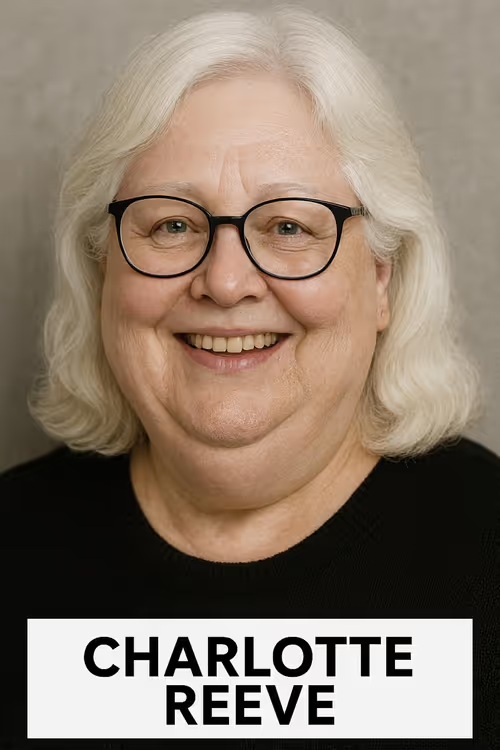
Written by
Charlotte Reeve
Senior correspondent · Capital Markets & Fintech
Charlotte cut her teeth on an equities desk before moving to the other side of the notebook. She covers capital markets, stock exchanges, and the fintech operators trying to disintermediate the banks that trained her. Sharpest on market microstructure and payments infrastructure; still reads a prospectus for fun. Based in Singapore. Reach out at charlotte.reeve@theplatinumcapital.com.