

Pedro Soccol: The Founder Building AI That Leaves the Final Decision to People
At Cognisynth, Pedro Soccol is building an AI-assisted control room for sensitive institutional work, designed so that people, not machines, make the decision and every step can be audited.…

As artificial intelligence moves into legal, corporate and public-sector work, the hardest question is often not what the technology can do but who answers for the result. When an AI system summarises a contract, flags a risk or drafts a recommendation, someone still has to decide, and someone has to be able to show later how that decision was made. Pedro Soccol, Founder, Chairman and CEO of Cognisynth, has built his company around that question. He is a nominee for Leader of the Year at the TPC Awards 2026.
A principle before a product
Cognisynth's central project is the Cognisynth Control Room, an AI-assisted environment for sensitive institutional and corporate processes. The principle behind it is set out plainly in Soccol's nomination: artificial intelligence should strengthen an institution's capacity without replacing accountable human authority.
In practice, that means a division of labour. The AI structures and supports the information; accountable people keep the final decision. It is a deliberate contrast with tools that push towards automation first and ask governance questions afterwards.
Six stages, one audit trail
Soccol led the conception and governance architecture of the Control Room, which reached advanced MVP stage in 2026. Its design follows a six-stage framework that links each step of a sensitive process: the document, its context, human review, the authorised decision, the supporting evidence and the audit.
The aim is a decision trail that can be checked. According to his nomination, the system brings together role-based access controls, cryptographic integrity verification, append-only records and audit-oriented outputs, so that an institution can show not only what was decided but who decided it, on what basis and when.
Governance shaping engineering
Part of Soccol's contribution is how the work is organised. He coordinates institutional, governance, strategic and technical perspectives in a single development model, in which governance requirements inform the engineering and technical feasibility informs the product. The team's collaboration connects legal reasoning, governance architecture, product strategy and software engineering.
That interdisciplinary approach reflects his own position at the intersection of law, institutional governance and technology, and it underpins the international positioning he has developed for Cognisynth around responsible AI, traceability, accountability and human judgment.
Discipline at an early stage
Cognisynth is still early in its development. The Control Room has moved into technical-commercial validation ahead of a controlled pilot deployment, and Soccol's nomination presents that sequence as a choice: accountable implementation before rapid rollout.
For institutions weighing how far to trust AI with consequential decisions, that restraint is part of the pitch. His nomination rests on a clear view of where AI belongs in high-stakes work, and on building the governance structure first.
Pedro Soccol is a nominee in the Leader of the Year category of the TPC Awards 2026. Details are as provided in the nomination submission.
Written by
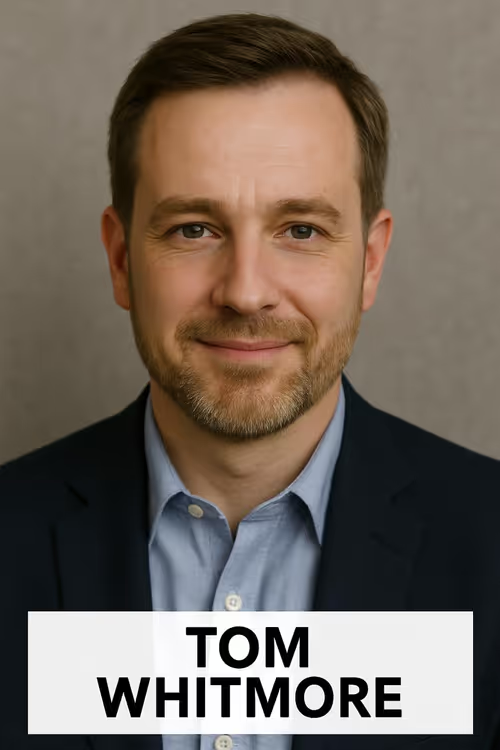
Tom Whitmore
Senior correspondent · Real Estate & Private Companies
Tom has interviewed most of the operators reshaping the Gulf skyline — and a few of the ones who tried and didn't. His beat is real estate, commodities, manufacturing, and the founder-led private companies that never bother to list. He knows which buildings and balance sheets survive a downturn before the spreadsheet does. Based in Dubai. Reach out at tom.whitmore@theplatinumcapital.com.