

REITs in a Rising Rate Environment: Navigating the Valuation Reset
As central banks sustain their aggressive tightening cycles, real estate investment trusts face a fundamental repricing of risk that separates the structurally resilient from the dangerously overleveraged, demanding a far more disciplined approach to sector allocation than the era of cheap capital ever required. For sophisticated capital allocators navigating this valuation reset, the decisive advantage lies not in abandoning REITs wholesale, but in identifying those with fortress-grade balance sheets, inflation-linked lease structures, and the operational density to defend distribution yields against a persistently elevated cost of debt.…

When interest rates began their aggressive ascent in 2022, the conventional wisdom was straightforward: rising borrowing costs crush real estate investment trusts. Four years on, the picture is considerably more nuanced — and for sophisticated investors operating across the Gulf, Central Asia, and emerging Asia, the valuation reset that followed has quietly created one of the more compelling entry points in a generation. The question is no longer whether REITs have been repriced. They have. The question is which structures, geographies, and asset classes are now positioned to outperform as the rate cycle matures.
The Mechanics of the Reset
Between 2022 and 2024, publicly listed REITs globally surrendered between 25% and 40% of their peak valuations as capitalisation rates expanded sharply in response to Federal Reserve tightening and its cascading effect across central bank policy worldwide. The FTSE NAREIT All Equity REITs Index fell more than 26% in 2022 alone — its worst annual performance since the global financial crisis. The mechanism was textbook: as risk-free rates rose, the yield premium investors demanded from income-producing real estate compressed the present value of future cash flows, forcing asset prices downward even when underlying fundamentals — occupancy, rental income, tenant quality — remained largely intact.
By mid-2025, a selective recovery had begun. The U.S. Federal Reserve's pivot, combined with easing inflation across most developed markets, stabilised discount rate expectations. But not all REIT sectors recovered equally — and that divergence is where the real story sits. Industrial and logistics REITs, buoyed by sustained e-commerce demand and supply chain reconfiguration, rebounded fastest. Retail REITs, particularly those anchored by grocery and experiential tenants, followed. Office REITs, by contrast, remain structurally challenged across many Western markets. Astute private capital has been quick to exploit exactly that gap.
Gulf Capital and the Private Real Estate Advantage
While publicly listed REIT markets absorbed the volatility of rate movements in real time, private real estate capital — particularly from the Gulf — operated with an entirely different discipline. The transactions now reshaping Dubai and Riyadh are being executed by private developers and family-backed groups whose underwriting logic is generational rather than quarterly. They are not watching the Fed dot plot. They are buying coastline.
The June 2026 acquisition of the Shangri-La Dubai by AHS Properties for AED 1.1 billion ($300 million) makes the point cleanly. The 42-floor Sheikh Zayed Road asset, acquired from Mismak — a First Abu Dhabi Bank subsidiary — represents the kind of irreplaceable, location-driven conviction that insulates private buyers from short-term rate sensitivity. Abbas Sajwani, the founder and CEO of AHS Properties, was direct about his rationale: "What attracted me to it is the location. You cannot replace this kind of location." That framing — location as an absolute rather than a relative value — is precisely how private capital sidesteps the valuation compression that punishes leveraged public vehicles when rates rise. No duration model captures it. No Bloomberg screen prices it correctly.
The Shangri-La acquisition is not a standalone bet. AHS Properties is assembling what amounts to a vertical corridor along Dubai's most coveted addresses, combining AHS Tower, AHS City, and the Shangri-La Hotel into a pipeline the firm values at AED 50 billion by year-end 2026. A separate $6.8 billion mixed-use development on the Dubai Water Canal is slated for launch in the third quarter of this year. This is systematic urban positioning — the kind that institutional REITs carrying quarterly redemption pressures and mark-to-market obligations simply cannot replicate.
Land as the Ultimate Hedge
The activity at the asset class level below landmark towers is equally instructive. In March 2026, Arabian Acres — a Dubai-based luxury real estate brokerage and development advisory — structured and completed a Dh400 million acquisition of more than 113,000 square feet of Jumeirah beachfront land encompassing 160 metres of private Gulf coastline. The combined site is projected to deliver a gross development value exceeding Dh1 billion, with plans for three ultra-luxury villas offering direct beachfront access and private marina docking.
Arabian Acres acted as exclusive broker for both buyer and seller. That arrangement speaks to the depth of trust required at this tier of the market — relationships that no online platform intermediates. The transaction also illustrates why beachfront and waterfront land in constrained supply markets holds structurally firm against rate-driven erosion. Unlike an income-producing REIT unit whose yield must compete with a government bond, a 160-metre private beach is not fungible. The total addressable supply is, by definition, zero. Rates are irrelevant when the asset itself cannot be replicated.
Sovereign Scale: What Riyadh Is Building
Dubai's market runs on a blend of private developers, family capital, and international buyers. Riyadh's trajectory is something different — sovereign ambition at a scale that reframes the entire regional conversation. The Diriyah Gate Development Authority is overseeing a SAR 190 billion ($63 billion-plus) transformation of the historic Diriyah district, backed by the Public Investment Fund, encompassing luxury residential plots, cultural institutions, heritage hotels, and commercial precincts built in traditional Najdi architectural style. A construction contract for the Waldorf Astoria Diriyah has already been signed, anchoring the project's hospitality positioning.
For family offices and private investors assessing real estate allocation across the GCC, sovereign-backed projects of this scale matter in a specific and practical way. When the PIF commits $63 billion to a single urban district, the surrounding real estate ecosystem — residential, hospitality, retail — acquires a price floor that no interest rate cycle is likely to dislodge. Adjacent private investment inherits that anchor. Few outside the region have fully priced this in. They should.
Where Private Capital Should Look Now
The numbers tell a complicated story, but the direction of travel is legible. For family offices and private investors carrying meaningful real estate allocations, the current environment presents a structured opportunity across three distinct vectors.
The first is selectively re-entering listed REITs in logistics, data centres, and healthcare — sectors where secular demand is powerful enough to override cyclical rate sensitivity — at valuations that in many cases remain 15% to 20% below their 2021 peaks. The second is pursuing direct or co-investment exposure to constrained-supply markets across the GCC, where private deal flow is generating risk-adjusted returns that public markets simply cannot access. The third warrants close attention from anyone not already watching it: emerging REIT markets in Southeast Asia, particularly Vietnam, Indonesia, and the Philippines, where REIT frameworks are maturing, yields remain attractive relative to sovereign rates, and institutional capital is still in early deployment phases. That window does not stay open indefinitely.
The rate environment of the past four years has performed a function that markets periodically require — it has separated assets priced on optimism from those priced on substance. Across the Gulf and beyond, the assets that held value, and in many cases appreciated, share a common thread: irreplaceable location, sovereign conviction, or structural demand that no rate model adequately discounts. For private capital with the patience and access to identify them, the valuation reset is not a warning. It is an invitation.
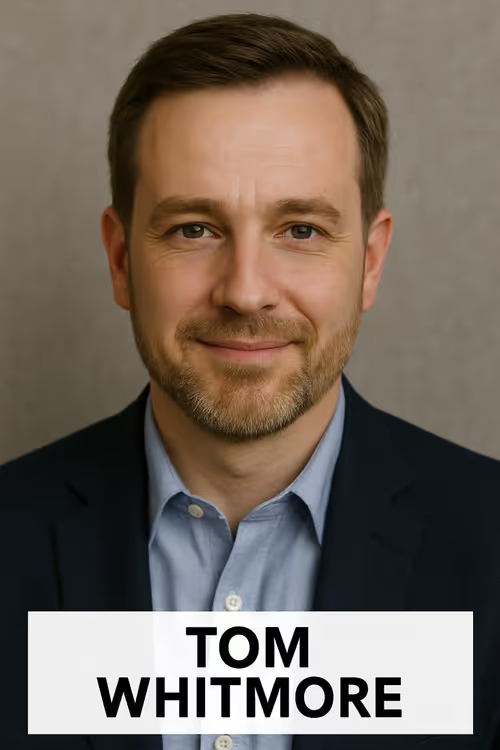
Written by
Tom Whitmore
Senior correspondent · Real Estate & Private Companies
Tom has interviewed most of the operators reshaping the Gulf skyline — and a few of the ones who tried and didn't. His beat is real estate, commodities, manufacturing, and the founder-led private companies that never bother to list. He knows which buildings and balance sheets survive a downturn before the spreadsheet does. Based in Dubai. Reach out at tom.whitmore@theplatinumcapital.com.