
The Democratization of Private Markets Through Tokenization
The tokenization of private market assets represents a structural shift in how capital is allocated globally, dismantling the institutional barriers that have long confined high-yield opportunities in private equity, real estate, and infrastructure to a privileged tier of investors. For family offices, sovereign wealth managers, and high-net-worth individuals navigating an increasingly complex wealth preservation landscape, blockchain-enabled fractional ownership is not a speculative trend but an emerging fiduciary imperative.…

When Saudi Arabia's National Debt Management Center raised SR10.57 billion in a single June sukuk issuance — a 338% surge from the prior month — the transaction ran across six tranches, the longest stretching to 2041. Every tranche was absorbed by a narrow pool of institutional investors: sovereign funds, insurance companies, major banks, and the handful of family offices large enough to meet minimum ticket requirements. For the vast majority of high-net-worth individuals sitting on USD 10 to USD 50 million in investable assets, that deal was simply off the table. So was virtually every other compelling fixed-income and private market opportunity the GCC produced that month. Tokenization is beginning to change that calculus. And it is arriving faster than most private wealth managers anticipated.
The Access Problem That Private Markets Have Never Solved
Private markets have always belonged to the institutionally connected. Saudi Aramco's January 2026 bond issuance drew over USD 21 billion in orders against a USD 4 billion offering — five-times oversubscribed, confirming an appetite for premium credit that shows no signs of cooling. The deal ran through Citi, Goldman Sachs, HSBC, JPMorgan, and Morgan Stanley. Allocations flowed almost entirely to sovereign wealth funds and tier-one asset managers. A family office principal in Riyadh, Lagos, or Jakarta managing USD 30 million had no meaningful pathway in. That is not an anomaly. That is how conventional capital markets were designed to work.
Minimum subscriptions, custodial complexity, regulatory fragmentation, illiquidity — together, these forces have maintained a de facto wealth threshold that decades of fintech innovation have failed to dismantle. The tools to address this structural exclusion existed, in theory, for years. In 2026, they are operational.
What Tokenization Actually Delivers — Beyond the Buzzword
Tokenization converts ownership rights in a real-world asset — a bond, a sukuk tranche, a private equity stake, a real estate portfolio — into a digital token recorded on a distributed ledger. The mechanics are no longer experimental. The Abu Dhabi Global Market has issued regulatory guidance for tokenized securities. The Dubai Financial Services Authority published its own framework in late 2025. Bahrain's central bank has been quietly piloting tokenized sukuk settlement infrastructure since 2024. Few outside the region have paid close attention. They should.
What these frameworks collectively enable is fractional ownership at scale. A sukuk tranche that previously required a USD 200,000 minimum can, in principle, be subdivided into tokens accessible at USD 5,000 or less — traded peer-to-peer with near-instantaneous settlement, held in a digital wallet, with none of the custody overhead that conventional fixed income demands. For the Gulf's growing cohort of next-generation wealth holders — many of them managing inherited portfolios with a more active, technology-forward sensibility — this is not a novelty. It is a structural upgrade to how capital gets deployed.
The GCC as a Live Testing Ground
The region's capital market activity in 2026 provides an unusually rich backdrop against which tokenization can prove its relevance. The MGC IPO on Tadawul has drawn new investor segments who previously had no gateway to primary issuances — a signal, market participants say, that Saudi Arabia's equity market is serious about deepening retail participation. Tokenization extends that logic further. Rather than requiring a brokerage account and a domestic identity verification process, tokenized equity or debt instruments can be distributed to accredited investors across jurisdictions through regulated digital asset platforms.
ADX has already explored tokenized equity frameworks. Conversations inside the region's financial free zones point strongly toward a first fully tokenized sukuk open to retail-eligible investors emerging from either Abu Dhabi or Bahrain within the next 18 months. That is a significant shift. For Central Asian family offices — particularly those operating out of Kazakhstan and Uzbekistan, where accessing GCC-quality fixed income has historically required routing through Geneva-based intermediaries — it represents a genuine compression of both cost and complexity.
Where Family Offices and Private Investors Stand to Gain
The most immediate beneficiaries of tokenized private markets are not billionaires. They are the principals managing USD 20 million to USD 200 million in family wealth who currently face an uncomfortable binary: accept the liquidity and transparency of listed markets, or accept the opacity and lock-up terms of conventional private equity and credit. Tokenization introduces a third option — one that preserves the return profile of private markets while introducing secondary liquidity through regulated token exchanges.
The numbers tell a complicated story, but not an unfavorable one. Early evidence from platforms operating in Singapore, Dubai, and Luxembourg shows tokenized private credit instruments clearing at yields 80 to 150 basis points above equivalent listed fixed income. The spread reflects a residual illiquidity premium — one that still rewards patient capital. For a family office in Nairobi, Manila, or Cairo that has historically been locked out of GCC sukuk issuances or Southeast Asian private credit, access to even a fraction of these instruments represents a material portfolio diversification opportunity. The geography of private wealth is expanding. The infrastructure to serve it is finally catching up.
The Risks That Sophisticated Investors Must Price In
Enthusiasm should not run ahead of due diligence. Regulatory fragmentation across jurisdictions means a token issued under ADGM rules may carry no legal recognition in Indonesia or Morocco without additional structuring. Secondary market liquidity for tokenized instruments, while improving, remains thinner than proponents tend to admit — most platforms report bid-ask spreads that would be unacceptable in conventional fixed income. Smart contract risk, custodial security, and the legal enforceability of token-based ownership claims in insolvency proceedings are all areas where the frameworks are still maturing. The technology is sound. The legal and operational architecture around it is not.
For family offices considering early exposure, the prudent position is not a wholesale rotation into tokenized assets. Allocate a defined exploratory tranche — typically 3 to 7% of total investable assets — through regulated platforms that carry established legal opinions and audited smart contract infrastructure. No amount of platform marketing substitutes for that work.
The direction of travel, though, is not in doubt. As Saudi Arabia accelerates its domestic capital markets agenda under Vision 2030, and as the UAE consolidates its position as the region's digital asset regulatory anchor, tokenized private market instruments will move from pilot programs to mainstream allocation faster than conventional wealth management firms are currently preparing for. Family offices and private investors who develop fluency with these structures now — who understand both the opportunity and the risk architecture before the crowd arrives — will access deal flow that was, until very recently, the exclusive preserve of institutions ten times their size. That is not democratization as a marketing concept. It is a structural realignment of who gets a seat at the table when the region's most compelling capital market opportunities are distributed.
Written by
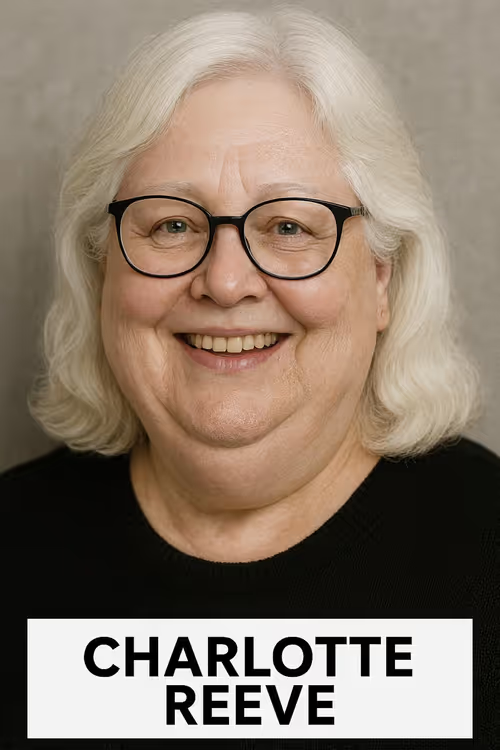
Charlotte Reeve
Senior correspondent · Capital Markets & Fintech
Charlotte cut her teeth on an equities desk before moving to the other side of the notebook. She covers capital markets, stock exchanges, and the fintech operators trying to disintermediate the banks that trained her. Sharpest on market microstructure and payments infrastructure; still reads a prospectus for fun. Based in Singapore. Reach out at charlotte.reeve@theplatinumcapital.com.