

The Rise of Gulf Asset Managers Competing With Global Giants
As sovereign wealth funds across the Gulf deepen their investment mandates and regional asset managers sharpen their capabilities in private equity, infrastructure, and alternative credit, a new generation of homegrown institutions is challenging the dominance of Western financial giants on their own terms. For family offices, high-net-worth investors, and government stakeholders navigating an era of accelerating capital reallocation, understanding this structural shift is no longer optional — it is essential to positioning wealth intelligently for the decade ahead.…

Something has shifted in the architecture of global asset management — and the clearest signal is not coming from New York, London, or Hong Kong. It is coming from Riyadh, Abu Dhabi, and Kuwait City. Across the Gulf, sovereign wealth funds, state-linked investment platforms, and a new generation of homegrown asset managers are no longer content to be passive allocators to Western giants. They are building — funds, platforms, co-investment structures, and direct capabilities — that increasingly position them as peers rather than clients of the firms they once wrote blank cheques to.
From Capital Exporter to Capital Architect
For decades, the Gulf's dominant role in global finance was straightforward: provide capital at scale. Sovereign wealth funds from Abu Dhabi, Kuwait, and Qatar fed the balance sheets of Blackstone, KKR, and Carlyle, enabling the global expansion of alternative asset management as an industry. That model has not disappeared. But it has been fundamentally rewritten. The Gulf is now demanding co-investment rights, GP stakes, regional allocation commitments, and increasingly, operational control.
The clearest recent example is Brookfield Asset Management's announcement on July 27, 2026 of a first close of approximately $2 billion for its Brookfield Middle East Partners fund, with Saudi Arabia's Public Investment Fund acting as anchor investor. Brookfield committed $500 million of its own capital alongside LP capital — a structuring detail that signals exactly the level of accountability PIF now expects from its partners. Yazeed Al-Humied, PIF's Deputy Governor and Head of MENA Investments, framed the partnership as one that will "anchor international private equity in Saudi Arabia and the broader region." With 50% of BMEP's capital directed at Saudi Arabia itself, this is no longer a fund that extracts Gulf capital for deployment elsewhere. It is a fund designed to build within the region, across financial services, industrials, technology, and healthcare.
The $16 Billion Signal From Kuwait
If the Brookfield-PIF structure illustrates how the Gulf is reshaping co-investment norms, the Kuwait Petroleum Corporation deal announced two days earlier — on July 25, 2026 — demonstrates something more consequential: the region's capacity to drive landmark infrastructure transactions entirely on its own terms. Few outside the region have paid close enough attention. They should.
KPC's $16 billion lease-and-lease-back agreement with a consortium of Blackstone, Brookfield, and KKR — covering all 13 of Kuwait's domestic and export pipelines across approximately 320 kilometres — will generate $7.85 billion in upfront proceeds for Kuwait. Shaikh Nawaf Saud Al-Sabah, Deputy Chairman and CEO of KPC, called it "the largest foreign direct investment in Kuwait's history." The deal structure is sophisticated: a newly formed Kuwaiti-incorporated joint venture holds the usage rights, preserving national ownership of the underlying assets while unlocking significant balance sheet liquidity. Blackstone is opening a permanent office in Kuwait as part of the arrangement. That detail alone tells you where the firm believes long-term deal flow will originate.
Gulf sovereigns are not merely recipients of Western financial engineering. They are commissioning it, structuring it, and setting the terms. The distinction matters enormously for any private investor or family office assessing where regional asset management capability is heading.
Homegrown Platforms Are Accelerating
Beyond sovereign vehicles, a distinct class of Gulf-domiciled asset managers has emerged — nimbler, regionally embedded, and increasingly competitive with international firms for the same mandates. Abu Dhabi's MGX, the AI and advanced technology investment platform backed by Mubadala, closed a record $49 billion AI-focused fund structure in July 2026. That figure rivals the flagship vehicles of the world's largest alternative managers. MGX arriving as a capital deployer of that magnitude — not merely an LP in someone else's fund — reflects a pattern repeating itself across the region.
Firms such as Investcorp, Gulf Capital, and Amwal have operated as genuine alternatives to global private equity for years. But a second wave of managers has arrived — many spun out of sovereign institutions, others founded by executives who built careers inside PIF, Mubadala, or ADIA. They are raising institutional-quality vehicles targeting sectors where Gulf managers carry structural advantages: regional real estate, Islamic finance, energy transition, and consumer markets across the Middle East and Africa corridor. Family offices in Dubai and Riyadh that previously defaulted to international managers for private equity exposure are now fielding credible pitches from managers with genuine regional insight — and better fee structures. The choice set has changed.
What This Means for the Global Allocation Hierarchy
The competitive dynamic between Gulf asset managers and global giants is not yet a zero-sum contest. The Gulf remains one of the most attractive LP pools on earth — Blackstone, KKR, Apollo, and their peers will keep raising capital here at scale. But the terms of engagement have changed. International managers now compete for mandates that require regional office commitments, local hiring targets, co-investment provisions, and demonstrated development impact aligned with national visions such as Saudi Arabia's Vision 2030 and the UAE's Operation 300bn industrial strategy. The era of showing up with a pitch deck and a handshake is over.
For wealthy private investors and family offices across the GCC, Central Asia, and Africa — markets where The Platinum Capital's readership is concentrated — this structural shift creates both opportunity and genuine optionality. Allocating to a Gulf-domiciled manager with strong sovereign relationships and sectoral depth in regional infrastructure or healthcare is no longer a compromise. In many cases, it is the sharper call. Managers embedded in Kuwait, Abu Dhabi, or Riyadh have faster access to deal flow, deeper regulatory relationships, and a cleaner alignment of interest with investors whose capital is also rooted in the region.
The Next Decade Belongs to Those Who Build Here
The trajectory is unmistakable. Gulf sovereign funds are evolving into direct investors, fund sponsors, and platform builders — simultaneously. Homegrown managers are closing institutional-scale vehicles. Global giants are being asked to demonstrate regional commitment through capital, offices, and talent before they can access the region's most significant mandates. Bruce Flatt of Brookfield put it with notable directness: "a compelling opportunity to partner with businesses across the region and position them for long-term growth."
For private investors, family office principals, and institutional allocators from Lagos to Tashkent to Manila who are reassessing their alternatives exposure, the question is no longer whether Gulf asset managers deserve a place in the portfolio. That debate is settled. The question now is how much of the allocation they should command — and whether the relationship with a New York-headquartered manager still carries the edge it once did, in markets where the Gulf increasingly sets the agenda.
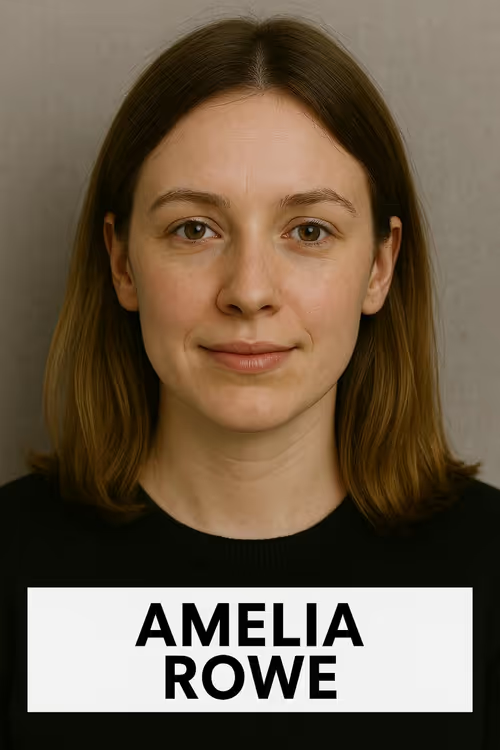
Written by
Amelia Rowe
Senior correspondent · Banking & Economy
Amelia spent eight years inside a sovereign wealth fund before deciding she'd rather write about institutional money than allocate it. She covers central banking, insurance, and the macro decisions that quietly choose which markets get the next decade. Sharp on monetary policy; impatient with anyone who confuses noise with signal. Based in London. Reach out at amelia.rowe@theplatinumcapital.com.