

Gulf Labour Market Reforms and the War for Global Talent
As Gulf nations dismantle decades-old kafala restrictions and accelerate visa liberalisation across the UAE, Saudi Arabia, and Qatar, the region is emerging as a formidable competitor in the global race to attract high-net-worth professionals, specialized technologists, and institutional capital alongside them. For sovereign wealth managers and family offices positioning long-term portfolios, understanding how these structural labour reforms reshape talent density, productivity curves, and ultimately asset valuations across Gulf markets is no longer peripheral analysis — it is foundational due diligence.…

The Gulf has never competed harder for human capital. And this time, the competition is structural, not cosmetic. Across the GCC, governments are not tweaking labour policy at the margins — they are redesigning the entire relationship between talent, residency, and economic citizenship. For investors, family offices, and private capital allocators who depend on attracting and retaining world-class expertise, the consequences are direct and immediate. With the World Bank projecting GCC-wide GDP growth of 4.5% in 2026 — and the UAE targeting 5.6% under IMF and ICAEW forecasts — the region's ambitions have simply outgrown its existing workforce architecture. Closing that gap has become a matter of state priority.
A Region Outgrowing Its Workforce
Saudi Arabia's Vision 2030 programme has moved well beyond headline megaprojects. The Kingdom's non-oil GDP is forecast to grow at an average of 3.6% annually through 2027 — and that number demands tens of thousands of specialists in financial services, technology, healthcare, logistics, and entertainment. Sectors, it bears remembering, that barely existed at meaningful scale in the Kingdom a decade ago. The challenge is structural. High public-sector employment rates among Saudi nationals, combined with ambitious Saudisation quotas under the Nitaqat system, have created genuine friction in industries where global expertise is non-negotiable. Riyadh's response has been targeted and, largely, quiet. The Saudi Premium Residency Centre has expanded its elite tier, opening permanent residency pathways to high-net-worth professionals and investors willing to commit capital and expertise to the Kingdom's diversification agenda.
The UAE has spent the past three years building arguably the most sophisticated talent attraction infrastructure in the emerging world. The Golden Visa programme — now covering scientists, artists, investors, and top university graduates — has issued over 200,000 visas since its 2019 expansion. That is a significant number. Abu Dhabi's Falcon economy initiative and Dubai's D33 agenda both treat talent strategy as a core economic variable, not an HR afterthought. Non-oil sectors in the UAE are projected to grow 4.9% in 2025 alone. Sustaining that requires a continuous pipeline of skilled professionals across every growth vertical. The pipeline, right now, is tight.
The Policy Toolkit: What Has Actually Changed
Gulf labour market reform has historically moved slowly and with considerable political caution. The reforms of 2024 and 2025 are a genuine break from that pattern. Saudi Arabia's amendment to its labour law — allowing skilled expatriates in select sectors to transfer employment without employer consent — ranks among the most consequential structural changes in a generation. It directly addresses the kafala critique that has long made the Kingdom a harder sell for senior international talent than Dubai or Doha. That matters enormously for any family office or asset manager weighing a Riyadh presence against alternatives.
Qatar, having absorbed substantial reputational scrutiny over its migrant labour framework during the World Cup cycle, has continued wage protection reforms and is expanding its permanent residency scheme for professionals in strategic sectors. The direction of travel is clear, even if the pace remains uneven.
Bahrain rarely features prominently in Gulf talent conversations. It should. Its Flexible Work Visa — which allows professionals to live in Bahrain while working remotely for overseas employers — has drawn a meaningful cohort of fintech and digital finance professionals who function as an informal bridge between Gulf capital and global markets. For family offices managing assets across multiple jurisdictions, the ability to base senior advisors in a low-tax, well-regulated hub without tying them to a single employer relationship carries real operational value. Oman, under Vision 2040, is similarly rethinking its Omanisation frameworks — shifting the emphasis from quota compliance to quality, after recognising that aggressive nationalisation targets in knowledge-intensive industries can actively undermine the growth they were designed to support.
The Competition Beyond the Gulf
Here is what makes this moment different. The Gulf is not simply competing against itself — it is competing against Singapore, London, and Zurich. And increasingly, Riyadh is competing directly against Dubai for the same pools of talent. The decisions by Franklin Templeton, Invesco, and other major global asset managers to establish or significantly expand regional headquarters in Saudi Arabia reflect more than regulatory incentives. They reflect a genuine recalibration of where long-term economic gravity is shifting. But sustaining those commitments requires that the human infrastructure — schools, healthcare, social environment, legal predictability — matches the financial inducements on offer. The money alone will not hold people.
Central Asia is watching closely and beginning to compete on the margins. Few outside the region have noticed. They should. Kazakhstan's Astana International Financial Centre has positioned itself as a talent hub for the post-Soviet professional class, offering English-language common law courts, residency incentives, and a low-tax environment that resonates with entrepreneurs from Almaty to Tashkent. For GCC-based family offices with exposure across the broader Muslim world or Eurasian trade corridors, the talent pools emerging from Uzbekistan, Azerbaijan, and Georgia — technically proficient, multilingual, and increasingly mobile — represent a seriously underutilised resource. Several Dubai-based private investment firms have already established small operational teams in Tbilisi and Baku. The reason is straightforward: the cost-to-quality ratio for junior and mid-level analytical talent is compelling in ways that Gulf hiring markets simply cannot match.
What This Means for Private Capital and Family Offices
The practical implications for wealthy families and private investors operating across the Gulf are direct. The UAE's expanded Golden Visa eligibility now covers family office principals, foundation trustees, and qualifying asset managers — creating long-term residency pathways that require neither active employment nor local business registration. Do not underestimate that. For multi-generational families managing assets from Singapore to Lagos, securing UAE residency for key family members and senior advisors materially reduces operational complexity and simplifies succession planning in ways that were not possible five years ago.
In Saudi Arabia, the new Investment Law — which entered into force in 2024 — gives foreign investors strengthened dispute resolution protections and, critically, the ability to sponsor their own professional workforce without a local partner requirement in designated sectors. For family offices looking to establish a Riyadh presence to access PIF co-investment pipelines or the Kingdom's rapidly deepening capital markets, that removes a historically significant structural barrier. The door is open. Whether firms move fast enough to walk through it is another question.
The Talent Premium Will Only Rise
The World Bank's projection of 4.5% GCC-wide growth in 2026 is not a ceiling — it is a floor, measured against the ambitions that Saudi Arabia, the UAE, and Qatar have publicly committed to. Sustaining that growth through non-oil sectors requires a density of skilled human capital that cannot be produced domestically within any relevant timeframe. The numbers are unambiguous on this point. The Gulf states that move fastest to create genuine long-term security for international talent — through residency rights, legal predictability, and social infrastructure — will capture a disproportionate share of both the professionals and the capital that follows them.
For private investors and family offices already positioned in the region, one conclusion is inescapable: talent strategy and investment strategy are now the same thing. The next decade of Gulf growth will be won or lost on that insight.
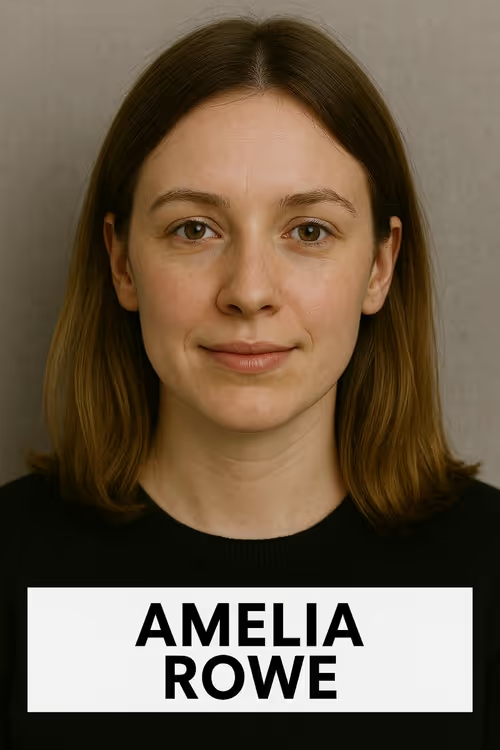
Written by
Amelia Rowe
Senior correspondent · Banking & Economy
Amelia spent eight years inside a sovereign wealth fund before deciding she'd rather write about institutional money than allocate it. She covers central banking, insurance, and the macro decisions that quietly choose which markets get the next decade. Sharp on monetary policy; impatient with anyone who confuses noise with signal. Based in London. Reach out at amelia.rowe@theplatinumcapital.com.