Gulf Sovereign Wealth: How the Middle East Is Reshaping Global Finance
As Gulf sovereign wealth funds quietly accumulate stakes in everything from Manhattan skyscrapers to cutting-edge artificial intelligence ventures, their combined assets — now surpassing $4 trillion — are redrawing the architectural blueprints of global capital markets with a speed and strategic precision that Western institutions are only beginning to comprehend. For family offices and institutional investors navigating an increasingly multipolar financial world, understanding the investment doctrine and geopolitical ambitions driving Abu Dhabi, Riyadh, and Kuwait City is no longer a matter of regional curiosity — it is an indispensable condition of serious portfolio strategy.…

When historians look back at the 2020s, this decade may well mark the moment Gulf sovereign wealth funds stopped being passive participants in global finance and became its most consequential architects. Far from retreating in the face of regional conflict, the major Gulf funds — Saudi Arabia's Public Investment Fund, Abu Dhabi Investment Authority, and Qatar Investment Authority — have shown a capital discipline and strategic clarity that Western institutional investors are increasingly struggling to match. The numbers are no longer modest. The ambitions are no longer regional. And the influence is no longer deniable.
Conflict Has Not Cooled the Capital
When the Iran war broke out, the consensus view was straightforward: Gulf capital markets would freeze, sovereign wealth activity would stall, and the region's funds would turn inward. That consensus was wrong. According to Global SWF's report published on June 1, 2026, Gulf sovereign wealth funds have shown "no sign of slowdown (yet), with a stronger average pace in the past quarter than in the five years before the start of the war." For family offices and private investors monitoring capital flow signals, that resilience is itself a meaningful data point. The Gulf's financial architecture has matured to a degree that regional instability no longer produces the reflexive capital flight it once did. That is a significant shift — and most Western allocators have been slow to absorb it.
The composition of that deployment is equally instructive. Both ADIA and PIF have shown a clear preference for China and emerging markets over traditional developed market allocations. Since the start of the Iran conflict, PIF has put $6.1 billion into emerging markets — more than double the $2.43 billion it deployed into developed market assets over the same period. The one outlier is QIA, which has cut its quarterly investment pace by approximately $2 billion since March. Whether that reflects Qatar's expanded commitments elsewhere — including its deepening engagement in Eastern Europe — or a more deliberate portfolio recalibration, it stands as a notable divergence from its Gulf peers. Worth watching.
Defense Diplomacy and the New Gulf Doctrine
The most striking signal of Gulf geopolitical confidence came in March 2026. President Zelenskyy confirmed the signing of ten-year defense agreements with both Saudi Arabia and Qatar. Speaking on March 29, he stated: "We have already signed the agreement with Saudi Arabia, and we have just signed a similar 10-year agreement with Qatar." The Qatari Ministry of Defense confirmed the agreement covers "collaboration in technological fields, development of joint projects, defense investments and the exchange of expertise in countering missiles and unmanned aerial systems."
This is not the Gulf of two decades ago — a region content to purchase security from Western patrons and stay out of the great-power game. These are sovereign states with autonomous foreign policies, entering bilateral defense arrangements with a nation at the centre of the most significant European conflict since 1945. Few outside the region have fully registered what that means. They should. For private investors and family offices operating across Central Asia, emerging Europe, and the Gulf, the signal is direct: Gulf capital now travels with Gulf diplomatic weight, and the two reinforce each other. Countries seeking investment partnerships increasingly want the full package — financial commitment, infrastructure expertise, and geopolitical credibility. The Gulf can now offer all three.
Syria: The Reconstruction Opportunity of the Decade
The removal of U.S. sanctions on Syria has unlocked what may prove to be the most significant frontier investment opportunity in the Middle East since the post-2003 Gulf construction boom. Qatar has committed approximately $7 billion to Syrian energy projects and is investing directly in Damascus International Airport — a critical node for any recovery in regional commerce. The UAE is moving with comparable ambition. A planned $2 billion Damascus metro system is in development, while DP World is advancing port development plans at Tartus, positioning itself to capture trade flows through a strategically vital Mediterranean access point. The numbers are large. The pace is fast.
For investors in the Gulf, Africa, and Southeast Asia who know the post-conflict reconstruction playbook, Syria presents a compressed version of a familiar opportunity: undervalued assets, acute infrastructure deficits, and government counterparts hungry for credible capital partners. The risk profile is real — nobody serious is pretending otherwise. But for family offices and private investors with a five-to-ten year horizon and existing relationships in the GCC, the Gulf states are effectively building the risk-mitigation scaffolding that makes adjacent private capital deployment increasingly viable. Diplomatic normalisation, anchor investment commitments, institutional credibility — the hard work of market-opening is being done at the sovereign level. Private capital's job is to move while the window is open.
Egypt and the Scale of Gulf-Backed Mega-Development
The $18.5 billion Marassi Red Sea project is not a real estate transaction. It is a statement about where Gulf capital believes long-term value is being created. Jamal Bin Theniyah, Chairman of UAE-based Emaar Properties, announced the project in partnership with Saudi Arabia's City Stars Group. It spans ten million square meters along Egypt's Red Sea coast — a development of a scale that redefines what "mega-project" means in emerging market terms. More than 900 billion Egyptian pounds committed. One of the largest single tourism and real estate investments in African market history.
Egypt's position — connecting Gulf capital to African markets, bridging Mediterranean trade with Red Sea logistics — has made it a natural anchor for Gulf investment diplomacy. The numbers tell a complicated story about risk and scale, but the strategic logic is clean. For high-net-worth families and private investors in Nigeria, Kenya, Morocco, and South Africa watching this transaction, the Emaar-City Stars collaboration offers a model worth studying closely. The combination of Gulf development expertise, sovereign-backed financing capacity, and local market scale produces a deal structure that smaller private capital cannot replicate independently — but can access through co-investment, supply chain participation, or adjacent market positioning. The door is not closed to outside capital. It simply requires a different kind of entry.
What This Means for Private Capital in 2026 and Beyond
Gulf sovereign wealth funds are not merely allocating capital. They are setting the terms on which emerging markets access global finance. PIF's pivot toward emerging markets, ADIA's disciplined expansion across Asia, QIA's defense-linked diplomacy, and the UAE's infrastructure push in Syria and Egypt collectively represent a reordering of financial gravity. The institutions that once looked exclusively to New York and London for capital and validation are looking to Riyadh, Abu Dhabi, and Doha. That reorientation is already underway. It will accelerate.
For family offices, private investors, and next-generation business leaders across the Gulf's priority corridors — from Nairobi to Tashkent, from Manila to Casablanca — this shift produces concrete opportunities: co-investment alongside sovereign mandates, early positioning in Gulf-backed reconstruction and development zones, and relationship-building with the increasingly sophisticated Gulf family offices now deploying their own capital in parallel with state funds. The Gulf is not simply reshaping global finance. It is redrawing the geography of opportunity. Those who understand that early, and move accordingly, will not be waiting for the next cycle to begin. They will already be inside it.
Written by
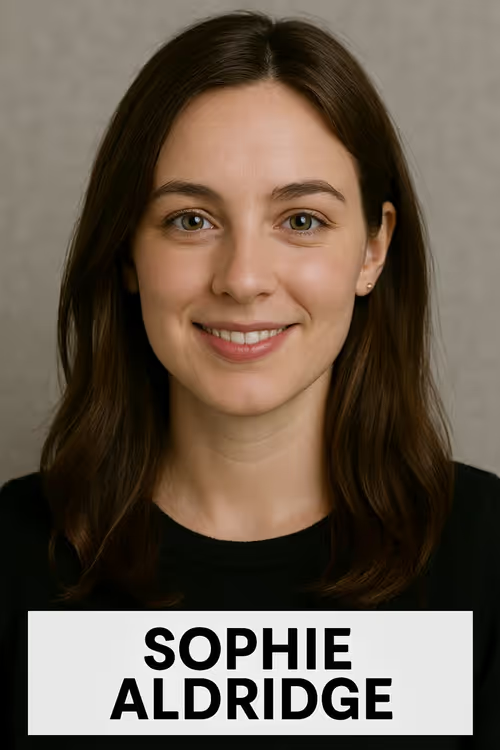
Sophie Aldridge
Global Economics Editor · Geopolitics
Sophie spent a decade advising governments on trade policy before deciding the story was more interesting than the memo. She covers global economics, geopolitics, and the power transitions reshaping emerging markets. Sharpest on sanctions, supply chains, and the politics behind the price of everything. Based in Washington, D.C. Reach out at sophie.aldridge@theplatinumcapital.com.