

Office Market Restructuring: From Vacancy to Conversion
The commercial office sector is undergoing its most significant structural transformation in decades, as persistent vacancy rates in major metropolitan centres force landlords and investors to confront the reality that a substantial portion of existing stock will never return to its pre-pandemic function. Adaptive reuse conversions into residential, life sciences and mixed-use developments are rapidly emerging not as a temporary corrective but as the defining investment thesis for urban real estate portfolios through the end of the decade.…
Office Market Restructuring: From Vacancy to Conversion
The glass towers that once symbolised corporate ambition across the world's major commercial districts are being reimagined at a pace that would have seemed improbable five years ago. In Dubai's DIFC, in Riyadh's emerging financial quarter, and across Southeast Asian capitals, office buildings that sat partially empty through the post-pandemic adjustment are now being gutted, rezoned, and converted into residential units, hospitality assets, and mixed-use developments. The office market is not simply recovering. It is being structurally dismantled and rebuilt to reflect a fundamentally different set of economic realities.
By mid-2026, global office vacancy rates remain elevated at approximately 18.2 per cent across major markets, according to JLL's latest quarterly survey. But beneath that headline figure lies a profound bifurcation. Grade A+ trophy assets in prime locations report occupancy rates above 93 per cent, while older Class B and C buildings — particularly those constructed before 2010 without ESG-compliant infrastructure — languish with vacancy rates exceeding 30 per cent in some jurisdictions. That gap is staggering. And it is this latter category that has become the target of an aggressive conversion wave, driven increasingly by Gulf-based capital and family office investors chasing countercyclical returns.
The Gulf as Conversion Capital
The United Arab Emirates and Saudi Arabia have emerged as both laboratories and financiers of the office-to-alternative conversion trend. Abu Dhabi's Mubadala Investment Company committed $1.4 billion in early 2026 to a portfolio strategy explicitly targeting distressed office assets in London, Frankfurt, and Singapore for conversion to mixed-use residential and co-living formats. The sovereign wealth fund's real estate division identified 14 properties across these markets where acquisition costs had fallen below replacement value by margins of 35 to 50 per cent — a threshold that makes conversion economics compelling even after substantial renovation expenditure.
Riyadh's office market tells a different story entirely. The Kingdom's Vision 2030 programme has generated such extraordinary demand for Grade A commercial space that older government office buildings in the Olaya district are being simultaneously vacated and repurposed. The Public Investment Fund's subsidiary, Rua Al Madinah Holding, has been converting former ministry buildings into boutique hospitality and retail concepts — a strategy that mirrors what developers in Manhattan and central London have been attempting, but with the advantage of state-backed planning acceleration and substantially lower regulatory friction.
Saudi family offices have been particularly active. The Olayan Group expanded its real estate conversion portfolio in Q1 2026 with the acquisition of two former corporate headquarters in Jeddah, earmarked for transformation into premium serviced apartments targeting the growing population of expatriate professionals relocating to the Kingdom. SEDCO Capital, the Jeddah-based Sharia-compliant investment firm, allocated approximately $600 million to a dedicated office conversion fund focused on secondary European cities where purchase discounts are steepest. Few outside the region have noticed.
The Mathematics of Conversion
The financial logic underpinning office-to-residential conversion has shifted materially since 2024. Construction cost inflation, which peaked at 14 per cent year-on-year in most Gulf and Asian markets in late 2023, has moderated to between 4 and 6 per cent in 2026 as supply chain normalisation took hold. Meanwhile, residential rents in conversion-target cities — Dubai, London, Singapore, Mumbai — kept climbing. Dubai recorded a 12.7 per cent year-on-year increase in prime residential rents through March 2026, according to CBRE.
The spread makes the bet obvious. Knight Frank's latest analysis estimates that a typical office-to-residential conversion in a Gulf or Asian market generates an internal rate of return of between 14 and 19 per cent over a five-year hold period, compared with 7 to 9 per cent for a conventional office repositioning strategy. The differential widens even further when developers secure rezoning approvals that permit higher density residential use than the original commercial designation allowed — a regulatory concession that authorities in Dubai, Kuala Lumpur, and Bangkok have been increasingly willing to grant as they try to address housing supply shortfalls.
Emerging Market Frontiers
Beyond the Gulf, the conversion trend is accelerating in markets where rapid urbanisation collides with office oversupply. India's commercial real estate sector added roughly 60 million square feet of office space annually between 2019 and 2024. Now it confronts vacancy rates of 22 per cent in secondary business districts of Bangalore, Pune, and Hyderabad. Embassy Group, one of India's largest commercial developers, announced in February 2026 a dedicated conversion division targeting its own older assets for transformation into co-living and student housing formats. That is a significant shift — a tacit acknowledgement that the space will not be reabsorbed as conventional office inventory.
In Southeast Asia, CapitaLand Investment has earmarked SGD 800 million for a regional conversion strategy spanning Vietnam, Thailand, and Indonesia. Ho Chi Minh City's Thu Duc district, originally planned as a technology office corridor, is seeing three major towers redirected toward mixed-use residential as multinational tenants consolidate into fewer, higher-specification buildings closer to the city centre. Philippine conglomerate Ayala Land is pursuing a similar approach in Manila's Makati district, where pre-pandemic office completions created a persistent supply overhang that shows no signs of clearing.
Private Wealth and the Institutional Pivot
Family offices and ultra-high-net-worth investors have proven particularly adept at exploiting the conversion opportunity. They can tolerate complexity. They can hold longer. The Bahrain-based Investcorp reported in its April 2026 investor letter that office conversion deals constituted 28 per cent of its real estate transaction volume in the preceding twelve months, up from just 4 per cent in 2023. Geneva-based multi-family office Mirabaud has structured three dedicated conversion vehicles for its Middle Eastern and Asian client base since late 2025, each targeting a different geography and end-use profile.
Institutional capital is following. Brookfield Asset Management, which owns one of the world's largest office portfolios, disclosed in its Q1 2026 earnings call that it had initiated conversion feasibility studies on 23 properties globally, representing approximately 8.5 million square feet. The firm's chief executive, Bruce Flatt, described the strategy as "recycling capital from secular decline into secular growth." That framing captures the essence of what is happening across the sector.
Structural Permanence, Not Cyclical Adjustment
What distinguishes the current restructuring from previous office market corrections is its irreversibility. Buildings converted to residential or hospitality use will not return to commercial service when the cycle turns. They're gone. Green Street Advisors estimates that by 2030, approximately 400 million square feet of global office space will have been permanently removed from inventory through conversion, demolition, or functional obsolescence — equivalent to roughly 3 per cent of total global stock. For Gulf-based investors and family offices positioned early, this structural contraction creates the conditions for sustained rental growth in the remaining Grade A office assets they hold, while simultaneously generating conversion returns on the buildings they repurpose.
The office market is not dying. It is being distilled — the surplus carved away and rebuilt as something more economically productive. The investors and developers who recognised this shift earliest, many of them based in Riyadh, Dubai, and Abu Dhabi, stand to define the next decade of urban real estate.
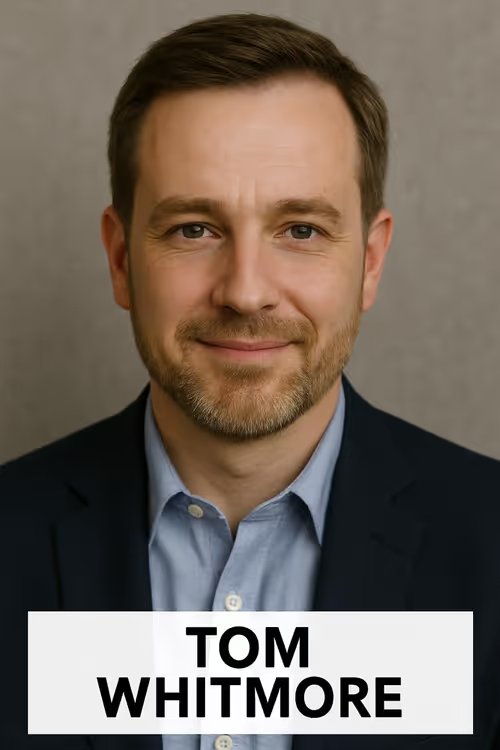
Written by
Tom Whitmore
Senior correspondent · Real Estate & Private Companies
Tom has interviewed most of the operators reshaping the Gulf skyline — and a few of the ones who tried and didn't. His beat is real estate, commodities, manufacturing, and the founder-led private companies that never bother to list. He knows which buildings and balance sheets survive a downturn before the spreadsheet does. Based in Dubai. Reach out at tom.whitmore@theplatinumcapital.com.