

Value vs Growth: Which Style Wins in the Current Cycle
As interest rates stabilize and inflationary pressures gradually recede, the long-running debate between value and growth investing has entered a decisive new phase, one where capital allocation decisions carry consequences that extend well beyond individual portfolios. Charlotte Reeve examines how sophisticated investors and family offices are repositioning across asset classes, drawing on macroeconomic signals and sectoral rotation trends to determine which investment style is best positioned to deliver superior risk-adjusted returns in the current cycle.…

The debate between value and growth investing has never been simple. But in this cycle — shaped by structural market liberalisation across emerging economies, geopolitical disruption, and a stubborn recalibration of interest rate expectations — the stakes have risen considerably. For private investors, family offices, and institutional allocators operating across the Gulf, Central Asia, and Southeast Asia, choosing the wrong side of this trade is not an academic misstep. It is a capital allocation decision with generational consequences.
The Cycle Has Shifted — And the Data Shows It
After more than a decade of growth-style dominance fuelled by near-zero interest rates in the West, the pendulum has moved — and this time it looks structural. Global value indices have outperformed their growth counterparts on a risk-adjusted basis for the third consecutive year through mid-2026. The MSCI World Value Index has delivered approximately 11.4% year-to-date against 7.8% for its growth equivalent. The driver is familiar but now entrenched: rates in the United States and Europe have not retreated to pre-2022 lows, and the compressing discount rates that once inflated the present value of future earnings — the fundamental engine of growth stock returns — no longer carry the same force.
This is not a dismissal of growth investing. The era in which investors paid 40 to 60 times forward earnings for speculative technology companies has passed, at least for now. What has replaced it is a premium on tangible cash flows, dividend yield, and asset-backed balance sheets. Energy companies, financial institutions, and industrial conglomerates are no longer the unfashionable corner of the portfolio. In many markets, they are the most sophisticated position to hold.
Saudi Arabia: A Value Investor's Emerging Thesis
Nowhere is this shift more visible than on the Tadawul. On February 1, 2026, Saudi Arabia's Capital Market Authority eliminated the Qualified Foreign Investor framework — dismantling the $500 million AUM requirement that had effectively restricted direct market access to only the world's largest institutions. For private investors across the Gulf, Africa, and Southeast Asia who had previously been locked out, this market is now genuinely open. Few outside the region have internalised what that means. They should.
The timing matters. The TASI had already been under pressure — Saudi institutions were net sellers of $7.5 billion in Riyadh-listed equities between the start of 2025 and the end of February 2026. That selling created a valuation opportunity that most international allocators were not positioned to capture. When the Iran conflict escalated in early 2026 and Gulf bourses sold off sharply, Saudi institutional buyers reversed course — hard. The TASI rose 5% in March alone, outperforming virtually every comparable regional index. Julian Bruce, Managing Director of EFG Hermes' UAE brokerage, framed it precisely: the Saudi market had already sold off to the point where rotating out of the UAE on valuation grounds — particularly in banking stocks — was the logical trade. That is value investing operating exactly as intended.
Analysts at Jefferies estimate that if the current 49% foreign ownership cap is eventually lifted — a review is scheduled for later in 2026 — passive inflows alone could reach between $3.4 billion and $10.2 billion. CMA Board Member Abdulaziz Abdulmohsen Bin Hassan has publicly signalled the regulator's commitment to lifting that cap, either fully or in phases. That is a significant shift. For long-term investors, this is not a trading signal. It is an index weight and capital flow thesis that warrants serious structural allocation.
Growth Still Has a Home — But You Must Be Selective
Abandoning growth entirely would be a strategic error, particularly for investors with exposure to Southeast Asia and parts of Central Asia. Demographic tailwinds, digital infrastructure buildout, and consumer market expansion in these regions create genuine long-duration earnings growth. Vietnam's technology and manufacturing sectors, Indonesia's digital financial services ecosystem, and Kazakhstan's expanding fintech and logistics corridor along the Middle Corridor trade route all offer growth-style opportunities still priced at emerging market discounts — not Silicon Valley premiums.
The distinction is worth drawing carefully. The growth trade that destroyed capital between 2022 and 2024 concentrated in late-stage, rate-sensitive, and often unprofitable Western technology companies. The growth trade that works now is rooted in under-penetrated markets with rising middle classes, improving regulatory environments, and companies that actually generate cash. The numbers tell a complicated story — but the geography matters enormously. Family offices with patient capital and multi-decade horizons should not abandon this allocation. They should sharpen it geographically.
IPO Activity and the Return of Capital Events
One of the more telling indicators of where sophisticated institutional capital is positioning is the pipeline of capital markets activity. HSBC currently holds 45 merger, acquisition, and IPO mandates across the Gulf region, with the bank targeting a Q4 2026 recovery in listing activity. IPO pipelines are populated by the companies that investment bankers and corporate advisors believe can attract real investor appetite. The current Gulf pipeline skews heavily toward asset-rich, cash-generative businesses in energy services, real estate, financial services, and industrial infrastructure. These are, almost definitionally, value-oriented listings.
For investors who participate in Gulf IPOs — through direct allocation, anchor positions via family office networks, or secondary market entry — understanding the style tilt of incoming listings helps calibrate portfolio construction. Buying growth-style valuations in markets that are structurally re-rating toward value is a mismatch. And markets tend to punish that mismatch over any meaningful time horizon.
What This Means for Sophisticated Private Investors
The practical read for high-net-worth individuals and family offices managing between $10 million and $1 billion in investable assets is this: the current cycle rewards investors willing to own what others have recently sold, to operate in markets that global benchmarks under-index, and to hold positions through the kind of geopolitical volatility that 2026 has already served up in abundance. The Tadawul liberalisation, the institutional defence of Saudi equities during the Iran conflict, and the anticipated wave of Gulf capital markets activity in the second half of 2026 are not separate stories. They form a coherent argument for a value-tilted, emerging-market-anchored allocation framework.
Growth investing will have its moment again — most likely when the next global rate-cutting cycle gains real momentum and risk appetite expands broadly. Until that point, the investors generating alpha are those who understand that price paid remains the most durable determinant of long-term return. And right now, some of the most attractively priced assets in the world carry Gulf, Central Asian, and Southeast Asian postal codes.
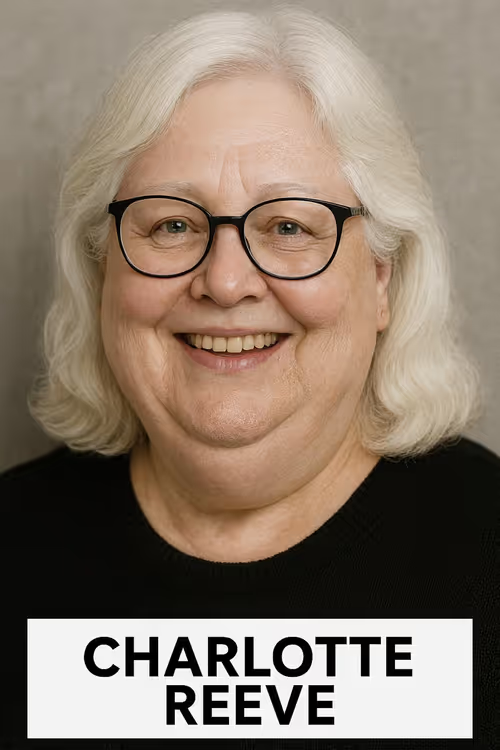
Written by
Charlotte Reeve
Senior correspondent · Capital Markets & Fintech
Charlotte cut her teeth on an equities desk before moving to the other side of the notebook. She covers capital markets, stock exchanges, and the fintech operators trying to disintermediate the banks that trained her. Sharpest on market microstructure and payments infrastructure; still reads a prospectus for fun. Based in Singapore. Reach out at charlotte.reeve@theplatinumcapital.com.