

WealthTech for the Gulf: Digital Platforms Serving HNW Investors
As the Gulf Cooperation Council's ultra-high-net-worth population continues its rapid expansion, a sophisticated new generation of digital wealth management platforms is reshaping how regional family offices and sovereign investors allocate capital across global asset classes. From AI-driven portfolio optimisation to Sharia-compliant digital advisory services, WealthTech is no longer a disruptive outsider in the Gulf financial landscape — it is fast becoming the infrastructure upon which the region's next decade of private wealth growth will be built.…
Something structural is happening in Gulf wealth management, and it is moving faster than most private investors realise. The region's high-net-worth community — long accustomed to white-glove private banking relationships built over decades — is now being actively courted by a new generation of digital platforms that understand Shariah compliance, cross-border capital flows, and the specific expectations of investors managing anywhere from $10 million to several hundred million dollars. The deals being struck, the licences being granted, and the capital being deployed in 2026 tell a story not merely about technology, but about who controls the future of Gulf wealth.
Capital Is Voting Early and Loudly
When Abu Dhabi-based BlueFive Capital led a $230 million seed round into Mal — an AI-native Islamic digital financial platform — it sent an unambiguous signal to the market. Seed rounds of this scale are almost unheard of globally. The fact that one of the largest in Q1 2026 was structured around Shariah-compliant digital finance tells you exactly where institutional conviction is gathering right now. Mal's founding team carries direct experience from Revolut and Nubank, two institutions that fundamentally rewired retail banking expectations in Europe and Latin America respectively. The platform is targeting a 2026 launch and is already in regulatory conversations in the UAE, Bangladesh, Indonesia, and Pakistan — a deliberately chosen group of markets that collectively represent hundreds of millions of Muslim consumers at varying stages of digital financial sophistication.
For family offices and private investors in the Gulf, this matters well beyond the headline figure. The architecture Mal is building — AI-native, Shariah-compliant, designed from inception for mobile-first users in emerging markets — represents the kind of infrastructure bet that precedes significant wealth creation. The early movers who understood what Nubank would become before it reached 90 million users are watching this space with that same quality of attention. A few of them helped write the cheque.
Saudi Arabia Opens the Data Layer
In March 2026, the Saudi Central Bank, SAMA, issued its first live open banking licences — moving the Kingdom's fintech sector out of controlled sandbox conditions and into full commercial operation. The practical consequence is real and immediate: APIs now enable real-time data sharing between established banks and licensed fintechs, unlocking more precise credit underwriting, dramatically faster client onboarding, and the kind of personalised financial product development that HNW investors in Europe and Singapore have taken for granted for years. That is a significant shift for a market of Saudi Arabia's scale.
Running in parallel, Riyad Bank's digital arm Jeel has entered a live pilot with Ripple to test blockchain-based cross-border transfers and tokenisation within a defined regulatory framework. This is not a proof-of-concept exercise. It is a functioning commercial test inside one of the GCC's most conservative banking environments. Its success would accelerate the timeline for tokenised asset settlement across the region considerably — and the people running Gulf family offices know exactly what that means in practice. For investors with capital distributed across the Gulf, Southeast Asia, and Central Asia — a common profile among the family offices The Platinum Capital speaks to regularly — near-instantaneous, compliant cross-border settlement is not an abstract benefit. It directly addresses one of the most persistent friction points in managing international private wealth. Few outside the region have connected these two developments. They should.
Tabby and the Architecture of a Super-App
Tabby's trajectory deserves careful reading by any investor tracking where Gulf consumer finance is heading. Following a secondary share sale in late 2025, the company reached a $4.5 billion valuation — the highest ever recorded for a fintech startup the region has produced — with total funding of $604 million. That part of the story is well known. What receives far less attention is what Tabby is actually building next.
The company recently obtained a Stored Value Facilities licence from the Central Bank of the UAE, a regulatory category that permits it to hold customer funds, offer spending accounts, issue payment cards, and develop broader money management tools. CEO Hosam Arab has been explicit that Tabby's ambitions extend well beyond buy-now-pay-later. The company built its user base by solving a genuine consumer credit gap in a region where credit card penetration remains comparatively low. It is now converting that trust and transaction data into something structurally more durable: a financial operating system for the Gulf's digitally active middle and upper-middle class. The numbers tell a complicated story — one that rewards closer reading. The HNW community should watch this evolution not merely as observers but as potential allocators. The platform's data assets and regulatory positioning are increasingly investable propositions in their own right.
The Funding Composition Tells Its Own Story
The MENA startup ecosystem raised $1.7 billion across 242 rounds in H1 2026. That figure represents an 18% decline from the equivalent period in 2025, and some commentators have framed it as a contraction. A more accurate reading is that the market is maturing. Fewer speculative early-stage bets. More capital concentrating in companies with demonstrated regulatory progress, genuine user bases, and clear paths to profitability. The UAE continues to dominate the regional funding picture, and fintech consistently leads by sector.
This shift in composition matters particularly to family offices evaluating direct or co-investment opportunities in the region. The era of Gulf fintech funding rounds driven largely by narrative and regional enthusiasm is giving way to one where due diligence looks more familiar — where unit economics, regulatory licensing timelines, and institutional backing serve as the primary filters. That is a healthier environment for sophisticated private capital, even if the headline growth rates are temporarily more modest. Discipline tends to arrive before the serious money does.
What the Next Twelve Months Require
The Gulf's wealthtech moment is not approaching. It is here. The platforms now receiving institutional backing, regulatory licences, and technical talent are building the rails on which the next generation of private wealth will be managed, transferred, and grown. For HNW investors and family offices across the GCC, the relevant question is no longer whether to engage with digital wealth infrastructure — it is how to do so with appropriate selectivity and without being late.
The most compelling opportunities sit at the intersection of Shariah-compliant architecture, cross-border capability, and genuine regulatory traction — precisely the combination that platforms like Mal and initiatives like the Jeel-Ripple pilot are beginning to embody. Families with wealth spread across the Gulf, Central Asia, and Southeast Asia are particularly well-placed to benefit as the friction costs of managing multi-jurisdictional capital continue to fall. The private investors who treat this moment as infrastructure — rather than speculation — will find themselves significantly better positioned when the next cycle of Gulf wealth creation fully matures. The window for that kind of positioning rarely stays open for long.
Written by
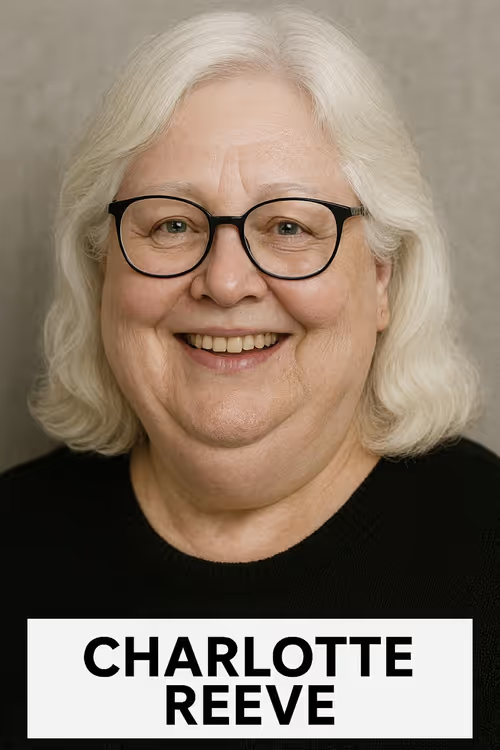
Charlotte Reeve
Senior correspondent · Capital Markets & Fintech
Charlotte cut her teeth on an equities desk before moving to the other side of the notebook. She covers capital markets, stock exchanges, and the fintech operators trying to disintermediate the banks that trained her. Sharpest on market microstructure and payments infrastructure; still reads a prospectus for fun. Based in Singapore. Reach out at charlotte.reeve@theplatinumcapital.com.