

Citadel Reports Record $24bn Profit For 2025 As Multi-Strategy Hedge-Fund Cycle Compounds
Citadel — the multi-strategy hedge-fund firm founded and led by Kenneth Griffin — reported record net profit of $24.3 billion for the calendar year 2025 on Friday, substantially exceeding the prior-year record of $17.8 billion and the $20.6 billion 2022 figure that had previously…

Citadel — the multi-strategy hedge-fund firm founded and led by Kenneth Griffin — reported record net profit of $24.3 billion for the calendar year 2025 on Friday, substantially exceeding the prior-year record of $17.8 billion and the $20.6 billion 2022 figure that had previously anchored the post-2008 high-water mark for the contemporary multi-strategy-hedge-fund commercial cycle. The Friday disclosure confirms Citadel's strategic-positioning leadership across the global multi-strategy-hedge-fund competitive architecture and substantively reinforces the structural-cyclical thesis around the multi-strategy-platform operating model.
The 2025 result composition, articulated in the Citadel partner letter released Friday morning from the firm's Miami headquarters, comprises substantively diversified strategy-segment contributions across the firm's principal investment-strategy framework: the Equities segment contributed approximately $9.8 billion (40% of total), the Fixed-Income segment contributed approximately $5.6 billion (23%), the Commodities segment contributed approximately $4.1 billion (17%), the Quantitative-Strategies segment contributed approximately $3.4 billion (14%), and the Credit-and-Special-Situations segment contributed approximately $1.4 billion (6%). The 2025 firm-wide cost-of-capital and risk-adjusted-return framework substantially exceeded both the firm's own internal-benchmark targets and the broader multi-strategy peer-group competitive comparison.
The strategic-context dimension is meaningful. Citadel's post-2023 commercial-trajectory cycle has been anchored on three substantive structural drivers: the continued substantial expansion of the firm's principal trading-and-investment-talent base across the equities, fixed-income, and commodities strategy verticals; the progressive maturation of the firm's substantial in-house quantitative-and-machine-learning infrastructure that has been progressively integrated across the broader investment-strategy framework; and the cumulative benefit of the firm's substantively-large pass-through fee-and-cost-allocation framework that has progressively become the industry-standard model for the contemporary multi-strategy-platform operating-economics architecture.
The wider multi-strategy-hedge-fund-sector context is meaningful. Citadel's 2025 result follows Millennium Management's record 2025 print of $14.2 billion (released Wednesday), Point72 Asset Management's record 2025 print of $7.8 billion (released last Friday), and the parallel strong 2025 results across the Balyasny Asset Management, ExodusPoint Capital Management, and Schonfeld Strategic Advisors operating cohort — collectively confirming that the substantive-strong post-2023 multi-strategy-hedge-fund-cycle expansion has continued to compound across the principal-platform competitive complex. The cumulative multi-strategy-platform assets-under-management across the principal-platform operator cohort now stands at approximately $1.1 trillion, broadly four times the equivalent base of 2018 on the same competitive-comparison framework.
For investors and operators across the global hedge-fund, alternative-investment, and broader institutional-asset-management landscape, the Friday Citadel record 2025 result is the clearest single confirmation that the substantial post-2023 multi-strategy-hedge-fund cyclical-expansion phase has continued to compound at a pace that substantively validates the constructive-thesis institutional-allocator framing — and that the underlying competitive-positioning advantage the principal-platform operator cohort has been progressively building remains substantively durable through the 2026 commercial cycle. The principal forward variable through the rest of the year is the rate of progression on the broader multi-strategy-platform talent-acquisition-and-retention competitive cycle — which will substantially determine the rate at which the cumulative-platform competitive-positioning architecture continues to compound.
Written by
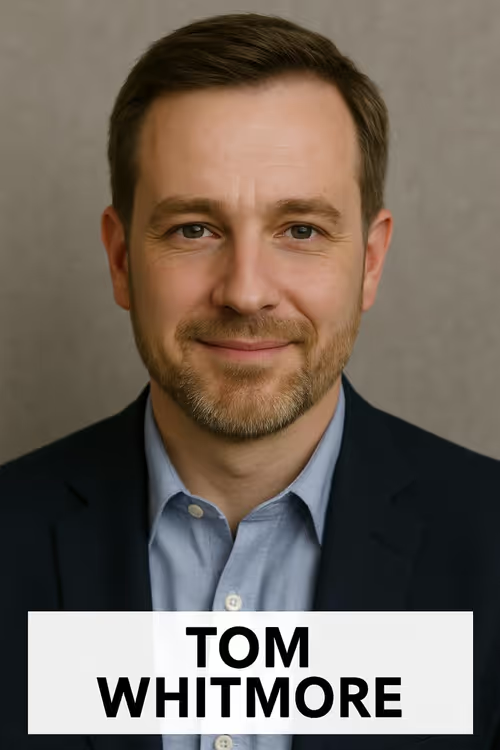
Tom Whitmore
Senior correspondent · Real Estate & Private Companies
Tom has interviewed most of the operators reshaping the Gulf skyline — and a few of the ones who tried and didn't. His beat is real estate, commodities, manufacturing, and the founder-led private companies that never bother to list. He knows which buildings and balance sheets survive a downturn before the spreadsheet does. Based in Dubai. Reach out at tom.whitmore@theplatinumcapital.com.