Dividend Investing in a High-Rate Environment
As central banks maintain elevated interest rates, the calculus for dividend investing has fundamentally shifted, forcing sophisticated investors to look beyond headline yields and scrutinize the structural resilience of cash flows, payout sustainability, and balance sheet discipline with far greater precision. For family offices and institutional allocators navigating this recalibrated landscape, the most compelling dividend opportunities now lie not in yield maximisation alone, but in identifying companies whose pricing power, low leverage, and earnings durability position them to grow distributions meaningfully above the prevailing rate of inflation.…

For the first time in a generation, income investors hold a structural advantage. Benchmark interest rates have stayed elevated across most major economies — the US Federal Funds Rate settled into a 4.25–4.50% range through the first half of 2026 — and yet the conventional wisdom that dividends lose their appeal in a high-rate world has been quietly dismantled by the markets themselves. In the Gulf, where sovereign-linked equities have long offered some of the most reliable yield profiles outside of fixed income, a new chapter is opening. The full liberalisation of Saudi Arabia's Tadawul in February 2026 and a recovering regional IPO pipeline are drawing serious capital from family offices, private investors, and cross-border wealth managers who understand that in volatile times, a company that pays you while you wait is not a consolation prize. It is the strategy.
Why High Rates Have Not Killed the Dividend Trade
The standard argument against dividend equities in a rising-rate environment is straightforward: when risk-free yields climb, income-generating stocks lose their relative appeal. For a period in 2023 and 2024, that logic held. But 2025 and 2026 have told a more complicated story. Companies with durable pricing power, low debt-to-equity ratios, and genuinely cash-generative business models — characteristics that run through GCC energy, utilities, and financial services like a common thread — have continued to outperform their growth-oriented peers on a total return basis. The numbers bear this out. The MSCI GCC Index, which carries significant weight in Saudi Aramco, Saudi National Bank, and First Abu Dhabi Bank, has delivered dividend yields in the 4.5–6.2% range. For investors holding in non-taxed jurisdictions, that frequently exceeds the effective after-tax return available on US Treasuries or regional sukuk. For a family office based in Dubai or Riyadh, that arithmetic is not academic. It drives allocation decisions.
The Tadawul Opening: A Structural Catalyst for Yield-Seeking Capital
The Saudi Capital Market Authority's decision to eliminate the Qualified Foreign Investor framework — effective February 1, 2026 — was not a regulatory tidying exercise. It was the final act of a decade-long liberalisation that has fundamentally repositioned the Tadawul as a destination for global income portfolios. Previously, direct access to the world's largest Arab equity market required a minimum of $500 million in assets under management, effectively limiting participation to a narrow band of institutional giants. That barrier is now gone. Any foreign investor — individual or institutional — can access a market with a capitalisation of $2.7 trillion, anchored by some of the most cash-generative companies on earth. Few outside the region have fully absorbed what that means. They should.
For dividend investors specifically, the implications are immediate. Saudi Aramco continues to pay a base dividend exceeding $70 billion annually, supported by a performance-linked component tied to free cash flow. Saudi Telecom Company has maintained consistent payouts through two years of macroeconomic turbulence. Al Rajhi Bank, the world's largest Islamic lender by assets, has historically returned 70–80% of net income to shareholders. Analysts at Jefferies estimate that if the current 49% foreign ownership cap — already under review for potential revision later in 2026 — is eventually lifted, the Kingdom could attract between $3.4 billion and $10.2 billion in passive inflows alone. The dividend story and the access story are the same story.
Geopolitical Resolution and the Return of the IPO Pipeline
Income investing is not simply about holding mature companies. For sophisticated investors, the IPO pipeline matters because today's listings become tomorrow's dividend payers — and in the Gulf, state-linked entities coming to market tend to reach yield maturity faster than private-sector companies in other regions. The first half of 2026 was, by most accounts, a disappointment on this front. War in the region at the end of February froze activity. Mutlaq Al Ghowairi Contracting Company pulled its Tadawul listing at the last minute in June, citing advice from its financial advisers amid uncertainty. Sentiment, as anyone who has worked these markets knows, can turn without warning.
But the framework agreement between the United States and Iran has materially changed the calculus. That is a significant shift. The Abu Dhabi Securities Exchange and the Dubai Financial Market both climbed to three-month highs in the days following disclosure of the 14-point memorandum. HSBC's MENAT chief executive Selim Kervanci — whose unit holds 45 active M&A and IPO mandates across the region — has indicated that Gulf listings are expected to resume in Q4 2026. Abu Dhabi is the one to watch. Etihad Airways, Emirates Global Aluminium, and clean energy developer Masdar are among the names circulating as potential listing candidates. Each carries the asset-backed, cash-generative profile that income investors prioritise. A successful Masdar IPO, in particular, could establish a new benchmark for green infrastructure yield in a region where ESG-linked income instruments remain largely underdeveloped.
Building a Dividend Portfolio Across Emerging Markets
For investors based outside the Gulf — family offices in Almaty, Nairobi, Jakarta, or Bucharest — the regional equity story demands a disciplined framework, not simple enthusiasm. Dividend investing across emerging and frontier markets turns on three variables that too many allocators underweight: currency stability, payout consistency, and the nature of state involvement. The UAE dirham's peg to the US dollar eliminates exchange rate risk for dollar-denominated portfolios entirely. The Saudi riyal peg provides similar insulation. Egyptian and Nigerian equity yields, while nominally attractive, tell a different story once you stress-test them against currency devaluation scenarios — scenarios that have eroded hard-currency returns by 20–40% in a single cycle, more than once.
Southeast Asian markets offer a complementary angle. Malaysian REITs and Indonesian blue-chips in banking and telecoms have delivered 4–7% dividend yields in an environment where Bank Negara and Bank Indonesia have held rates above pre-pandemic levels. Philippine conglomerates — SM Investments, Ayala Corporation — carry decades of unbroken dividend records that rival anything in developed markets. A well-structured family office portfolio combining Gulf fixed-yield anchors with Asia-Pacific growth dividend plays can produce blended income in the 5–6.5% range, with meaningful diversification across currency regimes and economic cycles. That combination is harder to replicate elsewhere.
The Forward View: Yield Quality Over Yield Quantity
The defining discipline of dividend investing in 2026 is not finding the highest yield. It is identifying the most sustainable one. Payout ratios above 90% in cyclical industries, dividend commitments backed by sovereign mandates rather than genuine free cash flow, income strategies built on leverage — high rates expose these vulnerabilities rather than forgive them. The investors who benefit most from the current environment are those who treat dividends as a measure of corporate quality, not simply a return mechanism. In the Gulf, where Vision 2030-linked companies face structural pressure to grow both earnings and shareholder returns simultaneously, management teams have unusually strong incentives to protect and grow their dividends. As the Tadawul's investor base widens and the IPO calendar rebuilds through Q4 2026, the foundation for a decade-long income story in the region is not being promised. It is already being laid.
Written by
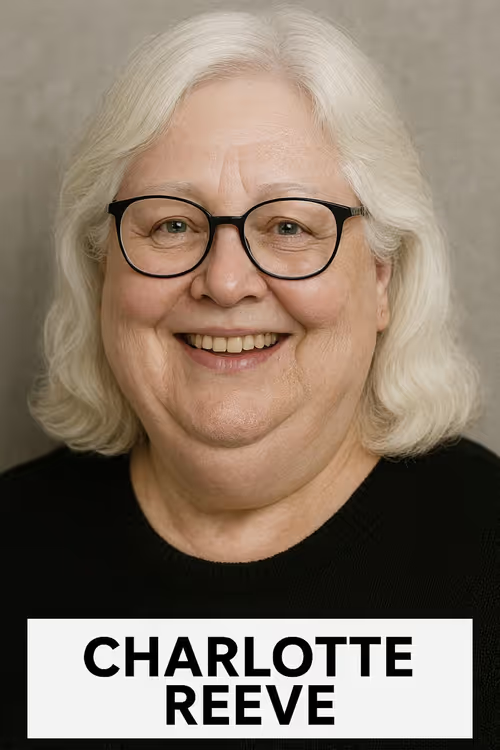
Charlotte Reeve
Senior correspondent · Capital Markets & Fintech
Charlotte cut her teeth on an equities desk before moving to the other side of the notebook. She covers capital markets, stock exchanges, and the fintech operators trying to disintermediate the banks that trained her. Sharpest on market microstructure and payments infrastructure; still reads a prospectus for fun. Based in Singapore. Reach out at charlotte.reeve@theplatinumcapital.com.