
Gulf Real Estate Developers Who Never List But Always Deliver
In the Gulf's most exclusive development circles, a quiet tier of operators has mastered the art of moving billion-dollar projects entirely through trust networks and closed-door mandates, rendering public listings not merely unnecessary but strategically beneath them. These are the firms that shape skylines from Abu Dhabi to Riyadh without a single press release, delivering institutional-grade returns to a carefully curated circle of principals who understand that the most valuable real estate in the region is never the kind you can find on a portal.…

When AD Ports Group completed the AED 295 million sale of KEZAD Logistics Park to Mair Group earlier this year, the transaction made headlines across the UAE's financial press. What attracted far less attention was the quiet network of private Gulf developers who had already identified the same industrial corridor opportunity years prior — and built into it without fanfare, without roadshows, and without any intention of listing on a public exchange. These are the builders behind the buildings. And in 2026, their relevance to serious capital allocators has never been sharper.
The Private Developer Archetype: Discretion as a Business Model
Gulf real estate has always had a visible, glamorous face — the listed giants, the flagship towers, the sovereign-backed megaprojects. Running parallel to that world is a stratum of private developers who operate on entirely different principles. They source land through relationships, not tenders. They finance through family capital, retained earnings, and bilateral arrangements with regional banks — not bond markets. And they deliver, on time, on specification, and on returns, to a concentrated client base of institutional tenants, government-linked entities, and fellow family offices who have neither the patience nor the appetite for public market volatility.
These developers are not obscure by accident. Discretion is a deliberate competitive advantage. When CJ Logistics commenced operations at its new Global Distribution Centre in Riyadh's Special Integrated Logistics Zone in February 2026, the shell that housed it — the industrial real estate infrastructure beneath the headline tenant — was almost certainly developed by a private group whose name will not appear in any investor presentation. That anonymity suits them perfectly.
Industrial and Logistics Real Estate: Where the Real Money Is Moving
The most significant shift in Gulf private development over the past three years has been the hard pivot toward logistics, cold-chain, and light industrial assets. This is not speculative positioning. It is a direct response to policy capital at scale. Saudi Arabia's commitment to developing 18 new logistics zones under a SAR 10 billion national initiative — combined with open invitations for private investment across 45 transport and logistics projects, including regional airport hubs — has created a generational pipeline for developers who can move fast and structure flexibly. Few outside the region have fully grasped the size of what is being assembled. They should.
SISCO's SAR 230 million acquisition of Transcorp in February 2026, specifically to bolster cold-chain and last-mile warehousing capabilities, signals that even listed Saudi operators are choosing to acquire rather than build from scratch. That is a significant shift. It only increases the premium on developers who already hold the right land parcels, permits, and infrastructure relationships. Private developers across the Eastern Province and Riyadh's outer logistics belts have spent the last 24 months positioning into exactly this demand. Several family-backed development groups in Jeddah and Dammam are understood to be holding assets valued at between SAR 400 million and SAR 1.2 billion in this segment alone — none of it publicly disclosed.
The UAE Model: Asset Recycling and the Private Developer Opportunity
In the UAE, the dynamics differ slightly but remain equally compelling for private capital. The KEZAD-Mair Group transaction and Agility Logistics' concurrent investment to develop a new multi-commodity bonded warehouse complex at JAFZA reflect an active phase of asset reshuffling — large institutional players simultaneously divesting mature assets and acquiring new development mandates. For private developers, this creates a two-sided opportunity: acquire stabilised assets being offloaded by balance-sheet-constrained institutions, while developing greenfield product to satisfy the next wave of demand.
Private Emirati and expatriate developer families — particularly those with deep roots in Abu Dhabi's industrial zones and Dubai's secondary logistics corridors — have been executing this playbook with considerable sophistication. Several have structured portfolios to include a mix of long-term JAFZA and KIZAD leaseholds generating stable dirham-denominated yields, alongside development-stage assets in Oman's Special Economic Zone at Duqm and Bahrain's Salman Industrial City, where land costs remain materially lower and government incentives remain generous. The numbers tell a complicated story, but the headline figure is hard to ignore: blended yields on such portfolios, for developers operating across multiple GCC jurisdictions, are understood to run at 9% to 13% on equity — well ahead of comparable listed REIT distributions.
Africa and Central Asia: Where Gulf Private Developers Are Looking Next
The most forward-looking Gulf private developers have stopped limiting their mandates to GCC markets. Africa Global Logistics' commitment of nearly €1 billion for 2026 — announced at Biashara Afrika in Lomé by Deputy CEO Mohamed Diop, who simultaneously signed a memorandum of understanding with AfCFTA Secretary-General Wamkele Mene — points to structural demand for logistics and industrial real estate across the continent's trade corridors. Gulf private developers, particularly those operating through UAE-based holding structures, are increasingly appearing as the real estate infrastructure layer beneath these logistics commitments. They are rarely credited. They are rarely visible. They are rarely unhappy about either.
In Morocco, A.P. Møller Capital's $243 million fund close for infrastructure investment reflects a wider trend of patient, institutional-grade capital moving into North African industrial assets. Gulf developers with existing relationships in Casablanca and Tangier are well placed to co-develop logistics and light industrial stock alongside this capital. Central Asia tells a similarly compelling story: Kazakhstan and Uzbekistan's accelerating industrial zone programmes are quietly pulling in Gulf family office capital seeking dollar-correlated returns outside saturated GCC markets. The flows are modest for now. The direction is clear.
What This Means for Family Offices and Private Investors
For family offices and private investors operating in the USD 50 million to USD 500 million range, the private Gulf developer segment is one of the most under-allocated opportunities in the current cycle. The barriers to entry are real — these developers do not market to strangers, and co-investment access runs almost entirely on relationships — but the risk-adjusted return profile is compelling precisely because of that exclusivity. Assets get acquired and developed at cost structures unavailable to listed vehicles. Exit timing stays with the developer, not the market. The tenant base — multinational logistics operators, government-linked entities, e-commerce infrastructure providers — ranks among the most creditworthy in the regional economy.
The developers who never list are not hiding from capital. They are selective about whose capital they accept. For those with the right relationships and the patience to participate on their terms, the returns speak clearly — and have done so, quietly, for decades. In a Gulf economy spending at unprecedented scale to build the infrastructure of the next century, the private developers enabling that build will remain among the most consequential, and least visible, wealth creators in the region. The smart money already knows their names. The rest is catching up.
Written by
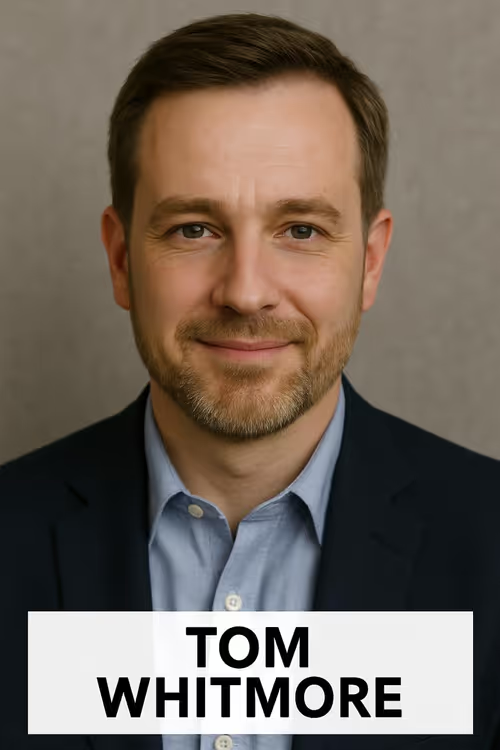
Tom Whitmore
Senior correspondent · Real Estate & Private Companies
Tom has interviewed most of the operators reshaping the Gulf skyline — and a few of the ones who tried and didn't. His beat is real estate, commodities, manufacturing, and the founder-led private companies that never bother to list. He knows which buildings and balance sheets survive a downturn before the spreadsheet does. Based in Dubai. Reach out at tom.whitmore@theplatinumcapital.com.