

How Retail Investors Are Changing Market Dynamics
The unprecedented surge of retail participation in global equity markets has fundamentally disrupted the institutional dominance that defined trading floors for decades, forcing hedge funds and sovereign wealth managers alike to recalibrate strategies once considered immovable. What began as a democratization of market access has evolved into a structural force capable of moving valuations, compressing spreads, and challenging the very assumptions underpinning sophisticated capital allocation models.…

For decades, the architecture of equity markets rested on a simple assumption: serious capital came from serious institutions. Retail investors were background noise — numerous but negligible, emotional rather than analytical, and largely excluded from the rooms where real market structure was debated. That assumption is now being systematically dismantled. Nowhere is the shift more consequential than across the Gulf, where regulatory reforms, digital brokerage infrastructure, and a new generation of financially literate investors are rewriting the rules of market participation in real time.
The Saudi Opening: A Structural Catalyst Unlike Any Other
The single most significant event reshaping Gulf equity dynamics in 2026 is Saudi Arabia's abolition of the Qualified Foreign Investor regime, effective February 1. The CMA's decision to dismantle the framework that had governed foreign access to Tadawul since 2015 — including the USD 500 million AUM threshold that had effectively reserved direct market access for the world's largest asset managers — is not a regulatory adjustment. It is an ideological repositioning of who belongs in the market.
The immediate implication: individual foreign investors, not just sovereign wealth funds or global fund managers, can now hold Saudi-listed equities directly. For wealthy individuals and family offices across Central Asia, Africa, and Southeast Asia — markets where sophisticated capital has long sought exposure to Gulf growth stories but faced structural barriers — this is a genuine inflection point. Naresh Bilandani, managing director of equity research at Jefferies International, has calculated that a foreign ownership limit increase from the current 49% to a range of 60% to 100% could attract between USD 3.4 billion and USD 10.2 billion in passive inflows from MSCI and FTSE index trackers alone. The passive flows are the headline. The retail and family capital flows may ultimately prove more durable.
Who Is Actually Buying — And What That Tells Us
Total foreign holdings on the Saudi Exchange reached SAR 457.18 billion — approximately USD 121.9 billion — as of end-May 2026, with average daily traded value for the month running at SAR 5.73 billion. These are not trivial numbers, but they require context. Saudi institutional investors were net sellers of USD 7.5 billion in Riyadh-listed equities from the start of 2025 through February 2026. That is a striking period of domestic institutional disengagement, and it coincided with the TASI declining 12.8% across 2025.
Then March 2026 arrived. Saudi institutional investors swung to net buyers of USD 1.9 billion. The professionals did not leave the market permanently. They repositioned — and they did so precisely at the moment retail and individual foreign investors were being welcomed in greater numbers. Anyone who has tracked the evolution of markets in South Korea, India, or Brazil will recognise this dynamic. Institutional consolidation, followed by retail broadening. The retail investor does not replace the institution. They expand the base of liquidity and, at elevated valuations, they absorb supply that institutions are unwilling to hold.
Digital Infrastructure and the Democratisation of Gulf Equities
The structural reform story cannot be separated from the technology story. The proliferation of mobile-first brokerage platforms across the GCC, combined with the integration of regional exchanges into global clearing frameworks, has reduced the friction cost of retail participation to near zero for investors with the right connectivity. A family office principal in Almaty, a private investor in Lagos, a next-generation wealth holder in Manila — each can now construct a position in Saudi petrochemical or banking stocks with the same operational ease they would apply to a US-listed ETF.
This is not hypothetical. Platform-level data from regional brokers consistently shows rising account opening rates from non-GCC jurisdictions, particularly from the UAE-domiciled international investor community, which functions as a proxy market for global emerging market capital seeking Gulf exposure. Few outside the region have tracked this closely. They should. The Tadawul's decision to modernise its post-trade infrastructure and align with international settlement standards was a prerequisite for this moment — and it is now bearing commercial fruit in ways that pure institutional reform alone never could have delivered.
IPO Markets: Temporary Pause, Not Structural Retreat
The broader GCC IPO market has visibly decelerated. Saudi Arabia accounted for 37 of the 42 GCC IPOs recorded in 2025, but sentiment softened considerably as the year progressed and the TASI underperformed regional peers. For investors accustomed to the extraordinary listing frenzy of 2022 and 2023, 2025 felt like a correction in ambition rather than just valuation.
The more instructive signal comes from HSBC. In mid-June 2026, Europe's largest bank by assets disclosed a pipeline of 45 mergers and acquisitions and IPO mandates across the Gulf region. Banks do not build 45-mandate pipelines on sentiment alone. HSBC's regional investment banking leadership expects listing activity to resume meaningfully in the fourth quarter of 2026, partly catalysed by the signing of the US-Iran agreement and the resulting reduction in geopolitical risk premium that had been suppressing institutional appetite for GCC equity risk. That is a significant shift. For retail and private investors considering positioning ahead of that recovery, the current period of subdued valuations represents one of the more attractive entry windows in recent memory.
What This Means for Private Investors and Family Offices
The convergence of structural reform, tactical institutional repositioning, and a Q4 recovery thesis creates a specific set of considerations for the private wealth community. Family offices with USD 50 million to USD 500 million in liquid assets should be reviewing their GCC equity allocation frameworks — not as an emerging market side pocket, but as a core strategic position. The Saudi market's full opening to foreign retail and individual investors means the access premium has been eliminated. The implicit cost of being a smaller player seeking entry into a historically restricted market is gone.
For next-generation principals across Nigeria, Vietnam, Georgia, and Indonesia, the Saudi market now offers something that was structurally unavailable two years ago: direct, uncomplicated equity exposure to the world's most ambitious sovereign transformation programme, priced at post-correction multiples, with an institutional recovery cycle beginning to form beneath the surface. The numbers tell a complicated story, but the direction is clear. The retail investor did not create this opportunity. It was the logic of democratic market access that made it available to them.
Markets built for broader participation tend to price more efficiently over time, distribute risk more widely, and prove more resilient in downturns because the seller base is more diverse. The Gulf's equity ecosystem is, at this moment, in the early stages of that maturation. The investors who recognise that transition before it becomes consensus will carry the better entry points — and the stronger long-term positions.
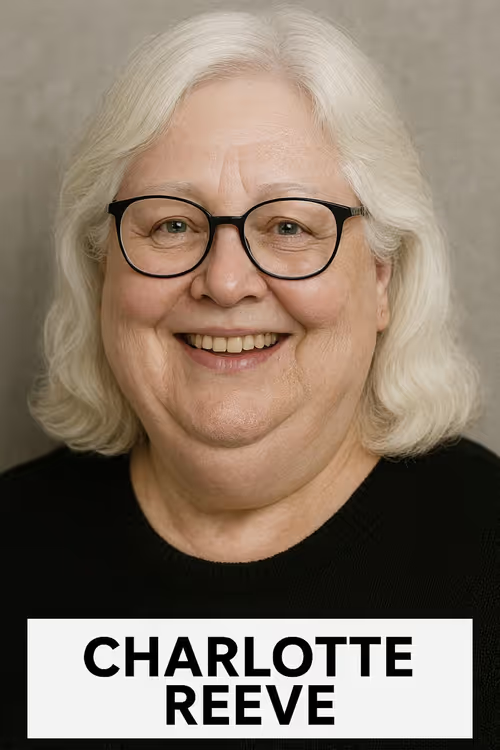
Written by
Charlotte Reeve
Senior correspondent · Capital Markets & Fintech
Charlotte cut her teeth on an equities desk before moving to the other side of the notebook. She covers capital markets, stock exchanges, and the fintech operators trying to disintermediate the banks that trained her. Sharpest on market microstructure and payments infrastructure; still reads a prospectus for fun. Based in Singapore. Reach out at charlotte.reeve@theplatinumcapital.com.