
Kenya's Private Healthcare Groups Serving a Rising Middle Class
As Kenya's middle class expands at an accelerating pace, a new generation of sophisticated private healthcare groups is capitalizing on chronic underinvestment in public infrastructure to build vertically integrated networks spanning diagnostics, specialist care, and insurance partnerships across Nairobi and beyond. For discerning investors seeking long-duration exposure to Sub-Saharan Africa's most resilient consumer story, these capital-efficient operators represent a rare convergence of structural demographic tailwinds, pricing power, and defensible market positioning that few sectors on the continent can match.…

Across Nairobi's Karen suburb and Mombasa's North Coast, something is shifting. Private hospitals, diagnostic chains, and specialist clinics are expanding aggressively, competing for a demographic that barely existed two decades ago: Kenya's salaried, insurance-covered, quality-conscious middle class. The country's private healthcare market sits at approximately USD 1.2 billion in 2025 and is projected to grow at a compound annual rate of over 9 percent through 2030. Serious capital is arriving. Serious operators are already here. And the pace of change is drawing attention well beyond East Africa.
A Middle Class With Rising Expectations
Kenya's middle class — broadly defined as households earning between KES 23,000 and KES 120,000 per month — now accounts for an estimated 44 percent of the urban population, according to the Kenya National Bureau of Statistics. This cohort does not simply want healthcare. It wants healthcare that works. Clean facilities. Specialist consultants. Short waiting times. Digital appointment systems. The experience, if not always the price point, of private care in Dubai or Johannesburg.
That gap between what the public system delivers and what this demographic demands is the commercial engine driving Kenya's hospital groups. The public system — chronically underfunded, perpetually overstretched — has pushed millions of Kenyans toward private providers. Meanwhile, the National Hospital Insurance Fund, now transitioning under the Social Health Authority reforms introduced in 2024, is extending formal coverage to a wider contributor base. For private groups, this creates both a structural opportunity and an operational headache: how do you absorb a larger, more diverse patient population without eroding the quality premium that justifies your pricing? That is not a trivial question.
The Groups Building at Scale
Three names dominate serious conversation at the private capital level. The Nairobi Hospital, operating as an independent not-for-profit, remains the sector's flagship — a 350-bed institution serving diplomats, corporate executives, and medical tourists arriving from Uganda, Tanzania, Rwanda, and South Sudan. Its recently completed critical care expansion added 40 ICU beds and a dedicated cardiac catheterisation laboratory. That is not a maintenance investment. That is a regional ambition.
The Aga Khan Health Services network, backed by the institutional depth of the Aga Khan Development Network, operates across multiple East African countries and has been methodically upgrading its Nairobi facilities — robotic surgery infrastructure, a dedicated cancer care centre that opened in phases between 2023 and 2025. These are calculated moves to capture a regional medical tourism flow that currently bleeds outward to India, Thailand, and the UAE. That outflow costs East Africa an estimated USD 400 million annually in health expenditure lost to foreign providers. Few outside the region have focused on that number. They should.
Further along the spectrum, Lancet Laboratories — Kenya's dominant diagnostic chain with over 80 collection points nationwide — has been building out its molecular diagnostics and genomics capabilities. It is positioning itself as the backbone infrastructure on which clinical decisions at both public and private facilities increasingly depend. Its partnership model with smaller clinics gives it reach that a hospital-only strategy simply cannot replicate.
Capital Is Beginning to Flow
Private equity interest in East African healthcare, once cautious and sporadic, has grown more deliberate. British International Investment — the successor to CDC Group — maintains exposure through portfolio commitments to health platforms operating across sub-Saharan Africa. LeapFrog Investments, historically focused on financial inclusion but increasingly intersecting with health financing, treats Kenya as a core market. And Gulf-based family offices — particularly those with Kenyan diaspora connections or existing real estate and agribusiness positions in East Africa — are starting to evaluate healthcare as a natural vertical extension of what they already own.
The logic tracks what has driven consolidation elsewhere on the continent. The numbers tell a complicated story of fragmentation meeting capital. When Africa Global Logistics committed nearly €1 billion to close intra-African trade and logistics gaps — announced at the Biashara Afrika 2026 summit in Lomé — it confirmed what sophisticated allocators already suspected: serious capital has recalibrated its view of African markets. Healthcare, like logistics, rewards well-capitalised operators with management depth. Kenya's private hospital sector remains significantly fragmented below the top three or four names. Dozens of mid-tier hospitals and clinic chains are profitable. But they lack the balance sheets to fund the technology and talent investments that the next phase of growth demands. That is an acquisition opportunity, and it will not stay open indefinitely.
The Insurance Equation and Digital Disruption
The financial architecture supporting Kenya's private healthcare system is changing faster than the physical infrastructure. Private medical insurance penetration among formal sector employees has climbed to approximately 22 percent, up from under 14 percent a decade ago. That is a meaningful shift. But the more consequential development sits further down the income curve — insurtech platforms such as Ilara Health and Turaco are extending micro-insurance and embedded health coverage to gig economy workers and informal sector participants who previously had no formal coverage at all.
For hospital groups, this expands the addressable patient population well beyond the traditional corporate and expatriate base. Groups that move now to streamline billing systems, broaden panel agreements, and build out outpatient and day-surgery infrastructure — which carries far lower capital intensity than inpatient beds — will absorb this new cohort profitably. Those that wait will find competitors have already locked in the relationships. Telemedicine, which saw extraordinary adoption during the pandemic years, has also become a genuine triage and consultation channel, allowing groups like Aga Khan to reach patients in secondary cities without committing to full satellite hospital builds.
What Investors and Family Offices Should Watch
For family office principals and private investors evaluating positions in Kenya's healthcare sector, three dynamics demand attention. First, the Social Health Authority reform — Kenya's most significant restructuring of health financing in a generation — is still bedding in. Its ultimate effect on reimbursement rates and patient flows to private facilities will take two to three years to fully materialise. Groups with strong balance sheets and operational flexibility will absorb this transitional period far better than those dependent on high occupancy to service debt. Timing your entry matters here.
Second, the medical tourism opportunity is real — but realising it requires coordinated investment in logistics and accommodation ecosystems beyond the hospital walls. Gulf-based investors, many of whom helped build integrated health and hospitality destinations in the UAE and Saudi Arabia, carry directly transferable expertise. That is an edge worth deploying.
Third, and most consequentially, the scarcity of trained specialists — surgeons, anaesthetists, oncologists — remains the single binding constraint on growth across the sector. The groups that solve the talent equation through training partnerships, competitive compensation structures, and diaspora return incentives will outperform those that simply build beds and hope the doctors follow. Kenya's private healthcare story is, at its core, a human capital story. The investors who recognise that early will write the most rewarding chapter of it.
Written by
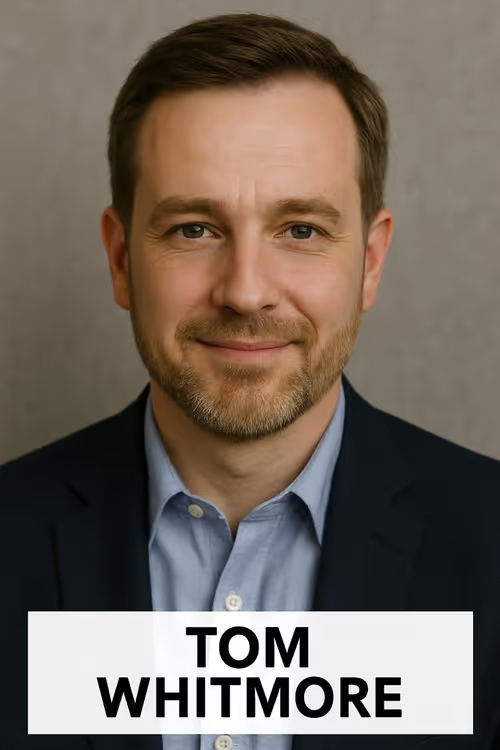
Tom Whitmore
Senior correspondent · Real Estate & Private Companies
Tom has interviewed most of the operators reshaping the Gulf skyline — and a few of the ones who tried and didn't. His beat is real estate, commodities, manufacturing, and the founder-led private companies that never bother to list. He knows which buildings and balance sheets survive a downturn before the spreadsheet does. Based in Dubai. Reach out at tom.whitmore@theplatinumcapital.com.