Morocco's Private Investment Groups and Their Cross-Border Ambitions
Morocco's most influential private investment groups are quietly reshaping the architecture of African and European commerce, deploying capital across infrastructure, agribusiness, and financial services with a sophistication that rivals sovereign wealth funds many times their size. For family offices and institutional investors seeking exposure to the continent's most strategically positioned economy, understanding the ambitions and methodologies of these conglomerates has moved from a peripheral consideration to an urgent priority.…

For decades, Morocco's most consequential business groups operated with deliberate quietness — building scale domestically, consolidating influence across North Africa, and occasionally making calculated moves into sub-Saharan markets. That era of restraint is ending. Across logistics, manufacturing, real estate, and agribusiness, a cohort of Moroccan private investment groups is now pursuing cross-border strategies of genuine regional significance, timed precisely as Africa's trade architecture reshapes itself and the Gulf doubles down on infrastructure at a scale that demands credible partners on the continent's Atlantic edge.
The Structural Moment Morocco's Investors Have Been Waiting For
The backdrop matters. Africa Global Logistics announced plans to deploy nearly €1 billion in 2026 to strengthen intra-African trade corridors, with Deputy CEO Mohamed Diop signing a memorandum of understanding with AfCFTA Secretary-General Wamkele Mene at Biashara Afrika 2026 in Lomé. The commitment — focused on inland corridors, multimodal infrastructure, and digital logistics solutions — signals that the continent's serious logistics operators are no longer waiting for governments to lead. They are moving ahead of them.
For Moroccan investors, this creates an immediate alignment of interest. Morocco's geography, its Atlantic and Mediterranean port access, its relative political stability, and the progressive expansion of its rail and road networks position the kingdom as a natural continental gateway. Private groups that spent years developing logistics, warehousing, and light manufacturing capabilities domestically are now finding that the infrastructure demand radiating south from Tangier Med — Africa's largest port — reaches far deeper into the continent than it did five years ago. That is a significant shift, and the smarter family offices in Casablanca registered it early.
Who Is Moving and Where
The families and holding groups making the most deliberate cross-border moves tend to share a common profile: third-generation leadership with professional management layered beneath founding family governance, exposure to European and Gulf capital markets, and existing operations in at least two sectors. The Holdco structures that emerged from the privatisation cycles of the 1990s and early 2000s — concentrated in Casablanca's financial district and the industrial zones of Kenitra and Tangier — have matured into vehicles capable of absorbing institutional co-investment. They are no longer purely family affairs.
In logistics and warehousing specifically, Moroccan groups have been watching the Gulf's sovereign repositioning closely. ADQ's acquisition of a controlling stake in Aramex — a network now processing over 2 million parcels daily across 65 countries — represents exactly the kind of sovereign-backed logistics consolidation that Moroccan private capital cannot replicate in scale. But it can complement it strategically. Several Moroccan family offices are understood to be in discussions with Gulf-backed logistics platforms about last-mile and cold-chain distribution partnerships across West and Central Africa, where Aramex and AGL hold network coverage but lack the local operational depth that Moroccan operators have quietly built through their Francophone African subsidiaries. That gap is worth money to the right partner.
Manufacturing Ambitions and the EV Supply Chain Opening
Morocco's automotive manufacturing sector — anchored by the Renault and Stellantis plants in Tangier and Kenitra, which together produce over 700,000 vehicles annually — has generated a supplier ecosystem of genuine sophistication. Private Moroccan groups that entered the automotive components space in the 2010s as tier-two and tier-three suppliers are now actively pursuing tier-one status. More significantly, they are positioning for the EV transition.
The Gulf connection here is direct. The deal between Khalifa Economic Zones Abu Dhabi (Kezad Group) and Titan Lithium to import lithium from Zimbabwe and process it locally for EV battery production illustrates the Gulf's determination to own segments of the EV supply chain. Morocco already sits at a critical node in battery chemistry. OCP Group controls approximately 70 percent of global phosphate reserves, and phosphate-based lithium iron phosphate batteries account for a growing share of global EV production. Private Moroccan investors with positions in phosphate processing downstream, specialty chemicals, and automotive components manufacturing are increasingly framing their cross-border ambitions around exactly this supply chain logic.
Several are actively seeking co-investment partnerships in the Gulf's emerging EV manufacturing zones. Saudi Arabia's USD 133.3 billion infrastructure commitment — covering ports, airports, railways, and including the Port of NEOM's first fully automated cranes — is generating demand for component suppliers with proven quality systems and proximity to European OEM standards. Moroccan operators, already audited to those standards through their Renault and Stellantis supply relationships, are better placed than most to meet that demand. Few outside the region have noticed. They should.
The West Africa Corridor and Financial Infrastructure
Moroccan private capital has long carried an appetite for West Africa that predates the current intra-African trade momentum. Attijariwafa Bank's pan-African banking network, now spanning 26 African countries, is the most visible expression of this — but the bank's footprint has created downstream opportunities for private groups operating in sectors adjacent to trade finance, real estate, and agribusiness. Family offices aligned with or previously associated with the major Moroccan banking groups have used those financial rails to enter markets in Côte d'Ivoire, Senegal, Cameroon, and Gabon with greater speed and lower friction than competitors arriving from outside the region. That is a structural advantage that does not show up cleanly in any fund prospectus.
The AfCFTA framework, while still operationally incomplete in many corridors, is already shifting investment calculus. The AGL-AfCFTA cooperation agreement signed in Lomé is one of several signals that the institutions underpinning intra-African trade are hardening into investable anchors rather than remaining aspirational frameworks. Moroccan groups with existing warehousing, cold-chain, or distribution assets in West Africa are being approached by international logistics operators seeking local partnerships that can absorb regulatory complexity across multiple jurisdictions simultaneously. The conversations are happening. Quietly, but they are happening.
What Sophisticated Investors Should Watch
For family offices, private investors, and sovereign-adjacent institutions assessing exposure to Morocco's outward investment wave, several indicators are worth tracking. The first is the pace of Tangier Med's expansion — the port handled over 9 million TEUs in 2024 and continues to attract anchor tenants whose supply chains extend into Gulf and Asian markets. The second is the consolidation occurring within Morocco's private logistics sector itself, where mid-sized operators are being absorbed into larger holding structures ahead of anticipated institutional fundraising rounds.
The numbers tell a complicated story, but a clear directional one. Saudi Arabia's logistics sector developments — SISCO's SAR 230 million acquisition of Transcorp for cold-chain capabilities and CJ Logistics' launch of its Global Distribution Centre in Riyadh's Special Integrated Logistics Zone in February 2026 — demonstrate that operational logistics businesses with genuine hard infrastructure are attracting serious capital. Moroccan equivalents are not far behind in attractiveness. The groups most likely to emerge as durable cross-border platforms are those combining family capital continuity with professional investment governance, sectoral depth in at least one high-demand vertical, and the institutional relationships required to access Gulf sovereign co-investment.
Morocco's private investment groups are no longer building for the domestic market. The cross-border ambitions are real, the timing is deliberate, and the capital behind them is patient enough to compound quietly. That is precisely the kind of story that looks obvious only in retrospect — usually when someone else has already taken the position.
Written by
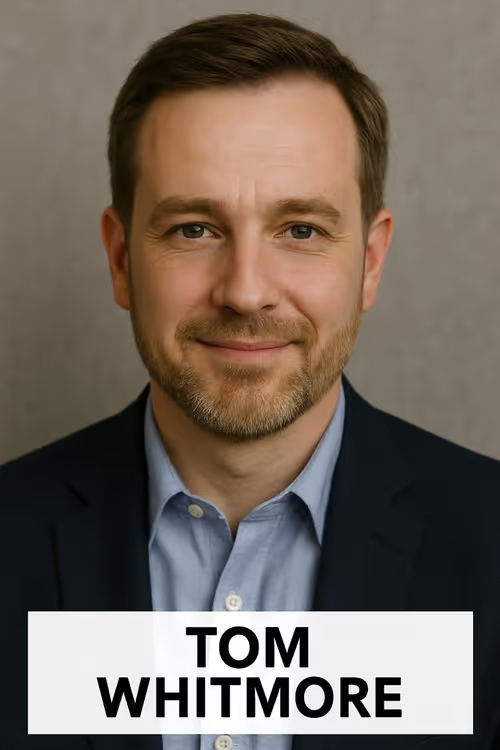
Tom Whitmore
Senior correspondent · Real Estate & Private Companies
Tom has interviewed most of the operators reshaping the Gulf skyline — and a few of the ones who tried and didn't. His beat is real estate, commodities, manufacturing, and the founder-led private companies that never bother to list. He knows which buildings and balance sheets survive a downturn before the spreadsheet does. Based in Dubai. Reach out at tom.whitmore@theplatinumcapital.com.