
Saudi Arabia's Private Manufacturing Champions Under Vision 2030
Saudi Arabia's Vision 2030 has quietly engineered a new class of industrial powerhouses, as privately held manufacturers across petrochemicals, defense components, and advanced materials capture government contracts and foreign partnerships that were unimaginable a decade ago. For discerning investors and family offices navigating the Kingdom's accelerating economic transformation, understanding which private champions are consolidating market position — and why — has become one of the most consequential allocation decisions of this decade.…
When Abu Dhabi's ADQ completed its $1.2 billion acquisition of Aramex in July 2025, the transaction sent a clear signal across the Gulf: state-backed capital is moving aggressively to consolidate logistics and supply chain infrastructure. But beneath that headline, a quieter and arguably more consequential story is taking shape inside Saudi Arabia. A generation of private manufacturers — family-owned, founder-led, and largely invisible to international financial media — are becoming the structural backbone of Vision 2030's industrial ambitions. These are not the gigaprojects. These are the companies building the components, packaging the pharmaceuticals, pressing the steel, and assembling the equipment that those gigaprojects require.
The Industrial Policy Behind the Opportunity
Saudi Arabia's National Industrial Development and Logistics Program has set a target of raising manufacturing's contribution to GDP from roughly 11% to 20% by 2035. The Kingdom currently imports more than 70% of its industrial inputs — a dependency that both the government and the private sector have identified as a strategic vulnerability. The Saudi Industrial Development Fund has responded by deploying over SAR 20 billion in concessional financing to domestic manufacturers since 2021, with priority allocations flowing into food processing, construction materials, petrochemical derivatives, and medical equipment.
The policy architecture is deliberate. Localisation quotas. Preferential government procurement for Saudi-made goods. Land grants inside Special Economic Zones. Together, these instruments are creating a protected but increasingly competitive environment for private operators willing to invest at scale.
What distinguishes this cycle from earlier Saudi industrialisation efforts is who is actually deploying the capital. Private family businesses, not state-owned enterprises, are driving the expansion. Across the Kingdom's industrial cities — Jubail, Yanbu, Jeddah, and the expanding KAEC corridor — it is privately held manufacturing groups that are expanding floor space, upgrading equipment, and negotiating long-term supply agreements with Vision 2030's mega-development entities.
The Family Business Foundation
Saudi Arabia's manufacturing sector was built on family conglomerates that have operated quietly for decades. Groups such as Al-Zamil, Olayan, and Al-Muhaidib have long maintained diversified industrial portfolios — spanning steel fabrication, HVAC systems, food production, and chemicals — largely self-funded and domestically oriented. Vision 2030 has dramatically expanded the addressable market for these businesses. NEOM alone requires construction materials, modular components, water treatment systems, and food supply chains at a scale that no single imported solution can efficiently serve. The same applies to Diriyah Gate, Qiddiya, and the Red Sea Project.
Several mid-tier private manufacturers — companies generating between SAR 200 million and SAR 2 billion in annual revenues — are now reporting order book growth that has outpaced their installed capacity. That is a significant shift. It has triggered a capital expenditure cycle: new factory lines, automation investments, and joint ventures with international technology partners seeking local manufacturing rights under Saudi content rules. For family offices managing wealth derived from these businesses, the question is no longer whether to reinvest. It is how to structure growth capital without diluting control.
Special Economic Zones as Catalysts
The King Abdullah Economic City Special Economic Zone and the Ras Al-Khair Industrial City have become focal points for private manufacturing investment, offering competitive lease rates, streamlined permitting, and direct port access that cuts logistics costs substantially. Saudi planners have studied the KEZAD model in Abu Dhabi closely — where the free zone authority recently signed deals with firms including Titan Lithium as part of its battery materials supply chain strategy — and the Kingdom has moved to replicate similar integrated industrial zone frameworks under its own SEZ authority, launched formally in 2022.
Private manufacturers that have established footholds inside these zones report real advantages: faster customs clearance, access to co-located suppliers, and eligibility for SIDF financing explicitly tied to SEZ residency. For investors and family offices evaluating entry points into Saudi manufacturing, these zones offer a defined geographic and regulatory perimeter within which private companies operate under a markedly more transparent and predictable framework than in the broader economy. That predictability is itself a form of de-risking. Few outside the region have fully priced it in. They should.
Sectors Where Private Capital Is Concentrated
Three manufacturing verticals stand out as particularly active for private Saudi capital. The first is construction materials and prefabricated systems, where demand from Vision 2030 projects has created near-guaranteed off-take for local producers of cement additives, structural steel, aluminium cladding, and pre-engineered buildings. The second is food and agro-processing. The Saudi government's food security mandate has accelerated investment in domestic production of dairy, poultry, packaged foods, and date derivatives — sectors where family-owned processors are expanding cold chain and packaging capacity at a rate not seen since the 1980s construction boom. The third is pharmaceutical and medical device manufacturing, a sector that received significant policy attention after supply chain disruptions in 2020 and 2021. The government's localisation target of 40% domestic production by 2030 is generating consistent procurement commitments for qualifying local manufacturers.
The numbers tell a complicated story — but the common thread across all three sectors is government-anchored demand. Not speculative export ambition. Contracted domestic consumption underwritten by public sector entities with multi-year budgets and explicit localisation mandates. That structure makes these businesses unusually attractive to private equity and family office capital seeking predictable cash flow without exposure to commodity cycles or export market volatility.
A Quiet Wealth Creation Event in Progress
For private investors, family office principals, and next-generation wealth managers paying attention to the Gulf, Saudi Arabia's private manufacturing champions represent one of the more compelling — and underreported — wealth creation stories in emerging markets right now. The combination of protected domestic demand, concessional government financing, SEZ infrastructure, and a generational leadership transition inside many founding families is producing conditions in which mid-sized private manufacturers could realistically double in enterprise value over a five-to-seven-year horizon.
The parallel with early-stage industrial consolidation in Southeast Asia during the 2000s is instructive. Vietnam and Indonesia produced significant private wealth in that cycle. The structural conditions in Saudi Arabia today carry comparable characteristics — with one critical difference. The policy commitment here comes from the highest levels of government, the captive domestic market is enormous, and most of the compelling operators remain privately held, undercapitalised relative to their opportunity, and entirely absent from any international investor's deal flow.
Obscurity combined with substance. That is precisely the environment in which lasting industrial wealth tends to get made.
Written by
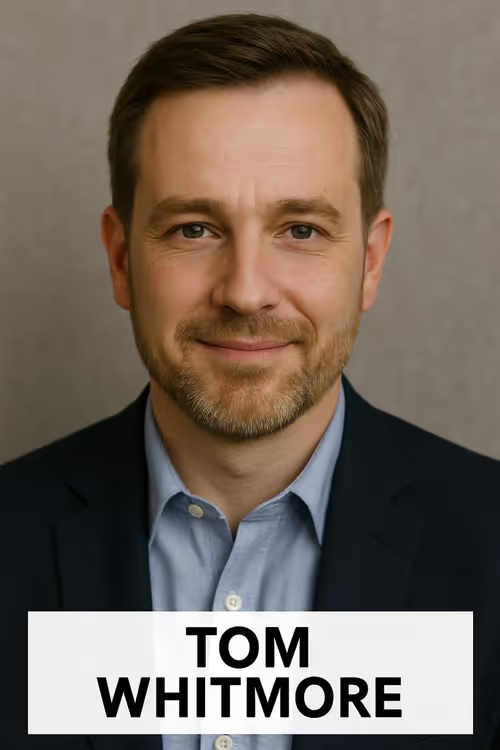
Tom Whitmore
Senior correspondent · Real Estate & Private Companies
Tom has interviewed most of the operators reshaping the Gulf skyline — and a few of the ones who tried and didn't. His beat is real estate, commodities, manufacturing, and the founder-led private companies that never bother to list. He knows which buildings and balance sheets survive a downturn before the spreadsheet does. Based in Dubai. Reach out at tom.whitmore@theplatinumcapital.com.