Sector Rotation: Where Smart Money Is Moving Now
As global monetary policy enters a pivotal inflection point, institutional capital is executing a calculated retreat from rate-sensitive growth equities and repositioning with precision into energy infrastructure, defense contractors, and select emerging market industrials that stand to benefit from a prolonged era of geopolitical fragmentation. For family offices and sovereign allocators navigating this transition, understanding the velocity and conviction behind these rotational flows is no longer a matter of portfolio optimization — it is a matter of capital preservation at scale.…

The first weeks of 2026 have confirmed what the most disciplined allocators already suspected: the era of passive, geography-agnostic investing is over. Capital is moving with precision — away from crowded developed-market indices and toward specific sectors in markets where structural reform, demographic growth, and sovereign ambition are colliding. For family offices managing portfolios between USD 50 million and USD 500 million, and for private investors who have watched Western equity valuations stretch uncomfortably thin, the rotation is not a trend to monitor. It is a decision to make now.
The Saudi Opening: A Structural Entry Point, Not a Cyclical Bounce
On 1 February 2026, the Saudi Capital Market Authority removed the last significant barriers to foreign participation in the Tadawul, abolishing the Qualified Foreign Investor framework entirely. For the first time, all categories of international investors can hold direct equity positions in Saudi-listed companies without intermediary structures — and without clearing the previous USD 500 million assets-under-management threshold that had long locked out smaller family offices and private wealth vehicles from direct access.
The immediate read is liquidity. Analysts are projecting up to USD 10 billion in new inflows as international capital reprices access to anchor names including Saudi Aramco, SABIC, and the expanding roster of Public Investment Fund-backed entities. But the more durable opportunity lies in what this reform signals about the kingdom's institutional maturity. A market that has deliberately redesigned its regulatory architecture to welcome foreign capital is not the same market that declined 13% through 2025 and went largely flat in 2024. That is a significant shift. The CMA reform is a sovereign commitment — and sovereign commitments in Saudi Arabia tend to arrive well-resourced.
For investors who track sector rotation specifically, the entry point is not Aramco. It is the mid-market industrial and infrastructure names sitting beneath the headline giants — companies now accessible to a far wider pool of international buyers for the first time.
The IPO Pipeline as a Rotation Signal
When a sovereign wealth fund announces eight IPOs in a single calendar year, it is not running a routine portfolio management exercise. The Public Investment Fund's decision to bring ArcelorMittal Jubail, Sela, Saudi Global Ports, Alkhorayef Petroleum, and CloudKitchens to the Tadawul in 2026 is a deliberate effort to deepen the market's sector breadth while recycling capital into the next generation of strategic investments.
Each listing carries a different rotation thesis. ArcelorMittal Jubail, a metal pipes producer embedded in the kingdom's infrastructure supply chain, offers direct exposure to Vision 2030's physical buildout. Saudi Global Ports plays into the Red Sea logistics corridor that Riyadh is positioning as a counterweight to Suez disruption. Sela, the events management company, is a proxy bet on Saudi Arabia's rapidly expanding entertainment and live experience economy — a sector that has grown from near-zero a decade ago to one generating billions in annual revenues.
Sophisticated investors do not wait for IPO day. They study the pipeline, identify which sectors the sovereign is deliberately capitalising, and take positions in listed proxies that will benefit from the same thematic tailwinds. The PIF's IPO calendar is, in effect, a published roadmap of where the state believes value will be created. Few investors are reading it that way. They should.
Infrastructure and Energy Transition: The Sector Receiving the Deepest Flows
Power Tower Company's announcement on 17 February 2026 — that it intends to list on the Tadawul main market, with Yaqeen Capital appointed as financial advisor and lead manager — is one data point in a much larger pattern. PTC operates across power transmission, substations, and renewable energy infrastructure, placing it at the intersection of two of the most heavily capitalised themes in global capital markets: grid modernisation and the energy transition.
This is not a Saudi story alone. Across the Gulf, Central Asia, and Southeast Asia, the same rotation is running. In Kazakhstan and Uzbekistan, state-backed energy infrastructure projects are opening to private co-investment for the first time. In Vietnam and Indonesia, grid expansion to support industrial zones and data centre clusters is generating deal flow that international infrastructure funds are actively competing to access. In Morocco and Egypt, solar and wind capacity additions are drawing project finance from both Gulf sovereign wealth and European development institutions simultaneously. The numbers tell a complicated story — but the direction is consistent.
The common thread is not geography. It is the recognition that the energy transition across emerging and developing markets requires private capital at a scale that governments alone cannot supply. Family offices and private investors who have historically treated infrastructure as illiquid and out of reach are now finding listed vehicles, hybrid structures, and co-investment opportunities that offer meaningful yield alongside capital appreciation potential.
Where the Rotation Is Moving Away From
Understanding where capital is going requires equal clarity about where it is leaving. Global technology indices, which dominated returns through 2023 and 2024, now carry valuations that price in a degree of AI-driven earnings acceleration that many institutional allocators privately regard as optimistic. Consumer discretionary in developed markets faces margin compression from persistent labour costs. Investment-grade fixed income, while more attractive than it was two years ago, simply does not offer the asymmetric upside that the current reform cycle in frontier and emerging markets is beginning to generate.
The rotation is also moving away from passive emerging market exposure — broad ETF positions that blend high-quality structural growth stories with political or currency risks that informed allocators would prefer to sidestep entirely. The smart money in 2026 is not buying an index. It is buying specific sectors in specific markets where the reform catalyst is identifiable, the capital flows are measurable, and the sovereign alignment is explicit.
What This Means for Private Investors and Family Offices
For principals managing family wealth across the Gulf, Africa, Central Asia, and Southeast Asia, the current rotation presents a rare alignment: the markets closest to home are, for the first time in several years, also the markets offering the most compelling structural entry points. The Saudi CMA's February reforms mean that a family office based in Dubai, Riyadh, or Kuwait City can now build a direct Tadawul position without the structural overhead that previously made smaller allocations impractical.
Sector selection is the immediate priority. Industrials, infrastructure, logistics, and energy transition assets are attracting the largest and most durable inflows. Entertainment and experiential economy stocks — particularly in Saudi Arabia and the UAE — carry higher risk and higher optionality for investors with a longer horizon. Financial services across the GCC continue to benefit from rate environments and credit growth that have no equivalent in developed markets.
The investors who will look back at 2026 as a defining vintage year are those who treated the Saudi market opening not as a news headline, but as an operational instruction — and moved their allocation committees to act before the USD 10 billion of anticipated foreign inflows fully repriced the opportunity. That window does not stay open indefinitely.
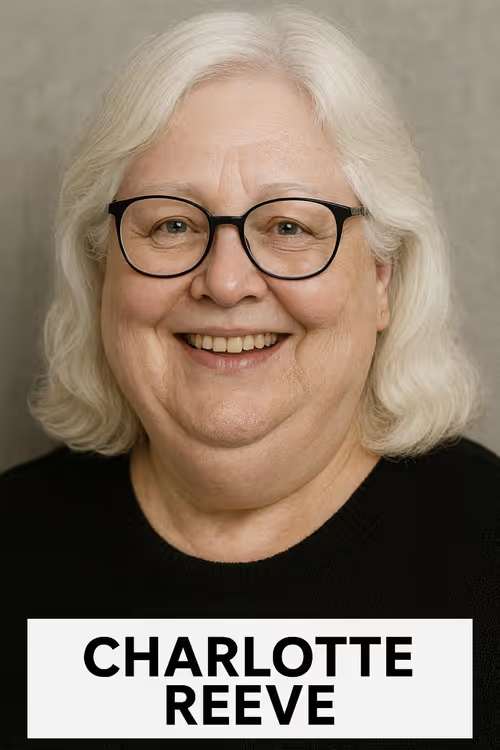
Written by
Charlotte Reeve
Senior correspondent · Capital Markets & Fintech
Charlotte cut her teeth on an equities desk before moving to the other side of the notebook. She covers capital markets, stock exchanges, and the fintech operators trying to disintermediate the banks that trained her. Sharpest on market microstructure and payments infrastructure; still reads a prospectus for fun. Based in Singapore. Reach out at charlotte.reeve@theplatinumcapital.com.