

Short Selling Under Scrutiny: Regulation vs Market Integrity
As regulators worldwide intensify their oversight of short selling practices, the tension between market surveillance and the legitimate price discovery function that short sellers provide has never been more consequential for institutional portfolios and sovereign wealth strategies. Understanding where the regulatory pendulum will settle is not merely an academic exercise — for family offices and high-net-worth investors navigating concentrated positions, it is a critical determinant of risk exposure and long-term capital preservation.…

Short selling has long occupied an uncomfortable position in modern capital markets — celebrated as a mechanism for price discovery, condemned as a vehicle for destabilisation. In 2026, that tension has sharpened. Gulf equity markets are undergoing their most ambitious structural reforms in a generation, and regulators from Riyadh to Kuala Lumpur are being forced to confront a fundamental question: does short selling protect market integrity, or does it erode the very confidence that draws long-term capital in the first place?
The Regulatory Pressure Points
The debate is not abstract. When Saudi Arabia's Capital Market Authority eliminated the Qualified Foreign Investor framework on February 1, 2026 — opening the Tadawul to all categories of foreign investors for the first time — it triggered a structural shift that regulators are still calibrating. Gone is the $500 million AUM threshold that previously gated direct market access. In its place: a far broader, more diverse investor base than the Tadawul has ever hosted. That breadth is precisely what makes short selling policy so consequential right now. Retail investors, smaller institutional players, and family offices with emerging market mandates all behave differently under short-selling pressure than the sovereign wealth behemoths who dominated the market before. The dynamics are not comparable.
Jefferies analysts project that passive inflows into the Tadawul could reach between $3.4 billion and $10.2 billion if the 49% foreign ownership cap — currently under review — is eventually lifted. Foreign ownership in SABIC (Tadawul: 2010) alone is expected to climb from approximately 6% to 10% by year-end. In that environment, even modest short-selling activity in heavily weighted names can produce outsized index effects, amplifying volatility in ways the original liberalisation architects may not have fully modelled.
When Sentiment Becomes a Weapon
The vulnerabilities of open markets to coordinated short pressure were made visible this year. Mutlaq Al Ghowairi Contracting Company — MGC — had been scheduled to list on the Tadawul. On June 9, it pulled the offering entirely, following consultations with financial advisers, citing the broader disruption that has gripped Gulf markets since conflict broke out in late February. The episode is instructive. IPO-stage companies carry no earnings history as public entities, no established short interest baseline, and often no institutional anchor to absorb selling pressure. When sentiment sours — whether driven by geopolitical risk, short-seller reports, or simple order book anxiety — the consequences are asymmetric and they arrive fast.
The 2026 IPO window, widely anticipated as a recovery year for new listings across the region, never fully opened. HSBC holds 45 active Gulf M&A and IPO mandates with several targeted for Q4 execution — and even they have had to recalibrate timelines. Against that backdrop, the prospect of speculative short positions building in newly listed mid-cap names — BaraSeen Medical Company, for instance, approved for listing on Nomu on June 25, 2026 — becomes a legitimate regulatory concern rather than a theoretical exercise.
The Market Integrity Argument
Defenders of short selling are not without a case. Properly regulated, short interest functions as a real-time audit — a mechanism by which sceptical capital challenges overvalued assets and corrects mispricings before they become systemic. In markets where analyst coverage is thin and public disclosure norms are still maturing, short sellers can surface information that formal regulatory oversight misses entirely. Hong Kong's Securities and Futures Commission has documented instances where short-seller activity preceded fraud disclosures by months. The same dynamic has played out across Southeast Asia, where family-controlled conglomerates in Indonesia and Malaysia have occasionally benefited from disclosure environments that actively discourage scrutiny.
The more sophisticated argument — gaining traction among institutional investors with Gulf and Central Asian allocations — is that the answer is not less short selling but better short selling. Stricter disclosure requirements. Position reporting thresholds. Pre-borrow confirmation mandates that prevent naked short selling without eliminating the instrument altogether. Singapore's Monetary Authority has moved in precisely this direction, tightening short-sale reporting requirements while preserving the mechanism itself. The UAE's Securities and Commodities Authority has signalled interest in similar frameworks as Abu Dhabi Global Market continues to position itself as a regulatory benchmark for the wider region. That is a meaningful signal.
Family Offices and the Practical Stakes
For family offices and private investors operating with portfolios in the $50 million to $500 million range — a core constituency of Gulf and Central Asian wealth — this debate has real money attached to it. These investors are frequently concentrated in a small number of high-conviction positions, often in markets where liquidity is thinner and disclosure timelines are longer than anything seen in developed markets. A coordinated short campaign against a position they hold — whether in a Saudi mid-cap, a Kazakh mining name, or a Nigerian consumer stock — can inflict mark-to-market losses that trigger margin calls or forced reallocation long before fundamentals get a chance to reassert themselves.
Several Gulf family offices have quietly lobbied through their advisers for tighter uptick rule enforcement — rules that restrict short sales to prices above the last traded price — as a minimum friction measure. The argument is not protectionist. It is structural. In markets still building the institutional depth and liquidity buffers that absorb short pressure in New York or London, the same instrument carries a materially different risk profile. Regulators in Bahrain and Oman have shown receptiveness to this framing, particularly as both markets work to attract more permanent foreign capital rather than short-duration speculative flows. Few outside the region have noticed. They should.
What Comes Next
The direction of travel across priority emerging markets points toward graduated tightening rather than outright prohibition. Saudi Arabia's CMA, emboldened by the momentum of its liberalisation programme, is expected to publish updated short-selling guidelines later in 2026 as part of the broader foreign ownership cap review. Market participants widely expect the centrepiece to be enhanced disclosure — mandatory public reporting of short positions exceeding 0.5% of issued share capital, modelled closely on the EU's Short Selling Regulation.
The markets are opening. The rules of engagement are being rewritten in real time. For investors with long-horizon mandates across the Gulf, Central Asia, and sub-Saharan Africa, that is not background noise — it is the story. Family offices that engage proactively with regulatory consultations, rather than treating governance as a passive backdrop to portfolio management, will be better placed to shape the frameworks under which their capital actually operates. In markets moving this fast, the distance between participant and regulator is shorter than most investors assume.
Written by
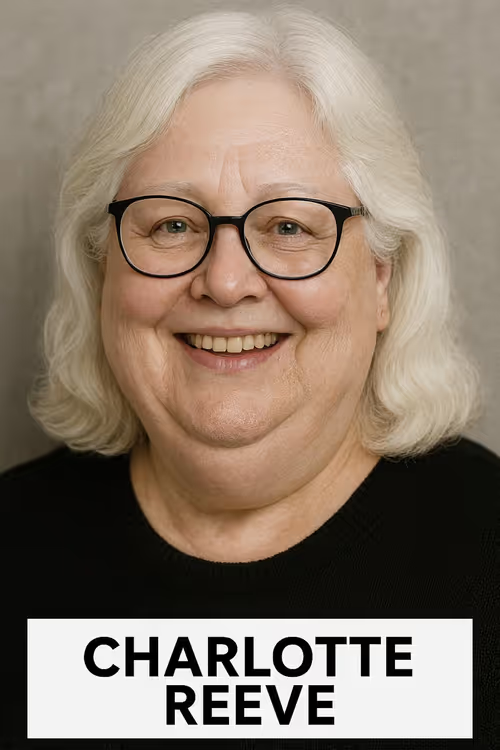
Charlotte Reeve
Senior correspondent · Capital Markets & Fintech
Charlotte cut her teeth on an equities desk before moving to the other side of the notebook. She covers capital markets, stock exchanges, and the fintech operators trying to disintermediate the banks that trained her. Sharpest on market microstructure and payments infrastructure; still reads a prospectus for fun. Based in Singapore. Reach out at charlotte.reeve@theplatinumcapital.com.